

Hiring decisions around backend and frontend technologies often create delays, especially when teams misunderstand the difference between tools like Ruby on Rails vs React. Choosing the wrong starting point can add weeks of rework and increase development costs before a product even reaches users.
Arc helps companies avoid these bottlenecks by connecting them with vetted developers across backend, frontend, and full-stack roles. With access to talent in 190 countries and hiring timelines as short as 72 hours for freelance roles, teams can quickly bring in engineers experienced in Rails with React architectures and AI-enabled systems.
This guide breaks down when to use Rails, when to use React, and when to combine them. You’ll learn how each impacts performance, hiring costs, and product scalability so you can make informed decisions from day one.
Ruby on Rails vs React: What’s the Real Difference?
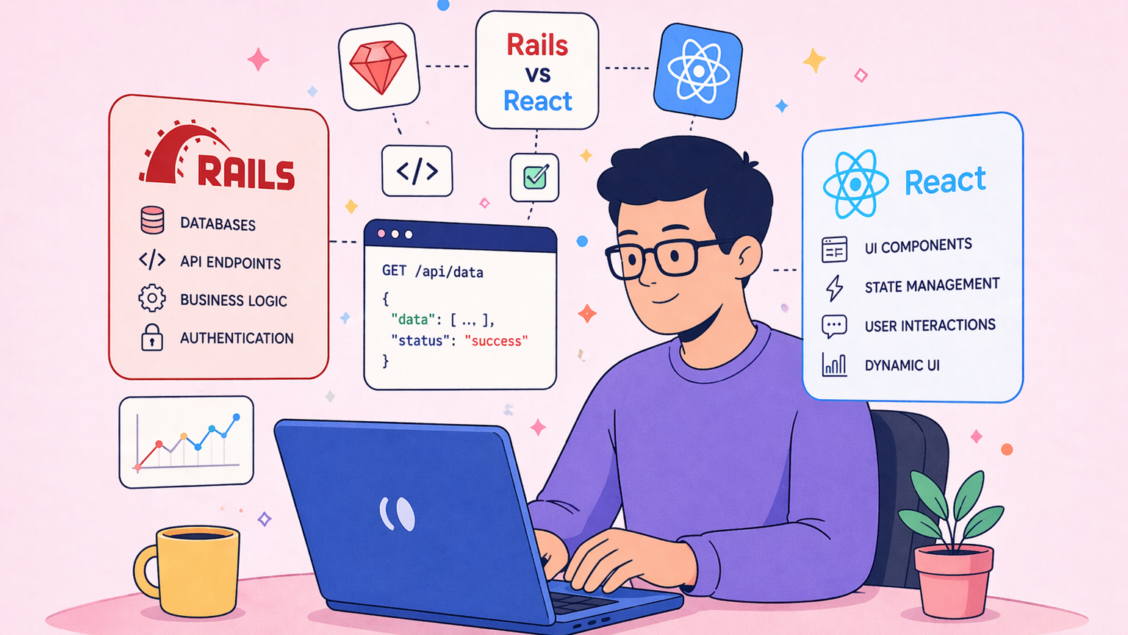
Understanding the difference between Ruby on Rails vs React starts with one key idea: they solve separate problems at different layers of your application.
Backend vs Frontend Explained in Simple Terms
Every modern application has two core layers. The backend handles data storage, business logic, and security, while the frontend controls what users see and interact with in their browser.
Rails operates on the backend. React runs on the frontend. Understanding this separation eliminates most of the confusion behind Ruby on Rails vs React.
Why “Ruby vs React” Is a Common Misunderstanding
The phrase “Ruby vs React” suggests these tools compete, but they solve different problems. Rails manages your application’s core systems, while React renders interfaces and handles user interactions.
Treating them as interchangeable leads to poor architectural decisions. In practice, most production systems rely on Ruby on Rails with React to balance backend reliability with frontend performance.
How Modern Web Apps Use Both Together
A common pattern is Rails as an API backend and React as a frontend client. Rails handles data and logic, while React consumes APIs and renders dynamic interfaces.
This approach allows teams to scale backend and frontend systems independently and support multiple clients, including mobile apps and AI-powered interfaces.
What Is Ruby on Rails? Backend Responsibilities and Use Cases
What Rails Handles: APIs, Databases, and Business Logic
Ruby on Rails is a server-side framework designed to quickly build database-driven applications. It manages API endpoints, authentication, background jobs, and business logic in a single structured environment.
Rails includes built-in tools like ActiveRecord for database management and integrates easily with background processing systems for tasks like payments, notifications, and AI inference.
When Rails Is the Right Choice for Startups and SaaS
Ruby on Rails remains one of the fastest ways to ship backend-heavy products. A small team of 1–2 experienced Rails developers can build a production-ready MVP in 2–6 weeks, including authentication, CRUD operations, and API endpoints.
Rails works best when your product depends on structured data and clear business logic. Common use cases include:
- SaaS platforms with subscription billing and multi-tenant databases
- Marketplaces with user roles, payments, and search logic
- API backends powering web, mobile, and third-party integrations
For teams evaluating Ruby on Rails vs React, Rails is typically the starting point because it defines the core system your frontend depends on.
Using Rails for AI Backends and Data-Driven Applications
Rails is increasingly used in AI-enabled products where backend orchestration matters more than raw model performance. Teams use Rails to manage data ingestion pipelines, prompt storage, user context, and API layers for AI inference.
A typical AI workflow with Rails includes:
- Storing structured data in PostgreSQL for model input
- Running asynchronous inference jobs via background workers
- Exposing endpoints consumed by frontend apps (often React)
In this setup, React-on-Rails architectures become standard: Rails handles AI workflows and data, while React delivers real-time user interaction.
What Is React? Frontend Responsibilities and Use Cases
How React Powers Interactive User Interfaces
React is a JavaScript library for building interactive user interfaces. It uses a component-based architecture, allowing developers to create reusable UI elements that manage their own state and behavior.
React updates only the parts of the page that change, improving responsiveness and making applications feel faster.
When React Is Essential for Modern UX
React becomes necessary when your frontend requires high interactivity and real-time updates. Applications like analytics dashboards, collaborative tools, and AI interfaces rely on fast client-side rendering that traditional server-rendered views cannot match.
However, React introduces additional complexity and cost. Teams typically need:
- A dedicated frontend developer or team
- Separate build and deployment pipelines
- API coordination with backend systems
For companies comparing React vs Ruby on Rails, React is rarely the starting point, but it becomes essential once the product demands a more dynamic user experience.
When React Adds Unnecessary Complexity
React is often overused in early-stage products. For simple CRUD apps, admin panels, or MVPs, introducing React can significantly increase development time due to added setup, API design, and frontend-backend coordination, especially in early-stage products.
In these cases, Rails alone can deliver faster results with fewer moving parts. Teams exploring Rails with React should validate whether their product truly requires a decoupled frontend before committing.
React for AI Interfaces: Dashboards, Chat UIs, and Real-Time Apps
React is widely used for AI-driven interfaces, including chat applications, real-time dashboards, and streaming data views. Its ability to update the UI dynamically makes it well-suited for products where users interact with AI systems in real time.
Ruby on Rails vs React: Key Differences in Roles, Performance, and Scale
Core Differences in Architecture and Responsibilities
When evaluating Ruby vs. React, the most important distinction is ownership of the application layer. Rails defines how data is stored, processed, and secured, while React determines how users interact with that data.
| Category | Ruby on Rails | React |
| Type | Backend framework | Frontend library |
| Language | Ruby | JavaScript |
| Runs on | Server | Browser |
| Primary role | APIs, logic, data | UI and interaction |
| Architecture | MVC | Component-based |
Choosing Rails impacts backend scalability and API design. Choosing React affects user experience and frontend performance. Using both introduces coordination overhead but enables specialization.
Performance Considerations: Server vs Client Rendering
Rails uses server-side rendering by default, which supports SEO and fast initial page loads. React handles rendering in the browser, enabling faster interactions after the initial load. Many teams combine both approaches to balance performance and user experience.
Learning Curve and Developer Skill Sets
Rails developers focus on backend systems, including data modeling and API design. React developers specialize in UI architecture and frontend performance.
Full-stack developers who understand both are valuable in Ruby on Rails with React environments, but they are harder to hire.
Using Ruby on Rails with React: Modern Integration Patterns
There are several ways to structure a Ruby on Rails with React setup, each with different tradeoffs in complexity, scalability, and team coordination.
- Rails API + React SPA (Decoupled Architecture)
This approach separates backend and frontend into independent systems. Rails serves JSON APIs, while React operates as a standalone application. This model supports scalability and multiple clients but requires more infrastructure and coordination.
- Embedding React Inside Rails Views
React can also be used selectively within Rails applications. Teams embed React components into server-rendered pages to enhance specific features without fully decoupling the stack.
- Full-Stack Approach: React on Rails Explained
In this setup, Rails and React are tightly integrated, with React components rendered both on the server and client. This approach reduces complexity compared to fully decoupled systems while still enabling dynamic interfaces.
Rails with React: Pros, Cons, and Tradeoffs
Benefits of Combining Rails and React
Using Ruby on Rails with React allows teams to scale backend and frontend independently while maintaining strong performance.
Key advantages include:
- Parallel development across backend and frontend teams
- Faster, more responsive user interfaces
- A reusable API layer supporting web, mobile, and AI integrations
Challenges and Complexity to Expect
Adopting React and Ruby on Rails together introduces measurable overhead. Teams must manage two codebases and coordinate changes across systems.
Common challenges include:
- Increased development time during setup (+2–4 weeks)
- API versioning and integration management
- Higher hiring requirements for specialized roles
Hiring Developers: Ruby on Rails vs React Skills Compared
Hiring decisions often drive the Ruby on Rails vs. React choice more than technical preference. Backend and frontend roles differ in cost, availability, and hiring speed.
| Role | Typical Rate (USD) | Time to Hire | Focus |
| Rails Developer | $40–$110/hr | 1–3 weeks | APIs, backend systems |
| React Developer | $30–$100/hr | 1–2 weeks | UI and frontend logic |
| Full-Stack (Rails + React) | $50–$120/hr | 2–4 weeks | End-to-end delivery |
Key hiring insights:
- Rails developers are fewer but often more experienced
- React developers are more abundant but vary in quality
- Full-stack engineers reduce coordination but are harder to find
For teams building Rails with React, hiring at least one engineer who understands both layers reduces integration risk.
AI Skills Increasing Demand Across Both Roles
Demand for AI-capable developers is increasing across both backend and frontend roles. In React on Rails architectures, this creates distinct expectations:
- Rails developers manage AI pipelines and backend integrations
- React developers build real-time interfaces and AI-driven user experiences
Engineers with both capabilities are increasingly valuable for scaling AI products.
Common Mistakes When Choosing Between Rails and React
- Treating React as a Backend Technology
React cannot replace a backend. It does not handle databases, authentication, or business logic. Every React application still requires a backend system such as Rails.
- Overengineering Early Architecture Decisions
Many teams build a fully decoupled stack too early. For MVPs, Rails alone often delivers faster results with fewer dependencies.
- Ignoring API Design in Rails + React Setups
Once you adopt Ruby on Rails with React, your API becomes the foundation of your system. Poor API design leads to slow development and fragile integrations.
Should You Choose Ruby on Rails, React, or Both?
Decision Framework Based on Product Stage
| Product Stage | Recommended Stack | Reason |
| MVP | Rails only | Fastest way to validate ideas |
| Early growth | Rails + minimal JS | Adds interactivity without complexity |
| Scaling product | Rails API + React | Supports complex UI and multiple clients |
| AI-driven product | Rails API + React | Enables real-time interfaces |
For most teams, the best approach is incremental—start with Rails, then introduce React as complexity increases.
The Case for a Combined Rails + React Stack
For products that require both robust backend systems and dynamic user interfaces, combining Ruby on Rails with React provides a balanced architecture. Rails ensures stability and speed, while React enables flexible and responsive interfaces.
This approach works well for SaaS platforms, AI-driven products, and applications that support multiple clients. Rather than choosing Ruby vs React, most teams benefit from using both at the right stage of growth.
Choosing the Right Stack Without Slowing Down Your Team
The decision between React vs Ruby on Rails is not about choosing a single technology, but about structuring your product for speed and scalability. Teams that align backend and frontend decisions with product stage avoid unnecessary complexity and reduce time to market.
Arc gives hiring teams access to vetted developers who understand both backend and frontend systems, including Ruby on Rails with React architectures. This reduces onboarding time and ensures engineers can contribute immediately to production systems. View matched candidates in 72 hours and reduce hiring time by 75%.
Frequently Asked Questions
What is the difference between Ruby on Rails and React?
Ruby on Rails is a backend framework that handles databases, APIs, and business logic, while React is a frontend library used to build user interfaces. Rails runs on the server and manages application logic, whereas React runs in the browser and controls how users interact with the product. Most modern applications use both together rather than choosing one over the other.
Should I choose Ruby on Rails or React for an MVP?
You should start with Ruby on Rails for most MVPs because it allows small teams to build production-ready applications in 2–6 weeks with minimal overhead. React is typically added later when the product requires more dynamic or interactive user interfaces. Starting with both at once often increases complexity and slows early development.
Can you use React with Ruby on Rails?
Yes, using React with Ruby on Rails is a common architecture where Rails acts as an API backend, and React handles the frontend. This setup allows teams to separate backend and frontend responsibilities while improving performance and scalability. It is widely used in SaaS and AI-driven applications.
When does React become necessary in a Rails project?
React becomes necessary when your application requires real-time updates, complex user interactions, or app-like experiences such as dashboards or chat interfaces. At that stage, server-rendered views are often not enough to deliver the expected user experience. Many teams transition to Rails API plus React once frontend complexity increases.
How much does it cost to hire Rails vs React developers?
Rails developers typically cost $40–$110 per hour and take 1–3 weeks to hire, while React developers range from $30–$100 per hour with a 1–2 week hiring timeline. Full-stack engineers who can handle both Rails and React usually cost $50–$120 per hour and take longer to find. Costs vary based on seniority and AI-related experience.
Is Ruby on Rails still relevant compared to React?
Yes, Ruby on Rails remains highly relevant because it powers backend systems for many large-scale applications and integrates well with modern frontend frameworks like React. It is especially valuable for API-driven products, SaaS platforms, and AI backends where data handling and business logic are critical. React complements Rails rather than replacing it.
When should I use Ruby on Rails with React together?
You should use Ruby on Rails with React when your product requires both a structured backend and a highly interactive frontend, such as SaaS platforms or AI-powered applications. This combination supports scalability, multiple clients, and real-time user experiences.
If you need to scale your team quickly, hiring developers experienced in both technologies reduces integration risk and speeds up delivery.