

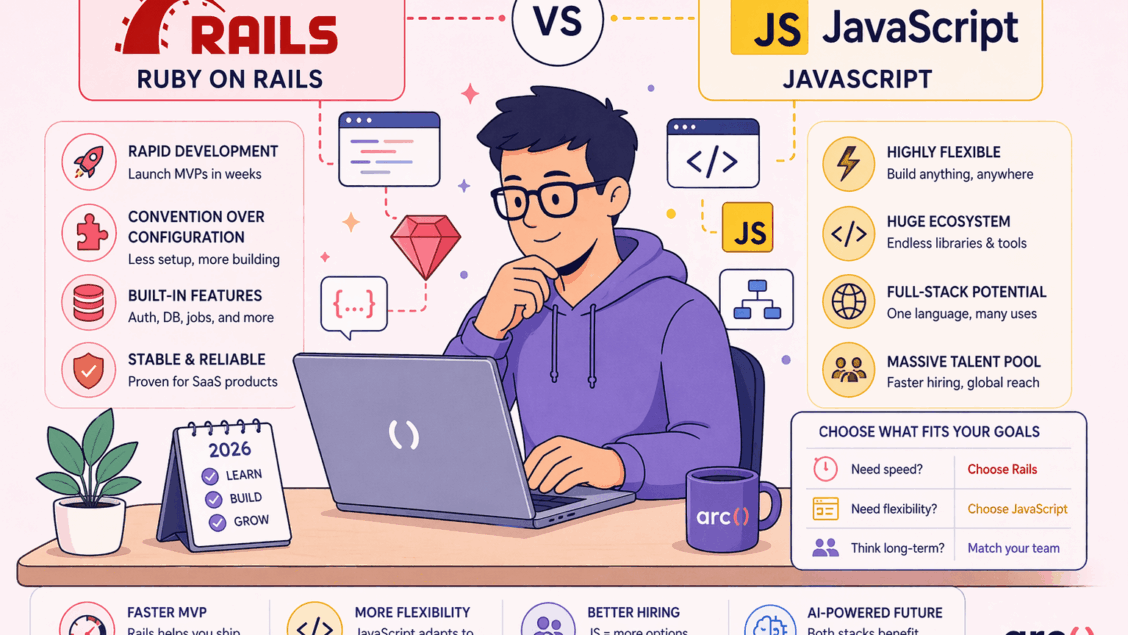

Choosing between Ruby on Rails vs JavaScript isn’t just a technical decision; it shapes how fast you can build, how complex your system becomes, and how easily you can hire. In practice, this decision is rarely Ruby on Rails versus “plain JavaScript”, but Rails versus a modern JavaScript stack built with TypeScript and frameworks like Next.js.
For founders, this often comes down to speed versus flexibility. For developers, it’s about job access and long-term growth. These choices are connected because the stack you choose directly affects your hiring pool and timelines.
Through platforms like Arc, this tradeoff shows up clearly in hiring: Rails roles tend to take longer but skew more senior, while JavaScript roles fill faster with a wider range of candidates. This guide breaks down both technologies across the learning curve, ecosystem, use cases, and hiring impact in an AI-driven development landscape.
Ruby on Rails vs JavaScript: Key Differences, Use Cases, and Tradeoffs
At a surface level, Ruby on Rails and JavaScript look like fundamentally different tools, but in practice, most teams are choosing between Rails and a structured JavaScript stack built with TypeScript and frameworks like Next.js.
Rails assumes that most web applications follow similar patterns. It encodes those assumptions into the framework, which means you spend less time deciding how to build and more time actually building.
JavaScript, by contrast, gives you the primitives to build anything, but expects you to define the structure yourself. That difference becomes tangible the moment you start a project.
Ruby on Rails vs JavaScript: Side-by-Side Comparison for Founders and Developers
| Factor | Ruby on Rails | JavaScript |
| Core Type | Backend framework (Ruby) | Full programming language |
| MVP Timeline | 2–8 weeks typical | 4–12 weeks, depending on the stack |
| Setup Overhead | Low | Medium–high |
| Architectural Decisions | Minimal upfront | Significant upfront |
| Best Fit | SaaS, CRUD-heavy apps | Real-time apps, SPAs |
For a founder trying to quickly validate an idea, Ruby on Rails reduces the number of decisions between concept and launch. For a team building a highly interactive product, JavaScript provides the flexibility needed, but requires more upfront investment in architecture.
What You’re Actually Comparing in 2026
| Stack | What You’re Actually Using | Complexity |
| Ruby on Rails | Rails + Hotwire + ActiveRecord | Low |
| JavaScript stack | Next.js + TypeScript + ORM + API layer | High |
Most teams are not choosing between a single language and a framework. A JavaScript setup typically combines TypeScript, a framework like Next.js, and multiple supporting tools, while Rails provides a more integrated system with fewer moving parts.
This difference directly affects development speed and maintenance. More flexibility introduces more decisions, while integrated stacks reduce overhead and allow teams to move faster with fewer dependencies.
Which Is Easier to Learn in 2026: Ruby on Rails or JavaScript?
The difficulty of learning a technology isn’t just about syntax; it’s about how much ambiguity you have to navigate before you can build something meaningful.
Rails reduces that ambiguity. When you create a new Rails application, you’re given a clear structure and a set of conventions that guide your decisions. That allows beginners to focus on understanding how applications work, rather than how to assemble them from scratch.
In practical terms, this means a new developer can:
- Build a database-backed app in a few days
- Add authentication within a week
- Deploy a basic product within a month
Progress feels tangible early, which matters more than most people expect.
JavaScript offers a different kind of accessibility. You can start writing code immediately in a browser, but building a complete application requires making a series of architectural decisions—frameworks, state management, backend integration—that can slow down momentum.
Many developers spend their first few weeks not building products, but figuring out which tools to use. GitHub Copilot can generate Rails scaffolding almost perfectly thanks to Rails’ strong conventions, which reduce the need for manual setup. In contrast, tools like Cursor perform better in structured environments, where patterns are consistent and predictable.
Rails benefits from consistency. Because most applications follow similar patterns, AI-generated code integrates cleanly with fewer adjustments and less debugging. In JavaScript, where architectures vary across projects, LLM-generated code often requires more iteration to align with existing structures and tooling.
For many beginners deciding whether to learn Ruby or JavaScript, the real difference is how quickly you can build something meaningful versus how many paths you’ll have later. This becomes more noticeable as applications grow, where inconsistent patterns in JavaScript stacks can slow down AI-assisted development over time.
Ruby on Rails vs JavaScript Syntax: Real Code Comparison
Syntax is not the biggest difference between Ruby on Rails and JavaScript. The bigger variation is how much each stack asks you to define before a feature works.
A basic route shows the contrast clearly:
| Task | Ruby on Rails | JavaScript |
| Define a route | get “/hello”, to: “home#hello” | app.get(“/hello”, (req, res) => res.send(“Hello world”)) |
Rails routes connect URLs to controller actions through framework conventions. JavaScript routing depends on the framework or server library you choose, such as Express, Next.js, or Remix.
The same pattern appears with database models:
| Task | Ruby on Rails | JavaScript |
| Define a user model | class User < ApplicationRecord | model User { id Int @id @default(autoincrement()) email String } |
Rails uses ActiveRecord as its built-in ORM, so models, validations, and database relationships follow one standard pattern. JavaScript teams often choose between tools like Prisma or Drizzle, which give more flexibility but add another architectural decision.
For developers, Rails usually feels faster once the conventions make sense. JavaScript feels more flexible, but the syntax comparison only tells part of the story, as most real projects rely on TypeScript, framework rules, and supporting libraries.
Rails vs JavaScript Ecosystem: Frameworks, Tooling, and AI Workflows
When comparing Ruby on Rails JavaScript ecosystems, the difference isn’t just size—it’s how much structure each one imposes on your development process.
Rails takes an opinionated approach, which includes most of what you need to build a production application, from database management to background jobs. You’re not choosing between competing libraries; you’re using a curated set of tools that are designed to work together.
This has a compounding effect. Features that might require coordinating multiple libraries in JavaScript can often be implemented in Rails with minimal setup because the integrations are already solved.
JavaScript, by contrast, is built around flexibility. You assemble your stack depending on your needs—React or Vue for the frontend, Node.js for the backend, and additional tools layered in as required. This allows for highly customized systems, but it also introduces complexity that grows over time.
The tradeoff becomes clearer when you look at how teams spend their time:
- Rails teams spend more time building features
- JavaScript teams spend more time configuring and maintaining tooling
AI tools reinforce this pattern: In Rails, AI can generate meaningful backend logic because the structure is predictable, while in JavaScript, AI excels at generating components and isolated features, but stitching them into a cohesive system still requires experience.
Neither approach is inherently better. The question is whether you want to optimize for speed through consistency or flexibility through control.
Modern Stack Reality: Rails vs Next.js, TypeScript, and Hotwire
In 2026, “JavaScript vs Ruby on Rails” is rarely a direct comparison. Most teams use TypeScript with frameworks like Next.js or Remix, which add structure but also increase complexity.
A modern JavaScript stack typically includes TypeScript, a framework, and multiple supporting tools for data, routing, and state. What starts as flexibility quickly becomes a system that requires ongoing architectural decisions.
Rails takes the opposite approach. With built-in conventions and tools like Hotwire and Turbo, it delivers interactivity without requiring a separate frontend stack.
The real difference is between a composed stack versus integrated system. JavaScript gives you more control, while Rails reduces complexity, and that tradeoff directly impacts development speed, maintenance, and hiring.
In practice, many teams evaluating Ruby on Rails are comparing it directly to frameworks like Next.js, rather than JavaScript as a language.
When to Use Ruby on Rails vs JavaScript for Real-World Projects
At this stage, the decision often shifts from JavaScript or Ruby on Rails as abstract options to choosing based on the product you’re actually building.
If you’re building a SaaS product with user accounts, dashboards, and structured data, Rails aligns naturally with that problem. Its conventions map directly to common application patterns, which reduces the need for custom infrastructure.
This is why many startups choose Rails early on, as it allows small teams to move quickly, test assumptions, and iterate without spending weeks assembling a tech stack.
JavaScript becomes the better choice when the product depends on interactivity. Applications with real-time updates, complex user interfaces, or highly dynamic experiences benefit from JavaScript’s event-driven architecture.
You can think of the difference like this:
- Rails is optimized for business logic and data workflows
- JavaScript is optimized for user interaction and real-time behavior
In practice, many teams combine both. A Rails backend handles data and logic, while a JavaScript frontend delivers the user experience. This hybrid approach reflects the reality that most modern products require both structure and flexibility.
JavaScript vs Ruby on Rails Performance: Speed, Scalability, and AI Workloads
Performance is often treated as the deciding factor, but in most cases, it’s not the constraint that matters early on.
JavaScript has a clear advantage in handling concurrent connections, thanks to its non-blocking architecture. This makes it well-suited for applications where many users interact with the system simultaneously.
Rails, while not optimized for extreme concurrency, performs more than adequately for the majority of SaaS applications. In many cases, performance issues come from database design or infrastructure decisions rather than the framework itself.
| Scenario | Better Choice | Reason |
| Real-time apps | JavaScript | Handles concurrency efficiently |
| SaaS platforms | Rails | Faster development, sufficient performance |
| AI-driven apps | Neutral | Bottleneck is external APIs |
AI is changing how performance should be evaluated. Many modern applications rely on external APIs for core functionality, which means latency is dominated by external systems rather than backend processing.
This shifts the focus from raw speed to system design and user experience, where both Rails and JavaScript can perform equally well.
The real tradeoff in 2026 is not performance, but complexity. Ruby on Rails reduces the number of decisions required to build and maintain an application, while JavaScript stacks expand flexibility at the cost of more architectural overhead.
AI amplifies this contrast, making structured systems faster to work with and fragmented ones more iterative to maintain.
Hiring Ruby on Rails vs JavaScript Developers: Cost, Availability, and Risk
Your technology choice ultimately determines who you can hire and how difficult that process will be.
JavaScript offers access to a massive global talent pool. This increases your chances of finding candidates quickly, but also introduces variability in skill level. Screening becomes a more significant part of the hiring process.
In practice, developers using TypeScript are often easier to source than those working with untyped JavaScript, as most modern production systems rely on typed codebases.
Hiring also requires evaluating framework depth, and experience with React does not necessarily translate into production-level knowledge of frameworks like Next.js, which adds complexity to screening.
Rails developers are fewer in number, but the pool tends to skew toward experienced engineers, often with 5–10+ years of experience working on production systems.
| Factor | Rails | JavaScript |
| Time to Hire | 2–6 weeks | 1–4 weeks |
| Candidate Volume | Lower | Higher |
| Screening Effort | Lower | Higher |
| Experience Consistency | Higher | Variable |
Cost reflects this dynamic.
| Level | Rails | JavaScript |
| Junior | $30–$60/hr | $25–$50/hr |
| Mid | $60–$100/hr | $50–$90/hr |
| Senior | $100–$160/hr | $80–$150/hr |
The decision here isn’t just about cost, it’s about risk. JavaScript gives you more options but requires more filtering. Rails gives you fewer options but reduces uncertainty in hiring.
Should You Learn Ruby or JavaScript in 2026? Career Paths, Salaries, and Demand
For developers, the decision comes down to whether you want breadth or depth. JavaScript provides access to a wide range of roles, from frontend development to full-stack engineering. This flexibility makes it easier to enter the job market and adapt as technologies evolve.
Rails offers a more specialized path. Roles are fewer, but they often involve working on established systems where understanding architecture and maintaining code quality are valued more than chasing new frameworks.
| Path | JavaScript | Rails |
| Job Volume | High | Moderate |
| Salary Range | $90K–$160K+ | $100K–$170K+ |
| Role Type | Broad | Specialized |
AI is shifting what matters in both paths. Developers who can effectively use AI tools to accelerate development and solve problems are becoming more valuable than those who rely solely on manual coding skills.
In that context, Rails benefits from its structured environment, while JavaScript benefits from its wide range of applications.
How AI Is Changing Ruby on Rails vs JavaScript for Hiring and Development
AI isn’t replacing these technologies; it’s changing how teams use them. Development cycles are becoming shorter —Tasks that once took days can now be completed in hours with AI assistance. This reduces the need for large teams and increases the value of developers who can operate across multiple layers of a system.
At the same time, simplicity is becoming more important. AI performs best in environments that are either highly structured or widely documented. Overly complex systems reduce the effectiveness of AI tools.
This creates an interesting balance:
- Rails benefits from predictability
- JavaScript benefits from ecosystem scale
The best results come from aligning your stack with how your team actually works, not just what the technology enables.
This makes AI-assisted development more predictable in Rails environments, while JavaScript stacks often require more iteration to align generated code with existing architecture.
Ruby on Rails or JavaScript: Decision Framework for Founders and Developers
By now, the choice should feel less abstract and more tied to your specific situation. If you’re a founder, your decision is driven by constraints: time, budget, and hiring realities. If you’re a developer, it’s driven by opportunity, growth, and the type of work you want to do.
A simple way to frame the decision:
- Choose Rails when speed and simplicity matter most
- Choose JavaScript when flexibility and interactivity are critical
Quick Decision Checklist
- Building a SaaS MVP → Rails
- Building a real-time application → JavaScript
- Need to launch quickly → Rails
- Need complex UI → JavaScript
- Want easier hiring → JavaScript
- Prefer experienced developers → Rails
Ruby on Rails vs JavaScript: Which Should You Choose Based on Your Goals?
If speed and simplicity matter most, Rails is the better choice. It reduces early decisions and helps small teams ship faster, which is critical when you’re validating an idea under time constraints.
If your product depends on interactivity or real-time features, JavaScript is the more practical option. It offers more flexibility and a larger hiring pool, but requires more structure and ongoing decisions.
This tradeoff shows up clearly in hiring. Rails teams work with smaller, more experienced talent pools, while JavaScript teams move faster but spend more time filtering candidates. Platforms like Arc make that difference visible by matching companies with vetted developers based on stack and timeline.
Choose the stack that removes your biggest constraint right now. View matched candidates in 72 hours to compare Rails and JavaScript developers based on your exact hiring needs.
Frequently Asked Questions
Is Ruby on Rails or JavaScript better for beginners?
Ruby on Rails is generally easier for beginners who want to build full applications quickly, because it provides structure and reduces early decisions. JavaScript is more flexible but requires choosing frameworks and tools before building anything meaningful. If your goal is to ship a working app fast, Rails is usually the better starting point.
Should I learn Ruby or JavaScript in 2026?
You should learn JavaScript if you want the widest range of job opportunities across frontend, backend, and full-stack roles. You should learn Ruby on Rails if you want to specialize in backend development and build complete products quickly. The right choice depends on whether you prioritize job volume or faster end-to-end productivity.
What is the main difference between JavaScript vs Ruby on Rails?
The main difference in JavaScript vs Ruby on Rails is that JavaScript is a full programming language used across frontend and backend, while Ruby on Rails is a backend framework built on Ruby. Rails provides structure and conventions, while JavaScript offers flexibility and requires more architectural decisions.
When should I choose Ruby on Rails over JavaScript?
You should choose Ruby on Rails when building SaaS applications, MVPs, or database-driven products that need to launch quickly. Rails reduces setup time and allows small teams to deliver features faster, especially when speed to market is the priority.
When is JavaScript a better choice than Ruby on Rails?
JavaScript is a better choice when building real-time applications, interactive user interfaces, or full-stack systems using a single language. It is especially useful for products that rely heavily on frontend performance or live data updates.
Is it easier to hire JavaScript or Ruby on Rails developers?
It is generally easier to hire JavaScript developers because the global talent pool is significantly larger. However, Rails developers tend to be more experienced on average, which can reduce screening time even if hiring takes longer.
How does AI impact the Ruby on Rails vs JavaScript decision?
AI makes both technologies more productive, but in different ways. Rails benefits from consistent patterns that make AI-generated code easier to integrate, while JavaScript benefits from a broader ecosystem where AI can generate UI components and frontend logic quickly. The choice depends on whether you prioritize structured backend speed or flexible frontend development.
Can you use Ruby on Rails and JavaScript together?
Yes, many modern applications use Ruby on Rails for backend logic and JavaScript for frontend interfaces. This combination allows teams to benefit from Rails’ structured development and JavaScript’s interactive capabilities in the same product.
Which is better for startups: Ruby on Rails or JavaScript?
For startups, Ruby on Rails is often better for quickly building and launching MVPs, while JavaScript is better for products that require real-time features or complex frontend interactions. The decision depends on whether speed to launch or product interactivity is the primary constraint.
How do I decide between JavaScript or Ruby on Rails for my project?
To decide between JavaScript or Ruby on Rails, evaluate your timeline, product complexity, and hiring needs. Choose Rails if you need to launch quickly with a small team, and choose JavaScript if your product requires real-time functionality or access to a larger hiring pool. Review your hiring constraints early to avoid delays when scaling your team.