



Written for Svelte 5, Vue 3.5 (Vue 3.6 RC noted), and SolidJS 1.x (Solid 2.0 beta noted). August 2026.
Most Svelte comparisons stop at React, but that framing misses the more useful question: if you already want a compiler-first or fine-grained reactive framework, how does Svelte 5 stack up against Vue 3 and SolidJS 1.x?
Compiler-based frameworks promise smaller bundles and less boilerplate. Vue ships a runtime reactivity system instead, and pays for it in kilobytes. The real trade-off shows up when you try to hire someone who knows the framework, or find a component library that already solves your date picker problem.
This comparison helps you decide based on three constraints that actually bite: how much JavaScript you can afford to ship, what your team wants day-to-day, and how big the hiring pool is for each stack.
In this guide:
The decision at a glance
- Framework architecture and reactive APIs
- Best-fit project profiles
- Quick comparison matrix
What changed in 2026
Rendering model, bundle cost, and runtime performance
- Virtual DOM vs fine-grained DOM updates
- What bundle size measurements actually include
- Initial load, update work, and performance testing
- Server rendering, routing, and Next.js
Developer experience and code ownership
- Svelte 5 runes and component authoring
- Vue 3 Composition API and template options
- SolidJS signals, JSX, and control flow
- State, transitions, and testing
- Learning curve and maintainability
- The same component in each framework
Ecosystem maturity and scale
- Vue’s tooling and community
- SvelteKit and the Svelte ecosystem
- SolidJS compatibility and adoption trade-offs
- Choosing for medium-sized and enterprise products
- Team availability and hiring risk
Frequently Asked Questions
The decision at a glance
Skim the table, then read the section that matters for your decision.
| Category | Winner | Why |
| Smallest bundle | Svelte 5 (at component scale) | Svelte’s floor is 2-3 KB vs Solid’s ~7 KB; the gap narrows on large apps where Solid’s flatter growth curve takes over |
| Developer experience | Vue 3 | Best docs, most mature IDE tooling, gentlest onboarding |
| Hiring availability | Vue, by a wide margin | Longest market presence, heavy adoption in Asia-Pacific and Europe |
| Ecosystem maturity | Vue 3 | Nuxt, Vuetify, Quasar, Pinia, and years of third-party plugins |
| Least boilerplate | Svelte 5 | Component files read close to plain HTML, CSS, and JavaScript |
| Familiarity for React devs | SolidJS | JSX syntax and hook-like APIs, without the re-render model |
Framework architecture and reactive APIs
The three frameworks solve the same problem in different places.
- Svelte 5 compiles your components at build time. Its reactivity uses runes: $state, $derived, and $effect. The compiler figures out what depends on what and writes direct DOM update code.
- Vue 3 ships a runtime reactive system. The Composition API uses ref() and reactive() proxies, tracked at runtime. Vue 3.5 and earlier use a virtual DOM, though the compiler optimizes templates aggressively. Vue 3.6 (RC as of July 18, 2026) changes this with two additions: Vapor Mode, which compiles opt-in components straight to DOM operations without a virtual DOM, and a complete rewrite of @vue/reactivity based on alien-signals that improves performance and memory usage for all components regardless of whether Vapor is used.
- SolidJS 1.x uses signals (createSignal, createMemo, createEffect) with no virtual DOM. Solid 2.0 beta (v2.0.0-beta.0, launched March 3, 2026, skipping alpha) rewrites the async model as a first-class primitive: createMemo can now return promises directly, <Suspense> is replaced by a new <Loading> boundary, createResource is removed, and deterministic batching changes how updates flush. These are real breaking changes. For a reader choosing a stack today, Solid 2.0 is the version you’d adopt, and its async model is still in beta.
All three use component-based architecture, TypeScript-first tooling, and scoped CSS patterns. The split is in when the framework decides what to update.
Best-fit project profiles
- Vue 3: Dashboards, admin panels, medium-to-large apps, teams that need to hire fast.
- Svelte 5: Marketing sites, dynamic landing pages, interactive widgets, content-heavy apps where payload size matters.
- SolidJS: Performance-critical user interfaces, data-dense views with frequent updates, teams already fluent in JSX.
Quick comparison matrix
| Svelte 5 | Vue 3.6 RC | SolidJS 2.0 beta | |
| Rendering | Compiled, no VDOM | Compiler-optimized VDOM (Vapor Mode: opt-in no VDOM per component) | Compiled, no VDOM |
| Reactivity | Runes ($state) | Refs and proxies | Signals |
| Syntax | HTML-like templates | Templates or JSX | JSX |
| Meta-framework | SvelteKit | Nuxt.js | SolidStart 2.0 (integrated into Solid 2.0 Vite plugin) |
| Ecosystem size | Growing | Large | Small |
| Talent pool | Moderate | Large | Small |
What changed in 2026
This comparison is unusually time-sensitive. Four significant things happened in the six months before this was written:
Vue 3.6 RC (July 18, 2026)
Vapor Mode is feature-complete — opt-in, per-component compilation that skips the virtual DOM. The @vue/reactivity package was also rewritten using alien-signals, improving performance and memory usage for all Vue 3.6 components regardless of Vapor. The article’s framing of “Vue = VDOM, the other two = compiled” is now a simplification. See the Rendering Model section for the full picture.
Solid 2.0 beta (March 3, 2026)
Async is now first-class in Solid’s reactive graph. createMemo can return promises directly, <Suspense> is replaced by <Loading>, createResource is removed, and deterministic batching changes how updates flush. These are real breaking changes. Solid 2.0 is the version a reader would adopt today, and it’s still in beta.
SvelteKit remote functions
Still behind an experimental flag, but shipping active changes as recently as June 2026. The client-server RPC model is Svelte’s stated direction for the next phase of SvelteKit. See the ecosystem section.
Cloudflare acquires VoidZero (June 2026)
Cloudflare acquired VoidZero, founded by Evan You to build Vite, Vitest, Rolldown, and the Oxc compiler suite. The tools stay MIT-licensed and under the same team’s leadership. Vue’s governance is separate from this deal. The practical effect: the build tooling that Vue, SvelteKit, and most modern frameworks depend on now has Cloudflare’s infrastructure investment behind it.
None of these events change the Bottom Line recommendations, but a reader planning architecture should know which parts of this comparison have a six-month shelf life.
Rendering model, bundle cost, and runtime performance
Bundle size isn’t a vanity metric. On a mobile connection, every 50KB of JavaScript costs real seconds of parse and execute time before your app becomes interactive.
Virtual DOM vs fine-grained DOM updates
Vue 3.5 and below keeps a virtual DOM. When state changes, Vue re-runs the render function for that component, diffs the output, and patches the real DOM. Vue 3’s template compiler cuts a lot of that work by marking static parts as static so it can skip them entirely.
Vue 3.6 RC introduces Vapor Mode: an opt-in compilation mode that skips the virtual DOM entirely for components that use it, generating direct DOM update code instead; the same approach Svelte and SolidJS use.
Vapor Mode is per-component and opt-in; existing apps can adopt it selectively on performance-sensitive pages without rewriting everything. <Suspense> is currently carved out from Vapor, and precompiled npm component libraries don’t get the benefit, so Vue-with-Vapor isn’t the same as a fully compiled framework today. But benchmarks put Vapor components in the same performance bracket as Svelte 5 and SolidJS.
Svelte and SolidJS skip the diff. Svelte’s compiler generates update functions tied to specific DOM nodes. SolidJS wires signals directly to the nodes they affect, so a counter update touches one text node and nothing else.
The practical difference: Vue 3.5 and below pays a small, predictable runtime cost per update. Svelte and SolidJS shift that cost to build time. Vue 3.6’s Vapor Mode bridges this gap for opted-in components; but opt-in means the comparison is component-by-component, not app-wide.
What bundle size measurements actually include
These numbers shift depending on app size. The ordering that matters for a five-component widget is different from the ordering that matters for a 200-component dashboard.
Small app (5–20 components, gzipped approx.):
| Framework | Baseline runtime | Small app total | Notes |
| Svelte 5 | ~2–3 KB | ~6–15 KB | Lowest floor; each component adds compiled output |
| SolidJS 1.x | ~7 KB | ~10–18 KB | Slightly larger floor; very flat growth curve |
| Vue 3.x | ~34–45 KB | ~35–47 KB | Fixed runtime cost dominates at small scale |
Large app (100+ components, gzipped approx.):
| Framework | Growth per component | Large app estimate | Notes |
| Svelte 5 | Higher (each component compiles its own update code) | Comparable to SolidJS | Advantage narrows significantly at scale |
| SolidJS 1.x | Lower (reactive graph shared, not duplicated) | Comparable to Svelte | Flatter curve; gap with Svelte closes |
| Vue 3.x | Lower (runtime cost already paid) | Competitive at scale | Fixed overhead amortizes across components |
The takeaway: if your app has five components, Svelte wins on size. If it has 500, the gap between Svelte and SolidJS shrinks considerably, and Vue’s fixed-cost model starts to look more competitive. Use the JS Framework Benchmark for current figures, as these numbers move with each release.
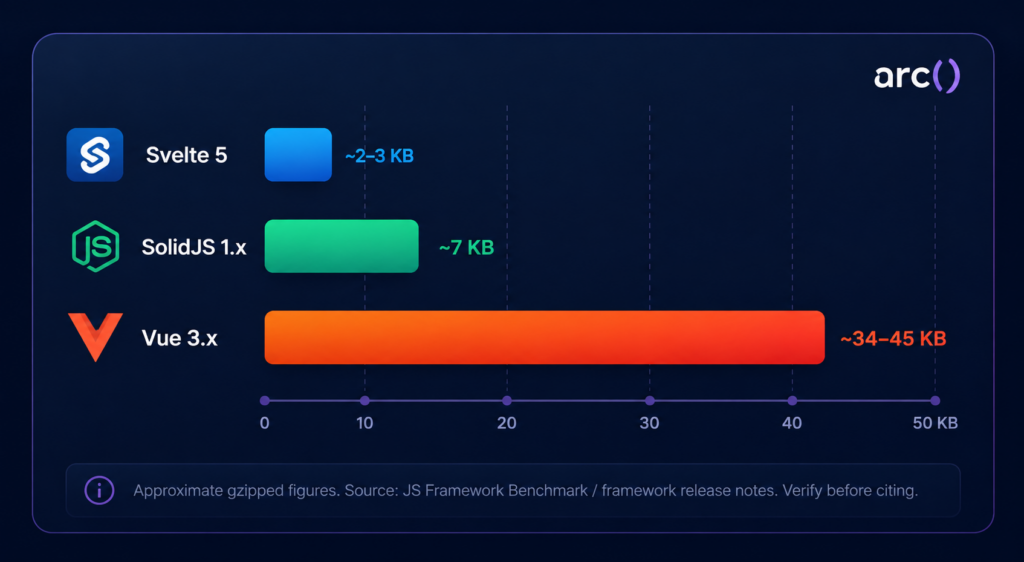
Two things explain the spread:
- Vue ships a runtime. Reactivity proxies, the VDOM patcher, and the component system all go to the browser. That cost is mostly fixed. A 200-component Vue app doesn’t pay that overhead 200 times.
- Svelte spreads cost across components. Its baseline is tiny, but each component compiles to its own update code. On very large apps, Svelte’s advantage narrows. SolidJS sits in between: a slightly larger floor and a flatter growth curve.
If your app has five components, Svelte wins on size. If it has 500, the gap shrinks considerably.
Initial load, update work, and performance testing
For initial load, smaller bundles win, and Svelte and SolidJS ship less JavaScript to parse. For update throughput, SolidJS consistently ranks at or near the top of public JS framework benchmarks, especially on large lists and frequent updates.
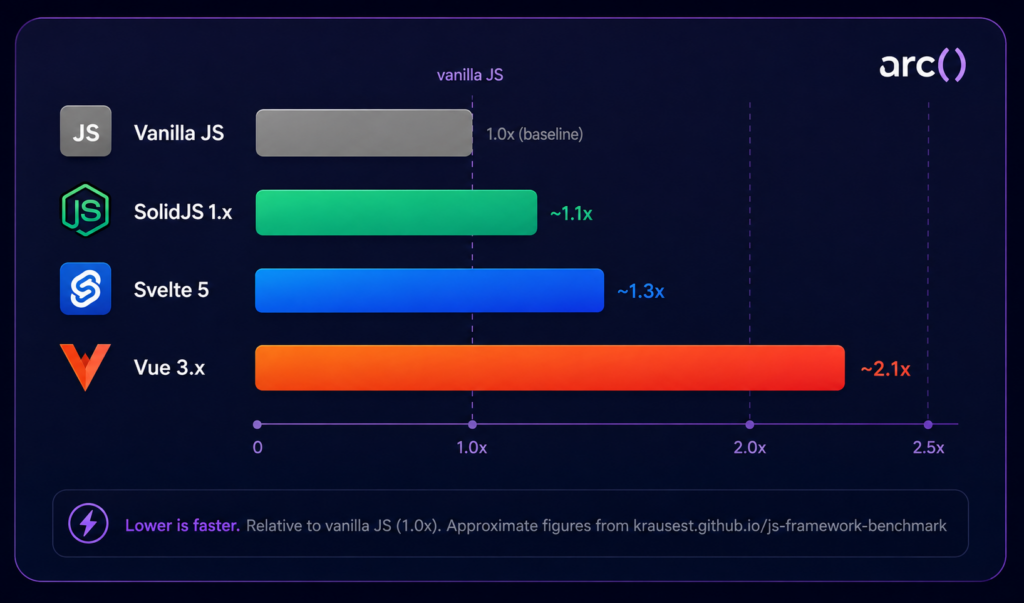
Vue 3 isn’t slow in practice. In real single-page applications, most users won’t feel the difference between these three. Bottlenecks usually come from unoptimized images, oversized third-party scripts, and slow API calls, not framework overhead.
Test with your own workload. Benchmark a real view with real data, not a hello world.
Server rendering, routing, and Next.js
All three have first-party answers for SSR and routing:
- SvelteKit handles routing, server-side rendering, static export, and progressive web app patterns. It’s the default way to build Svelte apps in 2026.
- Nuxt.js does the same for Vue, with a large module ecosystem. Vue Router is also available standalone for SPAs.
- SolidStart covers SSR and file-based routing for Solid. It reached 1.0 more recently than the other two, so expect fewer community recipes.
A quick note on a comparison you’ll see searched often: Svelte vs Next.js isn’t really the same question as Svelte vs Vue vs SolidJS. Next.js is a React meta-framework, not a reactive-framework peer to Svelte, Vue, and Solid.
Where React would land if it were in this comparison:
| Svelte 5 | Vue 3.x | SolidJS 2.0 | React 19 | |
| Baseline bundle | ~2-3 KB | ~34-45 KB | ~7 KB | ~45 KB (React + ReactDOM) |
| Talent pool | Moderate | Large | Small | Very large |
| Virtual DOM | No | Partial (Vapor opt-in) | No | Yes |
React’s bundle is comparable to Vue’s because both ship a runtime. Its talent pool is the deepest by a significant margin: larger than Vue, Svelte, and Solid combined. This article focuses on the compiler-first and fine-grained reactive frameworks because that’s where the meaningful architectural tradeoffs live.
If your decision is between React and one of these three, the ecosystem depth and hiring pool arguments favor React even more strongly than they favor Vue.
If your team has already committed to React and is weighing SvelteKit as an alternative meta-framework, that’s a separate decision built on React’s ecosystem depth and hiring pool versus SvelteKit’s smaller bundles and simpler component model. This article assumes you’re choosing the underlying reactivity model first, which is a different fork in the road.
For SEO-driven content sites and dynamic landing pages, Nuxt and SvelteKit are both proven. SolidStart works, but you’ll solve more problems yourself.
Read more: Best Platforms to Hire Svelte Developers in 2026
Developer experience and code ownership
DX is where framework choice affects your team every day. Bundle size is a one-time decision. Syntax and debugging are forever.
Svelte 5 runes and component authoring
A Svelte component is one file: a script block, markup, and scoped CSS. There’s very little boilerplate code.
Svelte 5 replaced the old let reassignment reactivity with runes. You declare state with $state(0), derive values with $derived, and run side effects with $effect. That’s more explicit than Svelte 4, and it works outside components too, which fixed a real maintainability gap.
Built-in transitions and animations are a genuine advantage. transition:fade works out of the box, with no extra library.
The trade-off: Svelte 4 tutorials and Stack Overflow answers may not match Svelte 5 code. Budget time for that confusion.
Vue 3 Composition API and template options
Vue gives you two authoring styles. The Options API groups code by option type. The Composition API with <script setup> groups it by feature, which scales better in large components.
Reactivity uses ref() for single values and reactive() for objects. You unwrap refs with .value in script code but not in templates. That inconsistency trips up newcomers, and it’s the most common Vue complaint.
Vue’s strengths are hard to overstate:
- Documentation is the best of the three. Clear, versioned, thorough.
- Vue DevTools is mature, with a component tree, state inspection, and timeline.
- Two-way data binding via v-model makes forms fast to build.
- Lifecycle hooks are well documented and predictable.
SolidJS signals, JSX, and control flow
SolidJS looks like React, but it behaves very differently.
You write JSX. You use createSignal, which returns a getter and setter. But the component function runs once. No re-render, no dependency arrays, no useMemo to memoize away wasted work.
Because components don’t re-run, you can’t use plain .map() and && for reactive lists and conditionals. You use <For>, <Show>, and <Switch> instead. Miss this, and your UI silently stops updating.
For React developers, the syntax is familiar within about an hour. The mental model takes a week or two to unlearn.
State, transitions, and testing
| Concern | Svelte 5 | Vue 3 | SolidJS |
| Global state | Runes in a .svelte.js file, or stores | Pinia (Vuex is legacy) | Signals or createStore |
| Transitions | Built in | Built in (<Transition>) | Community packages |
| Testing | Vitest + Testing Library | Vitest + Vue Test Utils | Vitest + Solid Testing Library |
| CSS approach | Scoped by default | Scoped or CSS Modules | CSS Modules or any CSS-in-JS |
Vue has the deepest testing conventions, largely because Vue Test Utils has been around the longest. All three work fine with Vitest and Playwright.
One longer-horizon note for the reactive-APIs section: the TC39 Signals proposal is at Stage 1, with input from the Vue, Svelte, Solid, Angular, and Preact teams. If it advances, it would provide a native JavaScript standard for the fine-grained reactivity pattern that all three frameworks currently implement differently.
The “signals vs runes vs refs” distinction you’re choosing between today may matter considerably less in three to five years if the proposal reaches Stage 4. For a stack decision with a two-to-three-year horizon, this is worth knowing as a hedge against the permanence of the comparison.
Learning curve and maintainability
For a team coming from React:
- SolidJS: Fastest syntax pickup, slowest mental-model shift. Expect two to three weeks to full productivity.
- Svelte 5: New syntax to learn, but very little of it. Two to three weeks, and less code to maintain afterward.
- Vue 3: Most concepts to learn (directives, template syntax, MVVM-style binding), but the best docs to learn them from. Two to four weeks.
Long-term maintainability favors Vue on team turnover and Svelte on code volume. Fewer lines means fewer places for bugs to hide, but only if the next engineer understands runes.
Read more: Svelte 5 and Runes: What Actually Changed and How to Migrate Without Breaking Reactivity
The same component in each framework
A counter with a derived value, to show how each framework’s reactivity model looks in practice.
Svelte 5:
<script>

  let count = $state(0)

  let doubled = $derived(count * 2)

</script>

<button onclick={() => count++}>Count: {count}</button>

<p>Doubled: {doubled}</p>
Vue 3 (Composition API with <script setup>):
<script setup>

import { ref, computed } from 'vue'

const count = ref(0)

const doubled = computed(() => count.value * 2)

</script>

<template>

  <button @click="count++">Count: {{ count }}</button>

  <p>Doubled: {{ doubled }}</p>

</template>
SolidJS:
import { createSignal, createMemo } from 'solid-js'

function Counter() {

  const [count, setCount] = createSignal(0)

  const doubled = createMemo(() => count() * 2)

  return (

    <>

      <button onClick={() => setCount(c => c + 1)}>Count: {count()}</button>

      <p>Doubled: {doubled()}</p>

    </>

  )

}
The structural difference is visible immediately: Svelte reads like annotated HTML. Vue requires unwrapping refs with .value in script (but not in template). SolidJS signals are getter functions (count() not count), which trips up React developers first.
List rendering
Svelte:
{#each items as item (item.id)}

  <div>{item.name}</div>

{/each}
Vue:
<div v-for="item in items" :key="item.id">{{ item.name }}</div>SolidJS:
<For each={items()}>{(item) => <div>{item.name}</div>}</For>The SolidJS <For> is not optional. A plain .map() won’t update reactively because the component runs once.
Ecosystem maturity and scale
This is where the gap between the three is widest, and where it costs the most money.
Vue’s tooling and community
Vue has been in production since 2014. Evan You leads it with the Vue core team, and the framework itself is funded through sponsorships and Open Collective, the same model it’s used for years.
Separately, Evan You founded VoidZero in 2023 to build a unified JavaScript toolchain, Vite, Vitest, Rolldown, and the Oxc compiler suite. VoidZero raised venture funding to staff that work, and Cloudflare acquired VoidZero in June 2026, keeping the tools MIT-licensed and under the same team’s leadership. That acquisition funds the build tooling that Vue, Svelte’s SvelteKit, and most modern frameworks run on. It doesn’t fund Vue directly, and Vue’s governance stayed separate from the deal.
What you get in practice:
- Component libraries: Vuetify, Quasar, PrimeVue, Element Plus, Naive UI. All production-tested, all with hundreds of components.
- State management: Pinia is the standard. Vuex still runs in older codebases.
- Vue DevTools: The most complete debugging experience of the three.
- Third-party integrations: Payment SDKs, analytics, charting, and rich text editors usually ship Vue wrappers.
- Mobile: NativeScript-Vue and Quasar’s Capacitor builds cover mobile-first applications.
Vue runs at Alibaba, GitLab, and a long list of enterprise applications. If your requirement is “someone has already solved this in Vue,” the answer is usually yes.
SvelteKit and the Svelte ecosystem
Svelte’s core team is small. Rich Harris works on it full-time at Vercel, which funds development but doesn’t own the project.
SvelteKit is the ecosystem’s center of gravity, and it’s genuinely good: file-based routing, SSR, form actions, and adapters for most hosts.
Component libraries have improved a lot. Skeleton, shadcn-svelte, Melt UI, and Bits UI cover most needs, though they’re younger than Vuetify or Quasar. For anything unusual, like a specialized diagramming widget, you may end up wrapping a vanilla JS library yourself.
That’s a real cost. Wrapping a third-party library is a few days of work plus permanent maintenance.
SolidJS compatibility and adoption trade-offs
SolidJS has the smallest ecosystem of the three. Ryan Carniato leads it; he works on open source at Netlify, a parallel to Rich Harris at Vercel for Svelte. That said, the bus-factor risk is real in both cases. Solid 2.0 is in beta as of this writing, which adds adoption risk: the async model is being rewritten, createResource is gone, <Suspense> is replaced by <Loading>, and third-party libraries are still catching up. For a production stack decision today, that’s a material constraint.
Solid UI and Kobalte provide headless and styled primitives. SolidStart covers SSR. Beyond that, expect to write integrations.
The JSX syntax creates a trap worth naming: React libraries do not work in Solid. They look compatible and aren’t, because React components rely on re-rendering. Every React library you planned to reuse needs a Solid equivalent or a rewrite.
For a small team building a focused product, that’s manageable. For a large-scale application with dozens of integrations, it’s a serious tax.
Choosing for medium-sized and enterprise products
- Medium-sized projects (10-30 screens): All three scale fine. Pick on DX and hiring.
- Large-scale projects: Vue’s ecosystem and hiring depth make it the low-risk default. Svelte 5 scales technically, since runes gave it a universal reactivity system, but you’ll build more infrastructure yourself.
- Enterprise applications with compliance and vendor requirements: Vue, or React and Angular if procurement demands a name they recognize.
Team availability and hiring risk
Framework choice is a hiring decision. Every quarter you spend unable to fill a frontend role costs more than any bundle-size win.
Candidate pool depth and sourcing
Approximate relative depth, sourced from State of JS 2024 usage and retention data, npm weekly download trends, and job posting volume:
| Framework | Relative talent pool | Notes |
| Vue | Large | Heavy adoption in Asia-Pacific, China, and Europe; deepest non-React pool |
| Svelte | Moderate | Strong enthusiasm, far fewer engineers with production experience |
| SolidJS | Small | Mostly senior developers who adopted it deliberately |
The mechanism matters more than the ranking. Vue’s pool is larger because Vue has shipped production apps since 2014 and became a default choice in several large regional markets. Svelte’s usage satisfaction is high, but satisfaction doesn’t create supply. SolidJS candidates exist in the low thousands globally, not the hundreds of thousands.
Practitioner sourcing estimates based on Arc’s hiring data: a Vue senior role typically produces a workable shortlist in one to two weeks. A Svelte role with a strict experience filter often takes three to five weeks. A SolidJS role filtered strictly on SolidJS can run six weeks or longer — these are ranges, not guarantees, and vary by seniority, geography, and remote availability.
Hire Vue.js developers when you need volume, speed, and a deep pool of production experience. For specialist roles where the framework is already decided, widen the requirement to “strong reactive-framework engineer with a short ramp-up” rather than an exact keyword match, as the transferable skills are real.
How to assess framework experience
The fix is usually to change the requirement, not to search harder.
A concrete scenario: a Series A startup posts a SolidJS senior frontend role. Filtering strictly on SolidJS, they see maybe a dozen plausible candidates worldwide who are also open to a new role. Rewritten as “senior frontend engineer with deep signal-based or fine-grained reactivity experience, two-week ramp on SolidJS,” the pool includes strong Vue 3 Composition API and Svelte 5 developers. Time-to-hire drops from months to weeks.
That works because the transferable skills are real. An engineer who understands Vue’s ref tracking or Svelte’s $derived already understands signals. What they need to learn is Solid’s control-flow components and the once-only component execution model — days of work, not months.
A workable interview loop:
- Recruiter screen (30 min): remote experience, English fluency, framework history
- System design (60 min): frontend architecture, state boundaries, SSR strategy — framework-agnostic on purpose
- Framework-adjacent pairing (60–90 min): let candidates use the reactive framework they know best, then ask them to reason about how the same pattern maps to your stack
- Team fit (30 min)
The pairing round is where you see transferability. A candidate who can explain why Solid’s <For> exists, having only used Svelte, is a stronger signal than someone who memorized Solid’s docs.
AI-assisted screening surfaces candidates whose Vue or React signal predicts Svelte or SolidJS proficiency, so recruiters spend their hours on real conversations instead of keyword filtering. Teams that need to fill a Svelte or SolidJS role without a six-week sourcing cycle often work with a pre-vetted marketplace like Arc, where candidates are already screened for domain expertise and framework-adjacent skill transferability.
Selecting a stack
| Team profile | Recommended choice |
| Small team optimizing for the smallest possible bundle | SolidJS |
| Team that needs a large hiring pool and fast onboarding | Vue 3 |
| Team that wants modern DX and can tolerate a smaller talent pool | Svelte 5 |
| Content site or dynamic landing pages with SEO requirements | SvelteKit, Nuxt, or Astro |
| Existing Vue 2 codebase | Vue 3, incrementally |
| React team wanting better performance without new syntax | SolidJS |
| Enterprise with vendor and compliance constraints | Vue 3 |
| Greenfield product, hiring 5+ frontend engineers in year one | Vue 3 |
For greenfield projects, weight hiring heavily. For a small internal tool or widget, weight DX and bundle size; you’re not hiring a team for it.
Bottom line
- Pick Vue 3 if you’re hiring a team, shipping an enterprise app, or want the fewest unknowns.
- Pick Svelte 5 if you want the least code to maintain and can accept a smaller ecosystem and hiring pool.
- Pick SolidJS if update performance is a hard requirement and your team already lives in JSX; but note that Solid 2.0 is in beta, and its async model is still settling.
The bundle-size gap between Svelte and SolidJS is small enough that it should rarely decide the question. Ecosystem depth and hiring reality should.
Frequently Asked Questions
Is Svelte faster than Vue?
For raw update speed, yes, in most benchmarks. Svelte skips the virtual DOM entirely, so a state change updates only the specific DOM node it affects. Vue’s compiler-optimized virtual DOM closes most of the gap for typical apps, and the difference rarely matters outside high-frequency updates like live data grids or animation-heavy interfaces. For most business applications, users won’t notice.
Is Svelte better than Vue?
Neither is better across the board. Svelte ships less code and has less boilerplate, which is a real advantage for small teams and content-heavy sites. Vue has better documentation, a larger ecosystem, and a much bigger hiring pool. If you’re optimizing for bundle size and code volume, pick Svelte. If you’re optimizing for hiring speed and long-term support, pick Vue.
Is SolidJS faster than Svelte?
On update-heavy benchmarks like large lists with frequent state changes, SolidJS often edges ahead, since its signals wire directly to individual DOM nodes with no compilation step deciding what to batch. On initial load and typical app-level performance, the two are close enough that framework choice shouldn’t hinge on this alone. Test both against your actual workload rather than relying on synthetic benchmarks.
What’s the difference between SolidJS and Svelte?
SolidJS uses JSX and signals, with components that run once and never re-render. Svelte uses HTML-like templates and a compiler that generates direct DOM update code from your component syntax. Solid feels closer to React syntactically. Svelte has less code to write and read. Solid’s ecosystem is smaller, and React libraries don’t work with it; Svelte’s ecosystem is more developed, especially through SvelteKit.
Should I learn Svelte or Vue in 2026?
Learn Vue first if you’re optimizing for job availability, since Vue’s talent pool and job postings are significantly larger than Svelte’s. Learn Svelte if you’re building your own projects, want less boilerplate, or you’re already employed and want a second framework that’s genuinely different from Vue or React. Most engineers who know one reactive framework well can pick up either in two to three weeks.
Is it hard to hire Svelte or SolidJS developers?
Harder than hiring for Vue or React, but the difficulty is usually a sourcing problem, not a supply problem. A Svelte role filtered strictly on Svelte experience often takes three to five weeks to fill. A SolidJS role filtered the same way can take six weeks or longer. Widening the requirement to “strong reactive-framework engineer with a short ramp-up” instead of an exact keyword match usually cuts that timeline significantly, since Vue and React experience transfers faster than most job descriptions assume.
Can I use React component libraries with SolidJS?
No. React libraries rely on re-rendering, and SolidJS components run once with no re-render cycle, so React libraries don’t work in Solid even though the JSX syntax looks nearly identical. You’ll need a Solid-native equivalent or a rewrite for any React library you were planning to reuse.
Is Svelte vs Next.js the same comparison as Svelte vs Vue?
No. Next.js is a meta-framework built on React, not a separate reactive framework. Comparing Svelte to Next.js really means comparing SvelteKit’s compiler-based, smaller-bundle approach to React’s ecosystem depth and hiring pool through Next.js. Svelte vs Vue vs SolidJS is a different decision: it’s about which underlying reactivity model your team wants before you pick a meta-framework at all.
Why does Vue have a bigger hiring pool than Svelte or SolidJS?
Mainly because Vue has been in production since 2014 and became a default framework choice in several large regional markets, including heavy adoption across Asia-Pacific. That longer track record produced more production experience, more job postings, and more engineers who’ve used it professionally. Svelte and SolidJS have strong developer satisfaction in surveys, but satisfaction doesn’t translate into supply the way years of production usage does.
Hire vetted frontend engineers faster
Skip the sourcing and screening overhead that makes niche-framework roles drag on for weeks. Arc gives you access to senior remote engineers with experience across React, Vue, Svelte, and SolidJS, pre-vetted for domain expertise and English fluency.
You can make a freelance hire in as little as 72 hours or a full-time hire in as little as 14 days, and you only pay once you’ve made a hire.