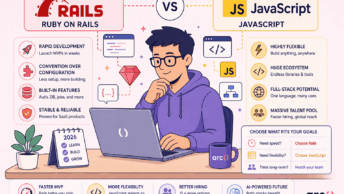



Many teams evaluating a remote hiring platform for backend engineers run into the same question: Is Ruby on Rails still a viable choice, or are they locking themselves into an outdated stack? The concern is real: choosing the wrong framework can lead to costly rewrites, slower hiring, and architectural limitations within 12–24 months.
Arc connects companies with vetted Rails developers who are actively building and scaling modern applications, including AI-enabled products and high-traffic SaaS platforms. With access to 450,000+ professionals across 190 countries, teams can validate Rails’ current relevance by shipping production features quickly rather than debating outdated assumptions.
This guide breaks down exactly where Ruby on Rails for web development still delivers long-term value, including architecture patterns, real-world timelines, AI integration workflows, and the specific scenarios where Rails remains a faster and more sustainable choice than newer stacks.
What Ruby on Rails Actually Solves in Modern Web Development
Rails targets three bottlenecks that still slow down most engineering teams:
- Initial project setup and architectural decisions
- Repetitive CRUD implementation across features
- Over-reliance on complex frontend frameworks for simple applications
These issues are especially common in early-stage SaaS products and internal tools, where speed matters more than perfect scalability.
Why Convention Over Configuration Reduces Setup Time by 2–4 Days
Running rails new generates a fully structured application with database configuration, testing setup, background job support, and asset handling already wired. This removes the need for early-stage decisions that don’t directly contribute to product functionality.
In contrast, a Node-based setup typically requires:
- Selecting a framework (Express, Fastify)
- Choosing and configuring an ORM
- Setting up validation libraries
- Defining folder structure and conventions
- Integrating testing tools manually
Each step adds friction. In aggregate, teams spend 16–32 hours on setup alone before building features. Rails eliminates most of that upfront, which compounds across multiple projects or microservices.
How Rails Eliminates 60–70% of CRUD Boilerplate
Most business applications rely heavily on CRUD operations, such as user accounts, dashboards, transactions, and admin interfaces. Rails compresses this repetitive work into generators and conventions.
For example:
</> Ruby
rails generate scaffold Product name:string price:decimal
This command produces a fully functional resource, including database migration, model logic, controller actions, and views. A developer can go from zero to a working feature in under a minute.
In practice, this reduces implementation time for standard features such as dashboards and inventory systems by eliminating large portions of repetitive CRUD code, often compressing multi-day builds into hours.
Where Rails Outperforms JavaScript-Heavy Architectures
Rails performs best in applications where:
- Most interactions revolve around forms, dashboards, or data workflows
- UI responsiveness requirements are moderate (not real-time intensive)
- Teams need to iterate on business logic quickly
With Hotwire, Rails delivers dynamic UI updates without maintaining a separate frontend application. This removes an entire layer of complexity, which is especially valuable for teams with fewer than five developers.
The result is fewer integration points, fewer bugs caused by API mismatches, and faster iteration cycles when requirements change.
Ruby on Rails Architecture in Production Environments
Most Ruby on Rails web application development follows a modular monolith architecture that prioritizes simplicity early and allows gradual scaling.
Typical Rails Production Stack
| Layer | Technology | Purpose |
| Web server | Puma | Handles concurrent HTTP requests |
| Database | PostgreSQL | Stores relational and semi-structured data |
| Cache | Redis | Improves response times and session handling |
| Jobs | Sidekiq | Processes background tasks |
| Storage | S3-compatible | Handles file uploads |
This stack is intentionally minimal, as fewer moving parts reduce failure points and simplify debugging in production.
Monolith vs Microservices: Why Rails Teams Delay Splitting
Rails applications typically remain monolithic until they reach clear scaling limits. For most products, this threshold appears when:
- User base exceeds ~1 million users
- The engineering team grows beyond 15–20 developers
Before that point, microservices often introduce unnecessary complexity:
- Increased latency between services
- More complex deployments
- Higher infrastructure costs
A modular monolith allows teams to organize code into components without introducing network boundaries, preserving both clarity and performance.
Database and Performance Optimization
Rails relies heavily on PostgreSQL’s advanced capabilities. Features like JSON columns and full-text search allow developers to extend functionality without introducing new services.
Common optimizations include:
- Indexing frequently queried columns to keep response times under 50ms
- Using eager loading to eliminate N+1 queries
- Implementing Redis caching can significantly reduce database load by serving repeated queries from memory instead of hitting PostgreSQL directly, especially in read-heavy applications.
These optimizations allow Rails applications to scale efficiently without major architectural changes.
Background Jobs and AI Workloads
Background job processing is critical for handling operations that exceed typical request-response time limits. Sidekiq processes tasks like email delivery, payment processing, and AI inference asynchronously.
AI workloads in particular benefit from this approach. Tasks like document summarization or embedding generation often take 500ms to several seconds, making them unsuitable for synchronous execution. Offloading them to background jobs keeps user-facing performance stable.
How Fast Can You Build a Web App with Ruby on Rails?
Speed remains the primary advantage of Rails web development, especially for early-stage products.
Realistic MVP Timelines
| Product Type | Timeline | Example |
| Simple CRUD app | ~2 weeks | Internal dashboard |
| SaaS MVP | 4–6 weeks | Subscription-based tool |
| Marketplace | 6–8 weeks | Two-sided platform |
These estimates assume:
- A team of 1–3 experienced developers
- Use of standard Rails tools and conventions
Custom frontend-heavy applications or complex integrations can extend these timelines.
Built-In Features That Save Weeks
Rails ecosystems provide ready-made solutions for common features:
- Authentication (Devise)
- Payments (Pay gem)
- Admin panels (Administrate, Avo)
- File uploads (Active Storage)
Each of these components reduces development time by several days to multiple weeks, depending on complexity.
How AI Accelerates Rails Development Further
Rails benefits from AI tools more than less structured frameworks because its conventions provide predictable patterns. This improves the accuracy of AI output and reduces incorrect code generation.
AI tools contribute in several ways:
- Autocomplete generates consistent controller and model logic
- Test generation covers edge cases quickly
- Refactoring tools identify inefficiencies early
Teams combining Rails with AI-assisted workflows often reduce development time per feature by automating repetitive tasks such as test generation, boilerplate code, and refactoring.
Step-by-Step: How to Build a Web App with Ruby on Rails
Understanding how to build a web app with Ruby on Rails requires focusing on workflow rather than syntax.
Step-by-Step Timeline to Build a Rails Web Application
| Phase | Timeline | Key Actions |
| Setup | 1–2 days | Initialize project and dependencies |
| Schema design | 2–3 days | Define data relationships |
| Core features | 1–3 weeks | Implement business logic |
| Frontend | 3–7 days | Build UI with Hotwire or React |
| Deployment | 1–2 days | Configure CI/CD and hosting |
Each phase builds on conventions, reducing decision fatigue.
Frontend Strategy: Hotwire vs React
| Factor | Hotwire | React |
| Team size | 1–3 developers | 4+ developers |
| Complexity | Low | High |
| Setup time | Hours | Days |
| SEO | Native | Requires SSR |
Hotwire is sufficient for most Ruby on Rails web design scenarios, particularly dashboards and SaaS interfaces.
Sustainable Web Development with Ruby on Rails
Sustainable web development with Ruby on Rails focuses on long-term efficiency rather than short-term optimization.
Why Rails Reduces Technical Debt
Rails enforces consistent patterns across projects, reducing variability among developers. This makes codebases easier to maintain and extend over time.
Teams typically onboard new developers in 1–2 weeks, compared to 3–4 weeks in less structured environments.
Infrastructure Cost Efficiency
A standard Rails deployment requires minimal infrastructure:
- Application server
- Database
- Optional caching layer
This simplicity keeps monthly costs between $100–$300 for moderate-traffic applications, significantly lower than those of distributed architectures.
AI and Sustainability
AI tools reduce unnecessary work in development cycles:
- Automated testing reduces redundant builds
- Monitoring systems detect inefficiencies early
- Refactoring tools prevent performance degradation
These improvements reduce time spent on maintenance tasks such as testing, debugging, and refactoring, making long-term development more sustainable.
Using Ruby on Rails for AI-Powered Applications
Rails is increasingly used as a backend layer for AI-driven products because it reliably handles user data, authentication, and API orchestration, while delegating compute-intensive AI tasks to external services.
This allows teams to integrate features like chat, recommendations, and automation without restructuring their core application.
Common AI Integration Patterns
Rails manages:
- User data
- Authentication
- API orchestration
AI services handle:
- Inference
- Processing
- Model execution
This separation allows teams to integrate AI features without restructuring core systems.
AI Performance Constraints
| Task | Strategy |
| Chat responses | Real-time API calls |
| Summarization | Background jobs |
| Embeddings | External services |
| Image generation | Async processing |
Rails acts as the coordination layer rather than the compute engine.
Cost and Hiring for Ruby on Rails Development
Understanding the cost and hiring dynamics of Ruby on Rails web application development is critical for planning timelines and budgets. Beyond hourly rates, factors like ramp-up speed, team size, and developer versatility directly impact total project cost and delivery efficiency.
Developer Rates by Region
| Level | US | Europe | LATAM | Asia |
| Junior | $50–80 | $40–65 | $25–40 | $15–30 |
| Mid | $80–140 | $65–100 | $40–65 | $30–50 |
| Senior | $140–200+ | $100–160 | $65–100 | $50–80 |
Hiring Efficiency
Rails developers typically:
- Ramp up in 1–2 weeks
- Handle both frontend and backend tasks
This reduces the need for larger, specialized teams.
When Ruby on Rails Is the Wrong Choice
Rails is not optimized for:
- High-concurrency systems exceeding 10,000+ connections
- Real-time event-driven architectures
- Ultra-low latency applications (<100ms requirements)
In these cases, lower-level or concurrency-focused technologies perform better.
The Strategic Case for Ruby on Rails in 2026
Rails remains one of the most efficient frameworks for building production-ready applications quickly, particularly for database-driven products where speed to market and maintainability matter more than raw performance.
Its conventions, mature ecosystem, and built-in tooling allow teams to move from idea to a stable, deployable product in weeks rather than months.
Where Rails Delivers the Most Value
- MVP development within 2–6 weeks
- Small, high-output teams
- Maintainable long-term codebases
Rails + AI as a Combined Advantage
Rails handles system structure and workflows, while AI tools enhance development speed and product capabilities. This combination allows teams to build and iterate quickly without sacrificing maintainability.
Rails Tradeoffs: Speed vs Scalability Explained
| Factor | Advantage | Limitation |
| Speed | High | — |
| Scalability | Moderate | Not extreme-scale |
| Maintainability | Strong | Requires discipline |
The bottom line is: For most SaaS platforms, marketplaces, and internal tools, Ruby on Rails for web development remains the fastest and most efficient way to move from idea to production, especially when combined with AI-assisted workflows.
The Fastest Path to Long-Term Rails Projects
Ruby on Rails remains relevant because it optimizes for outcomes that matter in real products: time to market, maintainability after 12+ months, and the ability to evolve without constant rewrites. For most SaaS platforms, marketplaces, and internal tools, the limiting factor is not raw throughput but how quickly teams can ship, learn, and iterate on real user feedback.
Arc helps companies validate that advantage in practice by connecting them with vetted Rails developers who have already built and scaled production systems using modern patterns, including AI-enabled workflows. With hiring timelines of ~72 hours for freelance roles and ~14 days for full-time roles, teams can move from evaluation to execution without delays caused by sourcing or screening.
If your priority is launching faster while keeping long-term costs and complexity under control, Rails remains a strong, defensible choice. View matched candidates and start building sooner.
Frequently Asked Questions
Is Ruby on Rails still relevant for web development in 2026?
Yes, Ruby on Rails remains highly relevant for database-driven applications such as SaaS platforms, marketplaces, and internal tools. Teams still use it to build production-ready apps in 2–6 weeks, especially when speed to market and long-term maintainability matter more than extreme-scale performance.
How long does it take to build a web app with Ruby on Rails?
A typical Rails MVP takes 2–6 weeks with a team of 1–3 experienced developers, depending on feature complexity. Simple CRUD-based apps can be completed in around 2 weeks, while marketplaces or SaaS products with billing and dashboards usually take 4–8 weeks.
What types of applications are best suited for Ruby on Rails?
Rails works best for applications that rely on structured data and standard workflows, such as SaaS tools, admin dashboards, marketplaces, and content platforms. It is particularly effective when most interactions involve forms, dashboards, and business logic rather than real-time processing.
Can Ruby on Rails be used for AI-powered applications?
Yes, Rails is commonly used as a backend layer for AI-driven products, where it handles user data, authentication, and API orchestration. AI features like chat, recommendations, and document processing are typically integrated through external services, with Rails coordinating requests and managing results.
When should you avoid using Ruby on Rails?
Rails is not ideal for systems requiring 10,000+ concurrent connections, sub-100ms latency, or real-time event processing at scale. Applications like high-frequency trading platforms or real-time multiplayer systems usually require lower-level or concurrency-focused technologies.
How does hiring Ruby on Rails developers compare to other stacks?
Rails developers typically ramp up in 1–2 weeks due to consistent conventions and full-stack capabilities. This reduces onboarding time compared to custom JavaScript stacks, where ramp-up can take 3–4 weeks due to greater architectural variability.
What is the most efficient way to start a Rails project today?
The fastest approach is to start with Rails defaults, use PostgreSQL as the database, and rely on established tools like Devise for authentication and Sidekiq for background jobs. For teams looking to move quickly, working with pre-vetted developers can reduce hiring time to days instead of weeks.