

When your runway is 12 months, and you need paying users in three, every week spent configuring a tech stack is a week not spent talking to customers. That tension between building and validating is where most early-stage teams lose time.
A two-person engineering team spinning up a Node/Express project from scratch can burn two to three weeks just wiring up an ORM, picking a folder structure, configuring authentication, and debating middleware choices before a single user-facing feature exists.
Ruby on Rails compresses that setup phase into days because the framework ships with answers to questions that other stacks leave open. Routing, database migrations, an ORM, asset pipeline, testing harness, and a standard file structure all come out of the box with rails new. You skip the “let’s research which libraries to use” phase and jump straight into building the thing users will actually touch.
This matters for rapid development with Ruby on Rails because the speed advantage is structural: Rails enforces conventions that eliminate the small decisions that compound into missed deadlines, where models live, how database tables map to classes, and how routes connect to controllers.
For founding teams evaluating Ruby on Rails for MVP work, the real value lies in the engineering arguments it prevents. This article breaks down how that speed shows up in practice, where Rails falls short, how AI tools amplify its conventions, and what the hiring reality looks like when you need a developer who can start shipping on day one.
Why Rails Cuts MVP Build Time Early
Rails is a full-stack web application framework built on the Ruby programming language. It follows two core principles that directly reduce the number of decisions your team has to make: convention over configuration and Don’t Repeat Yourself (DRY).
These principles translate into concrete time savings at three specific points in early development: generating your first feature, connecting to your database, and organizing your codebase.
How Scaffolding Removes First-Feature Friction
Running rails new gives you a working application skeleton in under a minute. That includes a directory structure, a configured database connection, a test suite, a web server (Puma), and a routing file (config/routes.rb).
From there, rails generate scaffold creates a full CRUD interface for any resource: model, migration, controller, views (ERB templates), routes, and even basic tests. In a Node/Express project, you would wire each of those pieces individually, choosing libraries for each layer.
For a marketplace MVP, scaffolding a Listing model with title, price, and description fields gives you a working create-read-update-delete interface in one terminal command. Your first feature is live in minutes.
That is the mechanism behind rapid development with Ruby on Rails: the framework generates the boilerplate so your engineers write only the business logic that differentiates your product.
Why Active Record Replaces Extra ORM Setup
Active Record is the built-in ORM that automatically maps Ruby classes to database tables. If you create a User model, Rails assumes a users table exists. Associations like has_many and belongs_to let you express relationships in plain English.
Compare that to a typical Express setup. You choose between Sequelize, Prisma, TypeORM, or Knex. Each has different configuration requirements, migration syntax, and query patterns. The selection process alone can consume a full sprint for a small team.
Active Record eliminates that evaluation phase entirely. Migrations, validations, and query methods are built in. Your team writes User.where(active: true) instead of debating which query builder to install.
How Conventions Reduce Architecture Debates
The MVC architecture in Rails is not optional. Models go in app/models, controllers in app/controllers, views in app/views. Routes live in config/routes.rb. Helpers, params handling, and asset organization all follow predictable patterns.
This matters because architecture debates are a hidden time sink for early-stage teams. When two engineers disagree on folder structure or naming conventions, the resulting back-and-forth costs hours that feel productive but ship nothing.
Rails removes that debate by making the decision for you. Every Rails application looks structurally similar, which means new team members (or AI coding tools) can navigate the codebase immediately. Developer productivity goes up because Rails developers spend less time deciding where code should live.
The Built-In Tools And Gems That Replace Custom Work
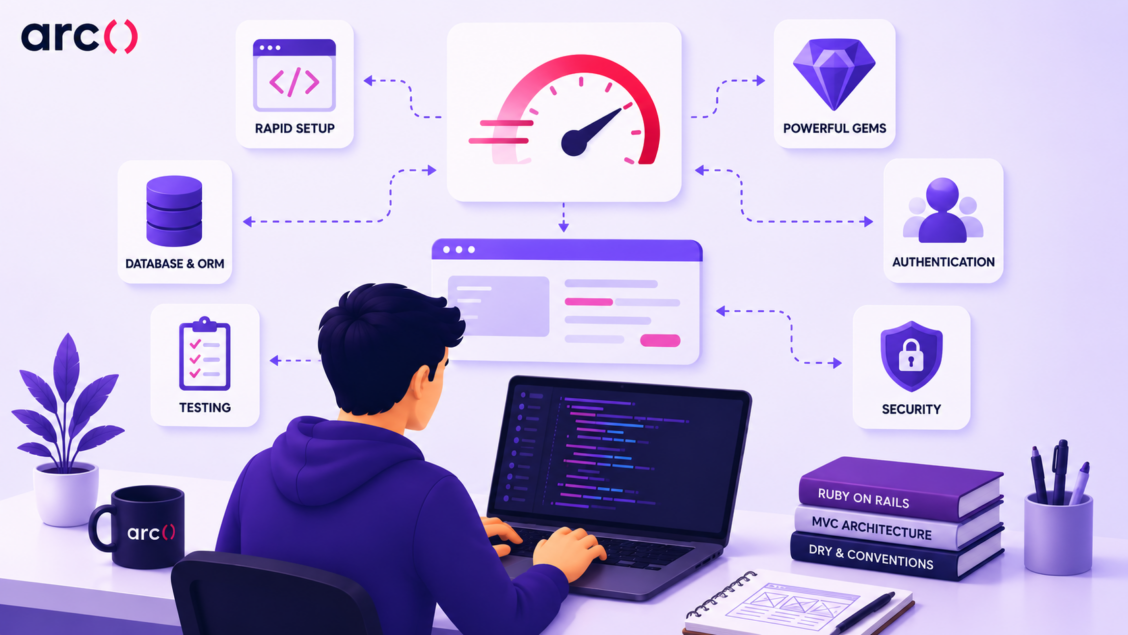
The gem ecosystem is where Rails shifts from “fast to set up” to “fast to ship real features.” RubyGems hosts thousands of open-source libraries, and the mature ones solve problems that would otherwise require weeks of custom development. Authentication, background processing, real-time updates, testing, and security all have battle-tested solutions you can install in minutes.
Authentication, Authorization, And Admin Basics
Devise handles authentication: registration, login, password reset, email confirmation, and session management. Installing it and running its generator gives you a complete auth system in under 30 minutes. Building that from scratch in Express or a similar framework typically takes one to two full engineering days, including edge cases like token expiry and secure password hashing.
For authorization, gems like Pundit let you define who can access what in plain Ruby classes. Need an admin panel? ActiveAdmin or Administrate generates a working dashboard from your existing models.
OAuth integration (Google, GitHub, etc.) layers in through OmniAuth. You add a gem, configure credentials, and your users can sign in with third-party accounts. The total time to get auth, authorization, OAuth, and an admin panel working in Rails: roughly one to two days. In a less opinionated stack, that same scope is closer to one to two weeks.
Background Jobs, Realtime Features, And Async Work
Sidekiq is the standard gem for asynchronous job processing in Rails. Sending emails, processing uploads, syncing data with third-party APIs: any task that should not block a user request goes into a Sidekiq job. Setup takes about an hour.
For real-time features, Rails 7 and Rails 8 ship with Hotwire (Turbo and Stimulus), which lets you build dynamic, reactive interfaces without writing custom JavaScript frameworks. Action Cable handles WebSocket connections natively. If your MVP needs a live chat feature or real-time notifications, you do not have to bolt on a separate Socket.io server.
Rails 8 introduced Solid Queue and Solid Cache, replacing the need for external Redis in many cases. That is one fewer infrastructure dependency on day one.
Testing, Security, And Day-One Production Readiness
Rails ships with Minitest out of the box, and most teams use RSpec for more expressive test syntax. Either way, you have a testing harness from the first commit, not something you add later when things start breaking.
Brakeman automatically scans your Rails codebase for security vulnerabilities. Encrypted credentials (built into Rails since version 5.2) keep API keys and secrets out of your repository. CSRF protection, SQL injection prevention, and XSS filtering are enabled by default.
Pagination (via Kaminari or Pagy), GraphQL support (via the graphql-ruby gem), and production monitoring integrations are all one bundle add away. The point is not that Rails does everything, it is that the gem ecosystem covers the 80% of features every MVP needs, so your engineers spend their time on the 20% that is unique to your product.
Rails Vs Other MVP Paths
Choosing a framework for your MVP is really a question of lead time: how quickly can your team ship the first version for real users to test? This is where Ruby on Rails for MVP development tends to separate itself from the alternatives, mainly in how few decisions stand between you and a working feature.
Rails, Node/Express, Django, and no-code tools each handle that differently. The comparison below focuses on the practical tradeoffs that affect time to market, scalability, and the cost of early technical debt.
Rails Vs Node And Express On Setup And First Feature
Node with Express gives you maximum flexibility. However, it is also the highest cost at the MVP stage. You choose your ORM, folder structure, auth library, validation approach, and templating engine. Each choice requires evaluation time.
Rails gives you one answer for each of those. As a result, a founding team using Rails typically ships a first working feature (say, user registration plus a basic CRUD resource) in one to two days. The same scope in Express, including selecting and configuring Prisma or Sequelize, setting up Passport.js, and organizing routes, usually takes five to seven days.
Node’s async I/O model does handle high-concurrency workloads well. But at the MVP stage, you rarely have concurrency issues; you have “we need to show this to users next week” problems.
Rails Vs Django Or No-Code On Flexibility And Debt
Django shares many of Rails’ strengths: an ORM, an admin panel (Django’s is arguably better out of the box), and convention-driven structure. The practical difference is in ecosystem breadth. Rails’ gem library is deeper for common SaaS features like subscription billing (Pay gem), multi-tenancy, and background jobs.
No-code tools (Bubble, Webflow with logic layers) get you to a demo faster. The tradeoff is rigid customization and high technical debt when you need to scale beyond the tool’s boundaries. If your MVP needs custom business logic, integrations, or data models that do not fit a drag-and-drop builder, you will hit a wall within weeks.
A Simple Decision Matrix For Founding Teams
| Factor | Ruby on Rails | Node/Express | Django | No-Code |
| Setup to first feature | 1-2 days | 5-7 days | 2-3 days | Hours |
| Time to launch MVP | 3-6 weeks | 6-10 weeks | 4-7 weeks | 1-2 weeks |
| Built-in conventions | Strong | Minimal | Moderate | N/A |
| Gem/package maturity for SaaS | Deep | Wide but fragmented | Moderate | Limited |
| Hiring pool size (US) | Smaller, specialized | Very large | Moderate | Non-technical |
| Scaling path | Proven (Shopify, GitHub, Basecamp) | Proven | Proven | Plateau quickly |
| Early technical debt risk | Low (conventions enforce consistency) | High (architecture varies per team) | Low-moderate | Very high at scale |
| Cost of switching later | Moderate | Moderate | Moderate | Very high |
Which path fits your team?
- Choose Rails if you’re validating a SaaS or marketplace idea within four to six weeks with a small team: it gives you the best balance of speed, flexibility, and manageable technical debt.
- Choose Node if your team already has deep JavaScript expertise and your product is heavily real-time.
- Choose no-code for landing pages and simple workflows, but expect expensive migration costs once the product outgrows the tool.
How AI Speeds Up Rails Without Replacing Engineers
AI coding tools work best when the codebase they are assisting follows predictable patterns, which is part of why Ruby on Rails for MVP teams is increasingly pairing the framework with AI assistants rather than treating them as separate decisions.
Rails’ convention-over-configuration approach means that a controller, model, or migration in one Rails application looks structurally identical to the same component in another. That predictability is exactly what makes AI assistants more useful in the Rails ecosystem than in less opinionated frameworks.
Why Predictable Rails Structure Works Well With AI Coding Tools
Tools like GitHub Copilot, Cursor, and Claude Code generate more accurate suggestions when they can infer context from file names, directory structures, and naming conventions. In a Rails app, a file at app/models/order.rb is almost certainly an Active Record model. A file at app/controllers/orders_controller.rb follows a known pattern of CRUD actions.
That token-efficient code structure means AI tools need less prompting to produce correct output. In a custom Express project where folder structure varies by team, AI tools guess more and get it wrong more often. Rails’ consistency reduces the correction loop.
Practical AI Workflows For A Two-Person MVP Team
A realistic AI adoption pattern for a founding team building with Rails looks like this:
- Scaffolding acceleration: Use AI to generate migration files, model validations, and controller actions from a plain-English description of the feature. A prompt like “create a Booking model with user_id, listing_id, start_date, end_date, and status” produces a usable migration and model in seconds.
- Test generation: After writing a controller action, ask AI to generate RSpec tests covering happy path and edge cases. This cuts testing time by roughly 40-50% on straightforward CRUD features.
- Debugging and refactoring: Paste a failing test or error message into an AI tool and get targeted fixes. Rails’ standardized error messages and stack traces give AI tools clear context.
- Documentation: Auto-generate API docs or README sections from existing controller code.
The operational outcome is fewer engineering hours per feature shipped. A two-person team using AI effectively within a Rails project can realistically match the output of a three-person team without AI on the same stack.
What Still Requires Senior Engineering Judgment
AI tools do not replace the decisions that matter most at the MVP stage:
- Data modeling: Deciding how has_many and belongs_to associations map to your business logic requires understanding your domain, not just your framework.
- Architecture choices: When to introduce a service object versus keeping logic in the model, when to add a background job versus handling something synchronously, and how to structure your CI/CD pipeline on CircleCI or GitHub Actions.
- Security review: Brakeman catches known vulnerability patterns, but nuanced authorization logic and data privacy decisions need human review.
- Performance tradeoffs: Query optimization, caching strategy, and knowing when to denormalize data for read performance are judgment calls that AI tools frequently get wrong in production contexts.
A Realistic MVP Timeline And The Cases Where Rails Falls Short
The best way to understand what rapid development with Ruby on Rails actually looks like is to walk through a concrete build scenario, then be honest about where the framework is not the right fit.
A Four-Week Marketplace Build With Rails
Here is what a two-person founding engineering team can realistically ship when building a marketplace MVP with Rails:
Week 1: Core data model and auth
- rails new and initial setup (day 1)
- User model with Devise authentication, including OAuth via OmniAuth (days 1-2)
- Listing model with scaffolded CRUD, image uploads via Active Storage (days 3-4)
- Basic associations: User has_many :listings, Listing belongs_to :user (day 4)
- Deploy to Heroku or containerize with Docker (day 5)
Week 2: Transactions and search
- Booking/order model with status tracking (days 1-2)
- Stripe integration for payments using the Pay gem (days 2-3)
- Basic search and filtering with Ransack gem (day 4)
- Admin dashboard with ActiveAdmin (day 5)
Week 3: Communication and polish
- Messaging between buyers and sellers using Action Cable for real-time delivery (days 1-2)
- Email notifications via Action Mailer with Sidekiq for async delivery (days 2-3)
- Responsive front-end polish with Hotwire/Turbo for dynamic interactions (days 3-5)
Week 4: Testing, monitoring, and launch prep
- RSpec test coverage for critical paths (days 1-2)
- Brakeman security scan and fixes (day 3)
- Performance review: query optimization with Bullet gem, basic caching (day 3)
- Monitoring setup with Datadog or similar (day 4)
- Production deploy and soft launch (day 5)
At the end of four weeks, you have a functional marketplace with auth, payments, messaging, search, an admin panel, and monitoring. This is the realistic shape of Ruby on Rails for MVP work when a small team uses the framework’s defaults instead of fighting them.
What Usually Slows Teams On Fragmented Stacks
On a Node/Express stack, the same marketplace scope typically takes six to ten weeks for a comparable team. The extra time comes from:
- Auth from scratch: Two to four days instead of 30 minutes with Devise
- ORM selection and setup: One to two days evaluating and configuring Prisma or Sequelize
- Admin panel: Three to five days building a custom admin interface (no equivalent to ActiveAdmin)
- Architecture debates: Recurring discussions about folder structure, middleware patterns, and state management that Rails eliminates by convention
- Integration testing setup: Configuring Jest, Supertest, and mocking layers versus Rails’ built-in testing defaults
Most of the slowdown at this stage is about finding a Rails developer who can start without a six-week ramp-up. The Rails hiring pool is smaller than the generic JavaScript pool, which means a job post that pulls 200 applicants for a React role might pull 15 for Rails, and most of those will not have shipped a production MVP before.
Arc’s network skips that sourcing gap: every Rails developer in it is already vetted for both code quality and communication, so you are choosing from a shortlist rather than screening a stack of resumes.
When Realtime Or ML-Heavy Products Need A Different Approach
Rails is not the right choice for every MVP, so be honest about these scenarios:
- ML-heavy products: If your core value proposition is a machine learning model (recommendation engine, computer vision, NLP pipeline), Python is the natural choice. Rails can serve as the web layer, but forcing ML work into Ruby adds unnecessary friction.
- Extremely high-concurrency real-time apps: Action Cable handles WebSockets adequately for chat and notifications. If your entire product is real-time data streaming (think collaborative editing at Google Docs scale or live trading dashboards), Elixir/Phoenix or a Node-based solution handles concurrent connections more efficiently.
- Teams already deep in another stack: If your founding engineers have five-plus years of Django or Express experience and zero Rails background, switching frameworks for the MVP wastes the expertise you already have. Framework familiarity often beats framework features at the earliest stage.
- Strict regulatory environments: If your product requires HIPAA or SOC 2 compliance from day one, the compliance overhead is roughly equal across frameworks. Rails does not give you a speed advantage here because the bottleneck is the compliance process, not code generation.
Choosing The Team That Preserves Rails Speed
Rails gives you speed at the framework level. Hiring the wrong developer (or taking too long to hire the right one) erases that advantage completely. The operational reality for MVP-stage startups is that time-to-hire often matters as much as time-to-build.
Why Time-To-Hire Can Erase Framework Advantages
You picked Rails because it saves four to six weeks compared to a fragmented stack. If your hiring process takes six weeks, you just lost the entire advantage. This is not hypothetical, as the median time-to-hire for a software engineer in the US sits around 40 to 58 days, and for specialized roles like senior Rails developers, it can stretch longer because the domestic pool is smaller than for generalist JavaScript engineers.
At the MVP stage, every week without an engineer shipping code is a week of runway burning with nothing to show investors. The framework decision and the hiring decision are inseparable.
What To Look For In A Strong Rails Developer
Not every Ruby developer is a strong Rails developer. For MVP work specifically, look for:
- Production MVP experience: Have they taken a Rails application from rails new to live users? Maintaining a mature codebase is a different skill from building from zero.
- Gem fluency: Can they evaluate, integrate, and customize gems like Devise, Sidekiq, and ActiveAdmin without over-engineering?
- Database design sense: Active Record makes queries easy. Designing the right has_many/belongs_to associations and avoiding N+1 queries from the start requires experience.
- Deployment comfort: Heroku, Docker, CI/CD with CircleCI or GitHub Actions. An MVP developer who cannot deploy their own code is a bottleneck.
- Communication clarity: For distributed teams, especially, the ability to write clear pull request descriptions and async updates matters as much as code quality.
Companies like Shopify, GitHub, Basecamp, and Airbnb built significant products on Rails. The Rails community, including resources like “This Week in Rails,” keeps the ecosystem active. The talent exists. Finding it quickly is the hard part.
How Global Hiring Changes MVP Execution
The Rails developer pool in the US is specialized and competitive, so expanding your search to LATAM, Eastern Europe, and APAC regions changes the math significantly.
You access experienced Rails developers at rates ranging from $15 to $110+ per hour, depending on seniority and region, compared to roughly $75 to $180+ per hour for equivalent senior US-based contractors, with rates above $150/hr typically reserved for specialized agency talent rather than the baseline for solid mid-to-senior hires.
Async collaboration works particularly well for Rails MVPs because the framework’s conventions reduce back-and-forth on code structure. A developer in São Paulo and one in San Francisco working on the same Rails app can review each other’s pull requests without long explanations about where things live or how things are organized. The convention is doing half the management’s job for you.
Frequently Asked Questions
Is Ruby on Rails good for MVPs?
Yes. Rails ships with authentication support (via Devise), a built-in ORM, database migrations, scaffolded CRUD, and a testing framework from the first commit. A two-person team can realistically launch a functional marketplace or SaaS MVP in four weeks. The convention-driven structure also means less time debating architecture and more time building features users will actually test.
How long does it take to build an MVP with Ruby on Rails?
Most Rails MVPs take three to six weeks with a small, experienced team. A straightforward SaaS product with user auth, a core CRUD feature, payments, and an admin panel can ship in about four weeks. More complex products with real-time messaging or multi-role permissions push closer to six. The primary variable is not the framework. It is the team’s familiarity with Rails conventions.
Is Rails faster than Django for MVPs?
Rails typically reaches a first deployable feature one to two days sooner than Django because of scaffolding generators and a deeper gem ecosystem for common SaaS needs like subscription billing and background jobs. Django’s built-in admin panel is stronger out of the box. For pure CRUD-heavy MVPs, Rails has a slight speed edge. For data-science-adjacent products, Django’s Python ecosystem is a better fit.
Does rapid development with Ruby on Rails lead to technical debt?
Less than most alternatives. Rails’ convention-over-configuration approach enforces a consistent code structure across every project, making the codebase easier to maintain as it grows.
The bigger source of early technical debt is usually no-code tools or custom-configured stacks, where each developer organizes code differently. Rails apps built following standard conventions are straightforward to hand off to new engineers later.
Do startups still use Ruby on Rails in 2026?
Yes. Shopify, GitHub, Basecamp, and Airbnb were all built on Rails and continue to use it at scale. Rails 8 introduced Solid Queue and Solid Cache, reducing infrastructure dependencies. The framework’s ecosystem remains actively maintained, with weekly updates tracked in “This Week in Rails.” Ruby on Rails for MVP development remains popular because the speed-to-launch advantage has not been matched by newer frameworks for CRUD and SaaS products.
How much does it cost to hire a Ruby on Rails developer?
Rates range widely by region. US-based senior Rails contractors typically charge $75 to $180+ per hour, with rates above $150/hr generally limited to specialized agency talent or strong senior infrastructure specialists.
On global hiring platforms, experienced Rails developers from LATAM or APAC regions are priced between $15 and $110+ per hour. Full-time Rails hires through platforms like Arc typically carry a placement fee equal to 20% of the developer’s first-year base salary, with most hires completing in about 14 days.
Is it hard to find Ruby on Rails developers?
The domestic US pool is smaller than for generalist JavaScript developers. A typical Rails job post attracts roughly 10-15% of the applicants a React role gets. This makes unfiltered job boards inefficient for MVP-stage hiring. Vetted talent networks with pre-screened Rails specialists significantly reduce search time, with some platforms delivering qualified candidates within 72 hours for freelance roles.
Should I use Node.js or Rails for my MVP?
Choose Rails if your MVP is a SaaS, marketplace, or CRUD-heavy application and you want batteries-included defaults that minimize setup decisions. Choose Node.js if your team already has deep JavaScript expertise, your product requires heavy real-time streaming, or you plan to share code between the front end and back end. For most standard web MVPs, Rails reaches a launchable product three to four weeks sooner due to built-in conventions and mature gems.
Rails gets your MVP built fast. The bottleneck is usually who builds it.
Hire the Rails Developer Who Can Start Shipping
If you have decided Rails is the right call, the next constraint is finding a developer who already knows the framework’s conventions, not one who is learning Rails on your runway.
Arc’s network includes Rails developers who have already passed technical and communication vetting, so you are interviewing the top 2% of applicants rather than sorting through hundreds of cold resumes.
Most teams hire a freelance Rails developer in about 72 hours or bring on a full-time engineer in around 14 days. That is fast enough that the hiring process does not eat into the runway you are trying to protect by building an MVP in the first place.