
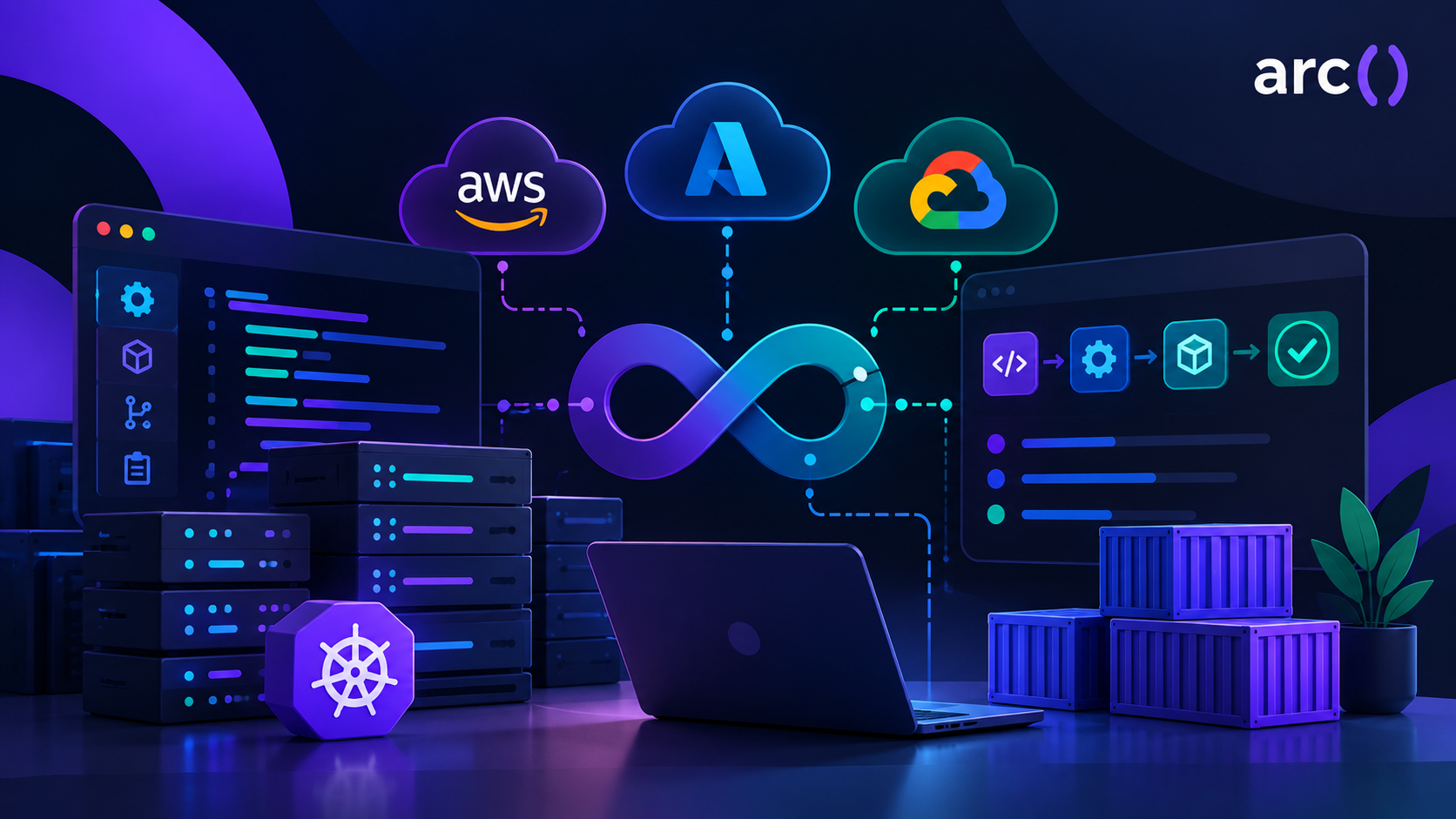

Most DevOps hires go wrong before the first interview. The mistake is treating a “DevOps engineer” as a single skill set you can swap in and out. AWS, Azure, and GCP each handle identity, networking, and failure differently. An engineer who knows AWS IAM policies cold can still lose weeks learning Azure role assignments and managed identities.
Picture how that plays out. You hire a strong AWS-focused engineer, and three weeks in they learn your billing system and data pipeline run on Azure. Now you are paying senior rates for ramp-up time.
So before you compare platforms, decide which of three engineers you need. A cloud-specific specialist owns the hard problems inside one provider, like an IAM redesign or an AWS migration. A generalist DevOps engineer builds pipelines, containers, and infrastructure as code across a small footprint. An SRE-leaning engineer owns uptime, alerting, and on-call once outages start costing you customers. The first section below lists the triggers for each, plus the adjacent titles (cloud engineer, platform engineer) worth searching.
Then judge every platform by two things. First, does its vetting test real infrastructure judgment (incident response, cost and reliability tradeoffs) or just tool names and certifications? Second, how fast can it put a qualified candidate in front of your team?
The best platforms to hire DevOps engineers in 2026 are vetted talent networks that screen for hands-on judgment and move fast; our top pick covers both freelance hires in as little as 72 hours and full-time hires in as little as 14 days, with $0 due until you hire.
Premium freelance networks and open marketplaces follow, each with a clear use case. By the end, you will know which kind of engineer you need, how to test them, how to protect production access, and what to budget.
In this guide:
- Do You Need an AWS, Azure, or GCP Specialist, a Generalist, or an SRE?
- Which Platform Fits Your DevOps Hiring Needs?
- Ranked Picks for Vetted DevOps Shortlists
- Ranked Picks for Specialist and Global Hiring
- Ranked Picks for Self-Directed Hiring
- How Do You Choose and Vet the Right DevOps Engineer?
- Frequently Asked Questions
Do You Need an AWS, Azure, or GCP Specialist, a Generalist, or an SRE?
Answer this before you open a single platform. It decides which vetting matters, what you should expect to pay, and which job title to search for.
Hire a cloud-specific specialist when most of your workload runs on one provider, and the hard problems live inside it. Triggers:
- You are migrating to or between clouds (for example, from on-prem to AWS).
- Your security or compliance audit depends on identity setup, like AWS IAM, Azure Entra ID, or GCP service accounts.
- Your cloud bill is large enough that provider-specific cost tools matter.
Adjacent title: cloud engineer. Many people with deep AWS, Azure, or GCP experience call themselves cloud engineers, so search both titles. A cloud engineer posting usually weighs architecture, networking, and identity more heavily than CI/CD.
Hire a generalist DevOps engineer when you need broad coverage more than deep cloud expertise. Triggers:
- You are early stage, with one or two services and no CI/CD yet.
- The job is mostly pipelines, containers, and infrastructure as code (Terraform, GitHub Actions, Docker).
- You run a small footprint across multiple providers.
Adjacent title: platform engineer. Once several product teams ship to the same infrastructure, the job shifts to building internal tooling: shared CI/CD templates, a self-service deploy path, and reusable infrastructure modules. If your pain is five teams each maintaining their own pipeline, you are hiring a platform engineer.
Hire an SRE-leaning engineer when reliability is now the main problem. Triggers:
- Customers notice outages, and you have uptime commitments in contracts.
- You need service level objectives, alerting that people trust, and a real on-call rotation.
- Incidents keep repeating because nobody owns the follow-up.
Write the choice into your job post. “DevOps engineer, AWS, EKS and IAM depth” pulls a very different pool than “DevOps engineer.” If you still can’t pick a title, describe the work instead: “Own Terraform and GitHub Actions for our six services” tells a candidate more than any title.
Which Platform Fits Your DevOps Hiring Needs?
Pick a vetted network when you need someone trustworthy with production access soon. Pick an open marketplace when the work is small, well scoped, and low risk.
A simple split helps:
- Vetted networks (Arc, Toptal, Turing, Lemon.io, Gun.io, Andela): the platform screens candidates before you see them.
- Self-directed channels (Braintrust, Upwork, Wellfound): you do most of the screening yourself.
If you’re hiring application engineers alongside DevOps, our guide to the best platforms to hire Python developers in 2026 compares many of the same networks on vetting and price.
How Were the Platforms Ranked?
The ranking weighs documented features and published terms. We did not run test hires on each platform. Each one was scored on five criteria:
- Vetting depth. Does screening include a live technical interview or pair programming, or only a quiz and a profile review?
- Speed to a real candidate. How many days from posting to a shortlist can you interview?
- Pricing clarity. Are rates or fees published, or only shared after a sales call?
- Hiring models. Freelance, full-time, or both.
- Protection if it goes wrong. Trial periods, replacement terms, and payment handling.
Platforms that support both freelance and full-time hiring ranked higher. Many teams start with a contractor for a migration and then want a permanent owner for the platform.
Comparison Table: Hiring Model, Vetting, Pricing, and Replacement Terms
| Platform | Hiring model | Vetting | Pricing | Trial / replacement terms |
| Arc | Freelance and full-time | Profile screening, behavioral interview, technical interview, or pair programming; top 2% match rate | Freelance ~$60 to $100+/hr for DevOps; full-time is 20% of the hire’s annual salary, paid per hire | $0 until you hire; risk-free trial of up to two weeks on freelance hires; replacement terms aren’t published, so confirm them with your recruiter |
| Toptal | Freelance, contract | Multi-stage screening; accepts roughly the top 3% | Fixed hourly or weekly price quoted per engagement; no recruiting fee | Trial of up to two weeks, not billed if you aren’t satisfied; up to three candidates per position |
| Turing | Remote contract and full-time | Platform-run technical screening | Quote-based | Check current contract terms |
| Lemon.io | Freelance | Platform-run screening and matching | Quote-based hourly | Check current contract terms |
| Gun.io | Freelance and full-time | Technology and delivery-risk review; verified delivery history required; acceptance rate not published | Quote-based | Check current contract terms |
| Andela | Distributed teams | Platform-run technical screening | Quote-based | Check current contract terms |
| Braintrust | Freelance marketplace | Network screening; you run interviews | Talent-set rates plus a flat 15% client fee | Set in your contract |
| Upwork | Open marketplace | You screen; public work history and reviews | Freelancer-set rates plus fees | Milestone escrow for fixed-price work |
| Wellfound | Startup job board | You screen everything | Posting-based | None; direct employment |
Ranked Picks for Vetted DevOps Shortlists
These three platforms do the heavy screening before a candidate reaches you. They cost more per hour than an open marketplace, but you spend far fewer hours on bad interviews.
Arc: Freelance and Full-Time Remote Hiring
Arc ranks first because it handles both hiring models through one process and publishes its numbers. You can hire a freelance DevOps engineer in as little as 72 hours or a full-time engineer in as little as 14 days.
Vetting: Candidates go through profile screening, a behavioral interview, and a technical interview or pair programming session, part of the four-step process Arc uses to admit the top 2% of applicants to its network. The platform also screens for English fluency. Your shortlist comes from that top 2% match rate across 450,000+ developers in 190 countries.
Pricing: DevOps freelancers run about $60 to $100+ per hour. Full-time hires are pay-per-hire at 20% of the hire’s annual salary, and you don’t pay until you hire. Hiring globally can save up to 58% versus local hiring.
Protection: Freelance hires start with a risk-free trial period of up to two weeks. Arc doesn’t publish replacement terms for freelance or full-time hires, so ask your recruiter what happens if a hire leaves or doesn’t work out, and get the answer in your contract.
Best for: Teams that want a contractor now and a full-time owner later, with a recruiter helping on both. Arc also handles freelancer payments and compliant global hires through trusted EOR partners.
Toptal: Freelance Specialists
Toptal is a legitimate premium choice when you need a proven senior specialist and are willing to pay for one. It accepts roughly the top 3% of applicants through a multi-stage screening process.
Pricing: Toptal quotes a fixed hourly or weekly price for each engagement and charges no recruiting fee. It doesn’t publish rate ranges, so expect senior-level pricing and ask for a quote early.
Protection: Toptal starts each engagement with a trial period of up to two weeks, and you aren’t billed if you aren’t completely satisfied. You can trial up to three people for the same position. That trial is useful for DevOps work, since you can watch how an engineer handles your real environment before committing.
Best for: Short, high-stakes projects like a Kubernetes migration or a cloud security review, where a senior freelancer’s hourly rate is worth it.
Turing: Remote Engineering Talent
Turing matches companies with remote engineers after its own technical screening. It supports contract and full-time remote work.
Pricing is quote-based, so you will get numbers after you share your role. Ask how its screening covers cloud-specific skills. A general coding test tells you little about whether someone can debug a broken Terraform state file.
Best for: Companies building larger remote engineering teams where DevOps is one of several roles.
Ranked Picks for Specialist and Global Hiring
These platforms fit narrower needs. Each one screens candidates, so you are not starting from zero.
Lemon.io: Freelance Developer Matching
Lemon.io matches startups with pre-screened freelance developers. It is a solid secondary option to Arc and Toptal when you want a freelancer quickly, and your needs are clear.
Its network leans toward product developers. Before you commit, confirm the matched candidate has run production infrastructure on your cloud, not just deployed apps to it. Rates are quoted per engagement.
Gun.io: Developer Recruiting Support
Gun.io says it starts each engagement with a technology review and delivery-risk assessment, and only places engineers with a verified history of delivery on its platform. It doesn’t publish an acceptance rate or a DevOps-specific vetting breakdown, so ask directly whether your candidate’s interview covered infrastructure work or just general coding.
Pricing is quote-based. Ask the recruiter for the exact screening steps for DevOps candidates and whether they include a hands-on infrastructure exercise.
Andela: Distributed Engineering Teams
Andela says its network includes more than 150,000 senior technologists across 135 countries (as of July 2026), with a strong base in Africa and Latin America. It suits companies that want several engineers at once, often across time zones, and since Andela doesn’t publish a DevOps-specific vetting breakdown, ask directly how it screens infrastructure skills versus general backend engineering.
That time-zone spread helps with on-call coverage. Before you sign, check how many hours each engineer overlaps with your core team.
Ranked Picks for Self-Directed Hiring
These channels give you the widest reach and the most control. You also carry all the screening risk, so use the tests in the next section.
Braintrust: Talent Marketplace Hiring
Braintrust is a talent marketplace where freelancers set their rates and clients pay a flat 15% fee on top. On a $90-per-hour engineer, that makes your cost about $103.50 per hour. You post the role, review applicants, and run the interviews yourself.
It works best when you already have a senior engineer who can judge DevOps candidates. Without one, you are guessing.
Upwork: Freelance Project Hiring
Upwork makes sense for small, well-scoped jobs: setting up a GitHub Actions pipeline, writing Terraform for one service, or cleaning up a Dockerfile. Fixed-price milestones hold payment in escrow until you approve the work.
Avoid giving an Upwork hire broad production access on day one. Use a scoped IAM role limited to the resources the task touches.
Self-screening tip: Ask every applicant about one specific past incident. What broke? How did they find it? What did they change so it would not happen again? Strong engineers answer with details: “Our RDS instance hit max connections during a deploy. We caught it from a CloudWatch alarm on connection count, then added connection pooling with PgBouncer.” Weak answers stay vague or blame someone else.
Wellfound: Startup Job Listings
Wellfound is a job board built for startups hiring full-time staff. You post the role, candidates apply, and you run the whole process.
It reaches people who want startup equity and early-stage work. Expect a high applicant count and a lot of screening work on your side.
How Do You Choose and Vet the Right DevOps Engineer?
Once you know which engineer you need (see the framework at the top of this guide), test for judgment with work that mirrors your real environment. Certifications prove someone studied, but they do not prove someone can stay calm at 2 a.m. with a failing deploy.
How Can You Test Infrastructure Judgment Before Hiring?
Use three tests. Together they show how a candidate thinks, not what they memorized.
1. A paid take-home built on a real tradeoff. Pay for two to four hours of work. Pick one scenario:
- Cost spike diagnosis: “Our cloud bill jumped 40% last month. Here is a redacted cost report and our architecture diagram. What would you check first, and what would you change?”
- Rollback planning: “A database schema change ships Friday. Write the rollback plan, including what you do if the migration half-completes.”
Look for ordered thinking, stated assumptions, and a plan that names the risk of each step.
2. A specific past-incident question. Use the same format as the Upwork tip above: what broke, how they found it, what they changed. Follow up with “What would you do differently now?” Good engineers admit mistakes plainly.
3. An access-control review scenario. Show a short, flawed IAM policy or role setup. Include one wildcard permission and one long-lived access key. Ask what they would fix and in what order. A strong candidate spots the wildcard, suggests least privilege, and asks who depends on the key before rotating it.
Run these tests even on vetted platforms. A platform’s technical interview confirms skill, while your test confirms fit with your stack. If you’re running any of this remotely, which most DevOps hires are, set up your remote technical interview with a stable connection and shared code access before the call, not during it.
If you would like a shortlist where profile screening, a behavioral interview, and a technical interview or pair programming are already done, you can view vetted DevOps engineers on Arc and meet freelance candidates in as little as 72 hours, paying $0 until you hire.
How Much Does a DevOps Engineer Cost in 2026?
Your cost depends on hiring model, location, and specialization. Here are Arc’s published DevOps figures, from its DevOps salary guide and its page to hire DevOps engineers:
| Hiring model | Typical cost |
| Freelance DevOps engineer | ~$60 to $100+ per hour |
| US full-time, entry-level | ~$110,000 per year |
| US full-time, average | ~$130,000 per year |
| US full-time, experienced | ~$165,000 per year |
| Global remote full-time, average | ~$85,759 per year |
| Arc full-time placement fee | 20% of annual salary, paid per hire |
Premium freelance networks like Toptal sit higher, since you’re paying for senior specialists and deeper screening. Open marketplaces span a wide range, and low rates often mean you spend more time screening.
For public benchmarks, note that the Bureau of Labor Statistics has no “DevOps engineer” category. Software Developers is the closest available proxy for CI/CD and infrastructure-as-code roles. Network and Computer Systems Administrators is closer for ops-heavy roles. Treat both as proxies, not exact matches.
Specialists cost more than generalists. Deep AWS, Azure, or GCP security experience and SRE skills both push rates toward the top of each range.
On timing, plan for these windows:
- Freelance via a vetted network: as little as 72 hours on Arc.
- Full-time via a vetted network: as little as 14 days on Arc.
- Job boards and open marketplaces: set by how fast you can screen applicants yourself.
Location moves both cost and coverage. Arc puts Latin American and Eastern European developers at around $75 to $95 per hour, and those regions give you working-hour overlap with US or European teams.
What Should You Check in Trial and Replacement Policies?
Read the exact words of any guarantee before you sign. “Replacement” can mean a free new match, a refund, or just a new shortlist.
Ask each platform these questions:
- Trial: How long is it, and what do you pay if you end it? Arc offers a risk-free trial of up to two weeks on freelance hires, and Toptal doesn’t bill you for a trial of up to two weeks if you aren’t satisfied.
- Replacement: Is a new candidate free? Does the clock restart? Does it cover a full-time hire who leaves in month two? Arc doesn’t publish replacement terms, so get your recruiter’s answer in writing.
- Payments: Who handles invoices and cross-border payments? Arc manages secure freelancer payments and compliant global hires through trusted EOR partners.
Then check the work itself:
- On-call coverage: Write down the expected hours, response time, and paging tool (PagerDuty, Opsgenie) before the offer. A freelancer in a far time zone can cover your night, but only if the contract says so.
- Incident response: Ask the candidate to walk through how they would run your next incident, from first alert to written follow-up.
- Runbook handoff: Require runbooks for every service they touch: how to deploy, roll back, rotate secrets, and restore from backup. Make handoff docs a paid deliverable in the final week of any contract.
Replacement policies cover the person. They do not cover missing documentation. If a contractor leaves without runbooks, a new match starts blind.
How Do You Protect Production Access and Stay Compliant?
A DevOps hire gets the keys to almost everything: cloud accounts, CI secrets, the paging tool, and often customer data. Settle four things before day one.
Background checks. Ask each platform exactly what it checks and when. Profile screening and work-history review don’t include a criminal or employment background check unless the platform says so. If your customers or auditors require one, make it a written condition of the engagement, get the candidate’s consent, and agree up front on who pays.
SOC 2 and NDA posture. If your company holds a SOC 2 report, your auditor will ask how you screen contractors with production access, grant access, and remove it. Ask each platform which documents it can provide: a signed NDA, an IP assignment clause, and its own security attestation if it stores your data.
Toptal’s FAQ, for example, says its contracts make work created by its experts the client’s property, and Arc’s FAQ addresses IP and confidentiality protection. Ask for the exact contract language either way, and put your own NDA and IP assignment in place.
Credential offboarding. Plan the exit on day one. Give the hire SSO-backed accounts and short-lived credentials instead of shared logins or personal access keys; AWS recommends temporary credentials over long-term access keys for both people and workloads. Keep a list of every system the hire touches, then on their last day:
- Disable their identity provider account, which cuts off every SSO app at once.
- Remove them from your cloud organization, GitHub organization, and CI/CD system.
- Rotate any secret they could read, including deploy keys, API tokens, and database passwords.
- Take them off PagerDuty or Opsgenie schedules and reassign their on-call shifts.
- Check last-accessed data in your cloud console for credentials you missed.
Misclassification and EOR. A freelancer you manage like an employee (set hours, ongoing on-call, no end date) may legally be one. The IRS weighs behavioral control, financial control, and the type of relationship, and the Department of Labor treats misclassification as a wage-and-hour problem.
If a contract has turned into a permanent on-call job, convert it to a full-time role. For full-time hires in another country, an employer of record (EOR) employs the engineer locally and handles payroll, taxes, and benefits. Arc places full-time hires across borders through trusted EOR partners, including Deel and Remote.
Frequently Asked Questions
What Is the Difference Between a DevOps Engineer and a Site Reliability Engineer?
A DevOps engineer typically focuses on building and automating the pipeline: CI/CD, infrastructure as code, containerization, and reliably moving code from commit to production. A site reliability engineer typically focuses on keeping systems running once they’re live: on-call rotations, service level objectives, alerting, and incident response.
The two roles overlap heavily in practice, and many job postings labeled “DevOps” are really asking for SRE work, so check whether the role is weighted toward building pipelines or toward owning uptime before you write the job post.
Should I Hire a Cloud-Specific Specialist or a Generalist DevOps Engineer?
Hire a cloud-specific specialist (AWS, Azure, or GCP) when most of your workload runs on one provider, you’re migrating to or between clouds, or your security and compliance audit depends on that provider’s identity model.
Hire a generalist when you’re early stage with one or two services and no CI/CD yet, or your work is mostly pipelines, containers, and infrastructure as code that doesn’t lean hard on one provider’s specific services. A specialist closes provider-specific gaps faster; a generalist gives you broader coverage per hire.
Specialists often use the title cloud engineer, and generalists who build shared tooling for several product teams often use platform engineer, so search for both.
How Much Does It Cost to Hire a DevOps Engineer in 2026?
Freelance DevOps engineers on vetted networks like Arc run about $60 to $100+ per hour. Full-time US salaries average around $130,000 a year, with entry-level closer to $110,000 and experienced engineers closer to $165,000, and global remote full-time averages run lower, around $85,759 a year.
Specialists with deep cloud security or SRE experience push toward the top of these ranges. No official government wage category covers “DevOps engineer” specifically, so treat the Bureau of Labor Statistics’ Software Developers and Network and Computer Systems Administrators categories as the closest available proxies, not exact matches.
What Happens if a DevOps Hire’s Infrastructure Judgment Turns Out Weaker Than Expected?
That depends entirely on what you got in writing before you signed. Ask each platform how long you have to flag a bad fit, what “replacement” actually means (a free new match, a refund, or just a new shortlist), and whether a full-time hire who doesn’t work out in month two is covered at all.
Also confirm handoff separately from replacement; a replacement covers the person, not missing documentation, so require runbooks as a paid deliverable so a new hire isn’t starting blind if the first one doesn’t work out.
Do I Need a DevOps Engineer or Can a Backend Developer Handle Infrastructure?
A backend developer can often handle light infrastructure work for a small, single-service app, deploying to a managed platform, writing basic CI, that kind of thing. You need a dedicated DevOps engineer once you have multiple services, real infrastructure-as-code needs, security or compliance requirements tied to your cloud identity setup, or reliability expectations (uptime commitments, an on-call rotation) that need someone whose main job is the infrastructure itself, not a developer picking it up between feature work.
Choose the Platform That Fits Your Infrastructure and Hiring Timeline
Start by naming the engineer you need: a cloud specialist, a generalist, or an SRE. Then match the platform to your risk and timeline.
- Need both freelance and full-time options with vetting done: Arc, with freelance hires in as little as 72 hours and full-time in 14 days.
- Need a proven senior freelancer for a high-stakes project: Toptal, with its top-3% screening and pay-only-if-satisfied trial.
- Need a small, scoped task: Upwork, with milestone escrow and your own incident-question screening.
- Need full-time startup hires and can screen yourself: Wellfound.
On every platform, run the paid take-home, the past-incident question, and the access-control review. Put on-call terms and runbook handoff in writing before day one.
When you are ready to meet DevOps engineers vetted through behavioral and technical interviews, tell Arc your stack and cloud provider on its DevOps hiring page. You will see matched candidates from 450,000+ developers across 190 countries, and you pay nothing until you hire.