

Hiring React engineers in 2026 is no longer just about sourcing candidates, but about speed, specialization, and cost control. Teams using the wrong remote hiring platform often spend 6–12 weeks in hiring cycles, only to lose top candidates in under 10 days. If you’re trying to hire remote developers with AI frontend experience, the gap gets even wider.
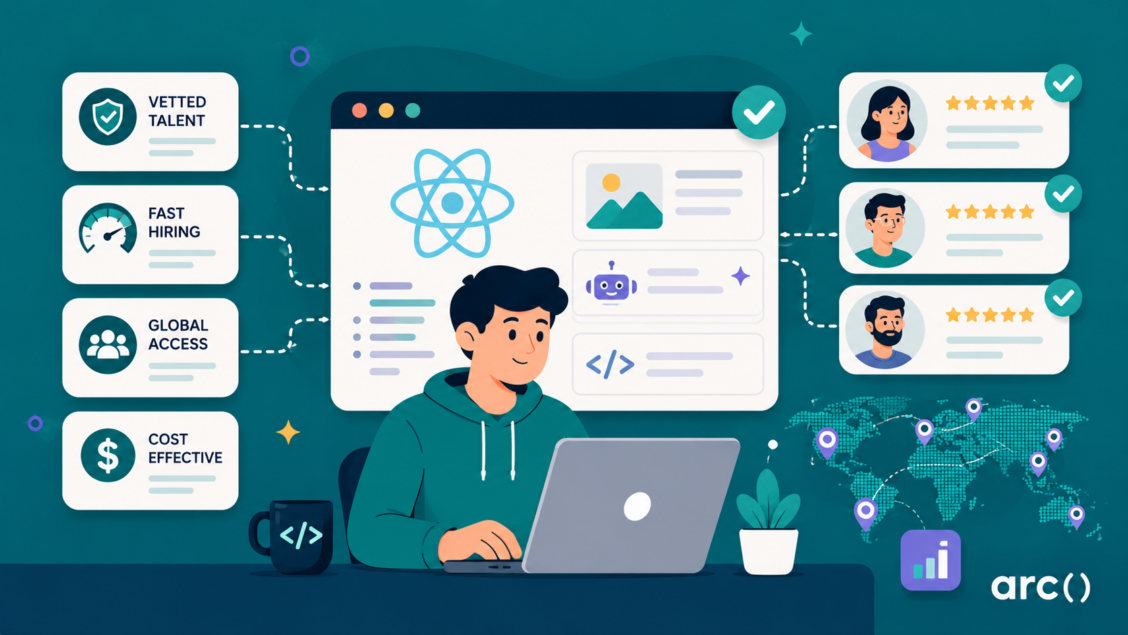
Arc helps companies close that gap by providing access to vetted remote talent across 190 countries, with hiring timelines as fast as ~72 hours for freelance roles and ~14 days for full-time hires. Instead of filtering through unqualified applicants, hiring managers start with developers already screened for modern React stacks, including Next.js and AI-integrated frontend workflows.
This guide breaks down the top platforms to hire React developers in 2026, including hiring timelines, pricing models, vetting quality, and technical assessment strategies. You’ll also see how AI is reshaping frontend hiring and how to choose the right platform based on your specific hiring needs.
Why React Developer Hiring Is More Competitive In 2026
The React hiring scene’s moving fast. Three big forces are changing how you find and win over good developers: more demand from AI projects, fewer experienced seniors, and traditional hiring just not keeping up.
AI-Powered Frontends Are Driving React Developer Demand
React has become the default for frontends that connect with AI services, LLMs, and real-time data. It powers millions of live websites worldwide, according to industry tracking data, and adoption continues to grow as companies add AI-powered features.
Everyone’s after the same developers now. If your product needs someone who can build responsive UIs that tap into AI APIs, you’re not alone—startups, mid-size companies, and big enterprises all want those folks.
Senior React Developers With Production Experience Are Hard to Hire
Mid-level devs are around, but senior React engineers with 5+ years in production are rare. These are the people who really get performance, scalable architecture, and complex state management.
The difference between a mid-level and a senior dev shows up in code quality and how fast they debug or spot architectural issues. A senior who’s shipped apps with Next.js or Remix will catch problems that less experienced hires just don’t see.
Traditional Hiring Pipelines Fail for React Developers in 2026
Posting on a job board, waiting weeks, screening resumes, then running interviews… It can drag on for 6 to 12 weeks. By then, the best candidates are long gone.
Top React developers are usually snapped up in under 10 days. If your process is slower, you’re mostly seeing people who didn’t land elsewhere. Speed really matters, and your choice of platform is one of the biggest ways to control it.
How to Evaluate Top React Developer Hiring Platforms
Choosing the right platform comes down to measurable stuff: how well they vet, how fast you can hire, what you’ll pay, and whether their dev pool matches your requirements. All of these shape your hiring outcome.
How Vetting Quality Affects React Developer Performance and Hiring Risk
How a platform screens developers makes all the difference. Some let anyone sign up, while others put candidates through multi-step technical tests: JavaScript, TypeScript, ES6, React hooks, Context API, state tools like Redux Toolkit or Zustand.
Good platforms test real skills: problem-solving, communication, and technical chops, not just quiz questions. Look for ones that assess React Query, GraphQL, REST API integration, and modern patterns. A well-vetted pool means fewer wasted interviews and quicker decisions.
If you need speed, curated networks and freelance sites get you working with a dev fast. Job boards cast the widest net but move the slowest.
React Developer Pricing Models Explained (Hourly vs Placement Fees)
Platforms usually go with one of three pricing models:
- Hourly rates: Pay per hour. Common on freelance and staff augmentation platforms. Rates run from $25/hour for junior offshore devs to $150+/hour for senior US-based folks.
- Placement fees: Pay a one-time fee, often 15–25% of first-year salary, when you hire full-time through the platform.
- Markup on developer rates: The platform charges you a rate that includes their cut. Typical in curated networks.
Each model has its own incentives. Hourly rates are flexible, while placement fees align interests for a good long-term match. Markups are simple but can hide what the dev actually gets paid.
How to Evaluate React Developer Seniority and Specialization
Platforms don’t all define “senior” the same way. One site’s “senior” might have three years’ experience, while another insists on 7+ years and architecture skills.
Ask how they define seniority. Look for platforms that verify experience with state management (Redux, Zustand), testing frameworks (Jest, React Testing Library), and routing (React Router).
Also, check if they have devs who specialize in performance: lazy loading, memoization, code splitting. Those things matter as your app grows.
Why Next.js and AI Integration Experience Matter When Hiring React Developers
React by itself isn’t enough anymore. Most serious React projects in 2026 use frameworks like Next.js or Remix for SSR, routing, and deployment.
Make sure the platform has developers with hands-on experience in these frameworks. If you’re working with AI, look for people who’ve actually built frontends that consume AI APIs and handle streaming responses.
Many platforms now tag devs by their framework skills, which makes filtering easier. A short trial period—maybe a week or two—can help you see if a developer’s claimed experience matches up in practice.
Top Platforms for Hiring React Developers: Pros and Cons by Platform Type
Each platform type fits a different scenario. The right one depends on your budget, how fast you need someone, and how much control you want.
- Curated React Hiring Platforms: Speed vs Control Tradeoffs
Pros:
- Pre-vetted for technical and communication skills
- Time-to-hire usually under a week
- Lower risk of a bad hire
Cons:
- Higher cost due to platform margins
- Smaller talent pool
- Less room to negotiate rates directly
They’re great if you need a strong dev fast and don’t mind paying a premium for less risk.
- Freelance Platforms: Cost Flexibility vs Hiring Risk for React Developers
Pros:
- Wide range of rates and availability
- Good for short-term or one-off projects
- You can check portfolios, ratings, and reviews
Cons:
- Vetting quality is all over the place
- You’re on the hook for evaluating candidates
- Communication and reliability can be hit or miss
These work best if you’ve got the time and skill to do your own screening.
- Developer Networks: Specialization vs Talent Availability
Pros:
- Devs are more likely to have deep React skills
- Regional networks offer better timezone overlap
- Smaller communities can mean higher average quality
Cons:
- Smaller pools can limit options
- Some networks have slow onboarding
- Pricing isn’t always clear up front
Staff augmentation firms usually fit here, offering dedicated devs who become part of your team.
- Recruitment Agencies: Full-Service Hiring vs Higher Costs
Pros:
- End-to-end hiring management
- Access to passive candidates
- Agencies handle paperwork
Cons:
- Placement fees of 15–25% of annual salary
- Less direct involvement in early screening
- Slower than curated platforms if you’re in a rush
Agencies make sense for senior or executive hires where a bad decision is really expensive.
Top React Developer Hiring Platforms Comparison (2026)
| Platform Type | Time to Hire | Cost Range | Vetting Quality | Best For | Key Tradeoff |
| Curated Talent Networks | 3–7 days | $$$ | High (pre-vetted) | Hiring senior React developers fast | Higher cost, smaller pool |
| Freelance Marketplaces | 1–5 days | $–$$$ | Low–Variable | Short-term projects, flexible hiring | Requires manual screening |
| Developer Networks (Specialized) | 5–14 days | $$–$$$ | Medium–High | React specialists, regional hiring | Smaller talent pool |
| Staff Augmentation Firms | 1–3 weeks | $$–$$$ | Medium–High | Scaling teams quickly | Less control over individual selection |
| Recruitment Agencies | 3–6 weeks | $$$$ (15–25% fee) | High | Full-time senior or leadership roles | Slower, expensive |
| Job Boards | 4–12 weeks | $–$$ | Low | Full-time hiring with large applicant pools | Slow + high screening effort |
How Much Does It Cost to Hire React Developers in 2026? (Rates + Salaries)
React developer costs in 2026 depend heavily on where and how you hire, with rates, salaries, and platform fees shaping your total investment.
React Developer Hourly Rates by Experience Level (2026)
| Experience Level | US Rate (Hourly) | Eastern Europe (Hourly) | Latin America (Hourly) |
| Junior (1–2 years) | $40–$70 | $25–$40 | $20–$40 |
| Mid-level (3–5 years) | $70–$120 | $40–$65 | $35–$60 |
| Senior (5+ years) | $120–$150+ | $65–$90 | $50–$80 |
These are typical across major platforms. Curated networks tend to be higher, while open marketplaces offer more range.
Full-Time React Developer Salaries in 2026
- Junior: $60,000–$80,000/year
- Mid-level: $80,000–$120,000/year
- Senior: $120,000–$180,000/year
Add 20–30% for benefits, taxes, and equipment. If you’re hiring through a platform with a placement fee, tack on another 15–25% of first-year salary.
Global React Developer Rates: Cost Differences by Region
Hiring globally can cut costs by 40–60% without losing quality. Eastern European devs, especially from Ukraine and Poland, have great React reputations and 4–6 hours of overlap with US East Coast teams.
Latin American devs offer even better timezone alignment for US companies, with most of the workday overlapping. The Philippines and South Asia have the lowest rates, but usually only 1–2 productive hours overlap with US teams.
Timezone overlap matters more than people realize. If you can’t reach your dev during work hours, delays pile up and slow the whole team.
React Hiring Cost vs Quality Tradeoffs
The cheapest option rarely gives the best value. Hiring a $30/hour dev who takes twice as long or writes code that needs rework can end up costing more than paying $80/hour for someone who gets it right the first time.
When comparing platforms, look at total engagement cost, not just hourly rate. Consider your time spent interviewing, the risk of a bad hire, and the ramp-up before a dev is productive.
Best React Technical Assessment Platforms in 2026 (How to Evaluate Skills)
Why Technical Assessments Reduce React Hiring Risk
Resumes and portfolios don’t tell the whole story. A technical assessment shows if a candidate can actually write clean React components, manage state, and debug real issues.
Good assessments cover testing with Jest and React Testing Library, component design, and practical debugging. Some platforms use Storybook to evaluate whether devs can build and document reusable components.
Without structured vetting, you’re basically guessing if a candidate can do the job. Companies that use structured technical assessments typically see better hiring outcomes because they validate real-world skills instead of relying on resumes alone.
When to Use External React Technical Assessment Platforms
External tools like HackerEarth and CodeSignal are commonly used when companies need greater control over React developer evaluations. They’re especially useful when hiring from job boards, inbound applicants, or referrals, where candidate quality varies widely.
This approach is standard for mid-size and large teams that want consistent evaluation across candidates. Instead of relying on resumes or platform vetting, hiring managers use structured tests to measure real skills like component design, state management, and API integration.
You’ll typically see external assessments used in these scenarios:
- When sourcing candidates from job boards with no built-in vetting
- When multiple hiring managers need a standardized evaluation process
- When hiring for roles requiring specific React expertise (e.g., Next.js, performance optimization, AI-driven frontends)
When Built-In Vetting Is Enough for Hiring React Developers
Curated platforms run their own multi-step vetting. If you’re using one, adding your own external test might just slow things down and put off good candidates.
Built-in vetting is usually enough when:
- The platform has a solid, documented screening process
- You’re hiring for a standard React frontend role
- You’re on a tight timeline, and extra steps would slow hiring
Still, even with strong platform vetting, it’s smart to do a quick pair programming session.
Built-In vs External React Technical Assessments: Which to Use?
Choosing between built-in vetting and external assessments comes down to how much control you need versus how fast you need to hire. Most teams don’t need both at full depth, but they do need clarity on when each approach adds value.
Speed vs Depth in React Candidate Evaluation
Built-in platform vetting prioritizes speed by pre-screening candidates before you ever review profiles. This removes the need for initial filtering and lets you focus on final-stage evaluation, which is ideal when hiring timelines are tight.
External assessments give you deeper insight into how a candidate handles your specific stack and workflows. You can test for things like Next.js data fetching, state management patterns, or API integration, but each additional step adds time and increases the risk of losing strong candidates.
Use this as a rule of thumb:
- Use built-in vetting when you need to hire within 3–7 days and trust the platform’s screening process
- Use external assessments when the role requires project-specific validation (e.g., performance optimization or AI integrations)
How Technical Assessments Impact Time-to-Hire and Candidate Drop-Off
Every additional step in your hiring process reduces your candidate pool. Senior React developers often manage multiple offers, and long or complex processes lead to drop-off before you reach the offer stage.
The highest-performing hiring pipelines typically follow this structure:
- Profile review within 24–48 hours
- One technical evaluation step (max 60–90 minutes)
- Final decision within 5–7 days total
If your process includes multiple assessments, take-home projects, and several interview rounds, you’re likely filtering out top candidates rather than improving quality.
How to Combine Vetting and Assessments for Better React Hiring Outcomes
The most effective approach is to combine platform vetting with a single targeted evaluation step. This gives you both speed and confidence without overloading the candidate.
A strong, balanced evaluation process looks like this:
- Start with pre-vetted candidates from the platform
- Run a 60–90 minute live session or code review
- Focus on real tasks like component design, debugging, or API integration
This approach validates practical skills while keeping the process fast enough to secure top candidates before competitors.
How to Choose the Right React Developer Hiring Platform Based on Your Needs
The right platform depends less on features and more on your hiring context. Speed, team size, budget, and project complexity all shape which option will actually work.
- Hiring One React Developer vs Building a Team
If you’re hiring a single developer, speed and flexibility matter most. Curated platforms and freelance marketplaces let you evaluate candidates individually and start quickly.
If you’re building a team, coordination becomes the bottleneck. Staff augmentation firms and agencies can provide multiple developers at once, often with shared workflows and faster onboarding across the group.
- Urgent vs Long-Term React Hiring
Urgent hiring requires immediate access to developers. Curated platforms and freelance marketplaces are designed for this, often delivering candidates within days.
Long-term hiring allows for broader sourcing and deeper evaluation. Job boards and traditional pipelines can work here, but only if you can tolerate slower timelines and increased screening effort.
- Budget vs Quality When Hiring React Developers
Lower-cost hiring options shift the burden of evaluation onto your team. You’ll spend more time reviewing candidates, running assessments, and managing risk.
Higher-cost platforms with strong vetting reduce that overhead. You pay more upfront, but save time on screening and lower the risk of rework, missed deadlines, or poor code quality.
- AI-Heavy vs Standard React Projects
AI-driven frontend work requires a narrower skill set. Developers need experience with streaming data, API integrations, and responsive UI patterns for real-time systems.
Standard React applications—forms, dashboards, and CRUD interfaces—have a much larger talent pool. This gives you more flexibility in platform choice and pricing, since fewer specialized skills are required.
Common Mistakes When Hiring React Developers in 2026
Even experienced hiring managers fall into predictable traps. Most of them come down to misjudging cost, speed, or evaluation rigor.
Prioritizing Cost Over Skill Leads to Bad React Hires
Lower hourly rates often hide higher total costs. Developers who require more oversight or produce lower-quality code increase timelines, introduce bugs, and create long-term maintenance issues.
A higher-rate developer who delivers clean, production-ready code typically reduces total project cost by minimizing rework and accelerating delivery.
Skipping Technical Evaluation
Resumes and portfolios don’t reliably reflect real-world ability. Without a structured evaluation step, hiring decisions rely on incomplete or misleading signals.
Even a short technical review—live coding, code walkthrough, or targeted exercise—provides significantly more confidence in a candidate’s ability to perform.
Ignoring Modern React Trends (AI, Next.js)
React development in 2026 includes frameworks like Next.js, server components, and increasing integration with AI systems. Hiring based on outdated criteria leads to mismatched skills and weaker technical decisions.
Candidates who understand modern tooling and architecture will build more scalable, maintainable applications.
Using Slow Hiring Processes
Top React developers rarely stay available for long. If your hiring process takes more than one to two weeks, you’re competing for candidates who already have other offers. Speed is not just a convenience, but a competitive advantage in securing high-quality talent.
React Developer Hiring Checklist (2026)
Use this checklist to hire React developers faster while maintaining quality and reducing risk.
Define role requirements:
- Identify required skills (e.g., Next.js, TypeScript, API integration, AI workflows)
- Clarify seniority level (mid-level vs senior with 5+ years production experience)
- Decide hiring model (freelance, full-time, or team scaling)
Choose the right hiring platform:
- Use curated platforms for fast, pre-vetted candidates (3–7 days)
- Use freelance marketplaces for flexibility and cost control
- Use agencies or job boards for long-term, full-time roles
Shortlist candidates efficiently:
- Review no more than 3–5 qualified candidates
- Prioritize developers with proven React production experience
- Look for experience with modern stacks (Next.js, testing, performance optimization)
Run a focused technical evaluation:
- Limit to one assessment step (60–90 minutes max)
- Test real-world skills (component design, debugging, API integration)
- Avoid long take-home assignments that increase drop-off
Optimize your hiring timeline:
- Respond to candidates within 24–48 hours
- Complete interviews and evaluation within 5–7 days total
- Move quickly to offer once a candidate meets the requirements
Validate fit before hiring:
- Conduct a short live coding or pair programming session
- Review past projects or GitHub code for quality
- Confirm communication skills and timezone alignment
The Fastest Path to Hiring High-Quality React Developers
Hiring React developers in 2026 is less about finding candidates and more about controlling speed, risk, and evaluation quality. Teams that rely on slow pipelines or unstructured screening consistently lose top candidates, while those using focused, efficient processes secure stronger hires faster.
Arc enables this by combining fast access to vetted remote talent with a streamlined hiring process, so you can skip initial screening and move directly to evaluation. Instead of managing large candidate pools, you can work with pre-qualified developers who already meet modern React and AI frontend requirements.
If you want to reduce time-to-hire without compromising quality, view matched React developers within 72 hours and make faster, more confident hiring decisions.
Frequently Asked Questions
What are the top platforms to hire React developers in 2026?
The top platforms to hire React developers in 2026 include curated talent networks, freelance marketplaces, developer networks, and recruitment agencies. Curated platforms typically deliver pre-vetted candidates within 3–7 days, while freelance platforms offer faster access but require more manual screening. The right choice depends on whether you prioritize speed, cost control, or long-term hiring.
How much does it cost to hire a React developer in 2026?
React developer rates in 2026 range from $40–$70/hour for junior developers to $120–$150+/hour for senior developers in the US. Global hiring reduces costs, with rates in Eastern Europe and Latin America typically between $25–$90/hour, depending on experience. Full-time salaries range from $60,000 to $180,000+, plus hiring fees if using a platform.
How long does it take to hire a React developer through a platform?
Hiring timelines vary by platform type. Curated platforms typically present candidates in 3–7 days, freelance marketplaces in 1–5 days, and staff augmentation firms within 1–3 weeks. Traditional job boards take the longest, often 4–12 weeks, due to sourcing and screening delays.
What are the best React technical assessment platforms in 2026?
The best React technical assessment platforms in 2026 are those that evaluate real-world skills like component design, state management, and API integration. External tools are useful when hiring from job boards or referrals, while curated platforms often include built-in vetting that eliminates the need for additional assessments.
Should I use built-in vetting or external technical assessments?
Built-in vetting is sufficient when using platforms with strong pre-screening processes, especially for standard React roles. External assessments are better when hiring from unvetted sources or when you need consistent evaluation across candidates. Most teams combine platform vetting with one focused technical step to balance speed and accuracy.
What skills should I look for when hiring React developers in 2026?
You should prioritize experience with React hooks, TypeScript, and modern frameworks like Next.js or Remix. For AI-driven projects, developers should also have experience integrating APIs, handling streaming data, and building responsive UIs for real-time interactions. Testing skills with tools like Jest and React Testing Library are also important.
How can I hire React developers faster without sacrificing quality?
Use platforms with pre-vetted developers to eliminate initial screening and reduce hiring time to under one week. Limit your process to one technical evaluation step, keep interviews under 60–90 minutes, and make decisions quickly after evaluation. Start with pre-vetted candidates to reduce screening time and accelerate hiring decisions.