

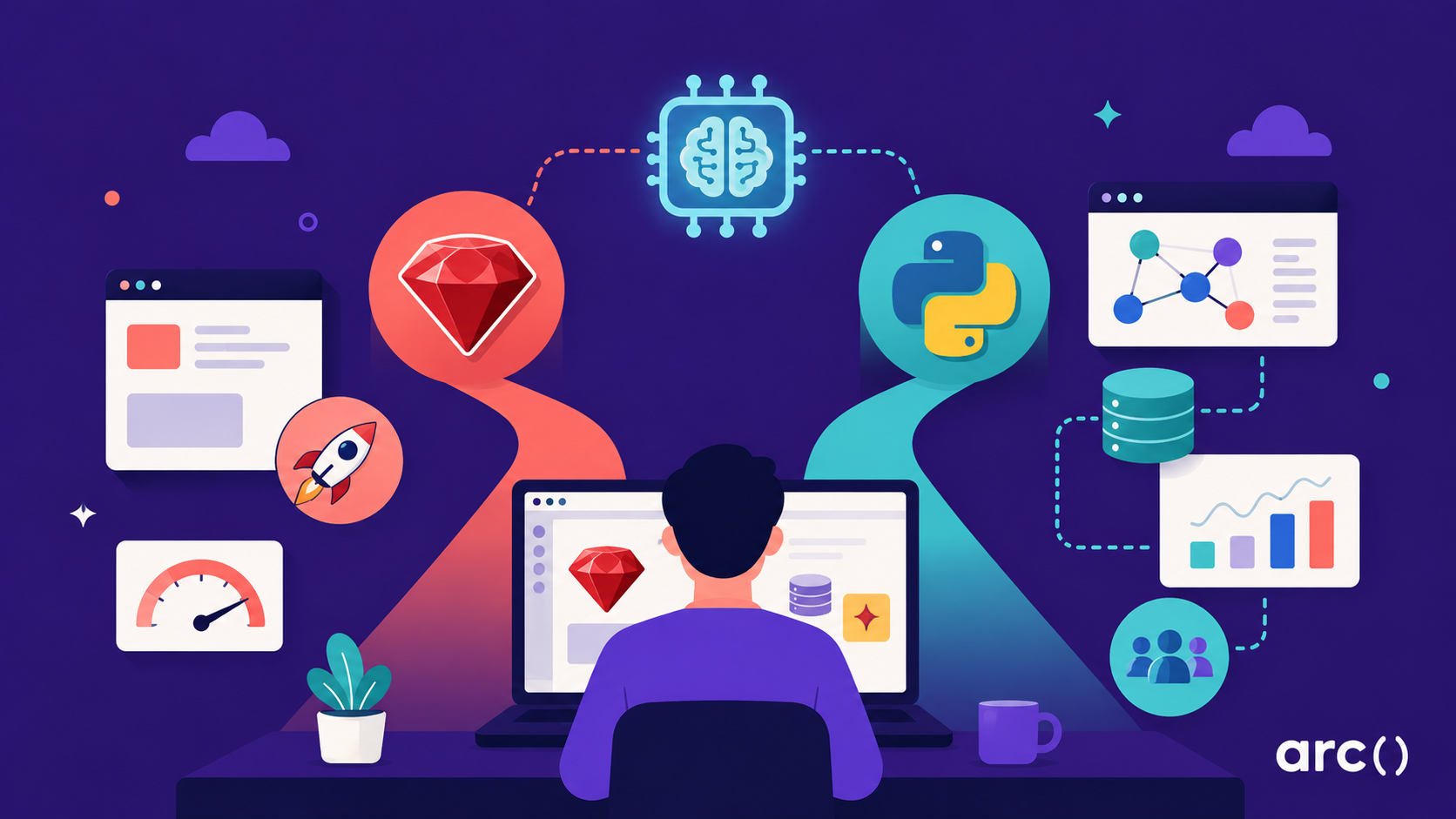

Choosing between Ruby on Rails vs Django isn’t just a technical preference; it directly affects how fast you can hire, how easily you can integrate AI features, and how your system performs under real-world load. Many teams underestimate how this decision compounds over time, especially when scaling beyond an MVP or adding data-heavy functionality.
Arc helps companies navigate this exact decision by connecting them with vetted remote talent across 190 countries, enabling teams to hire faster while aligning skills with long-term product needs. Whether you need backend engineers or AI specialists, the ability to access the right talent early reduces rework and avoids costly architectural mismatches.
This guide breaks down the Django vs. Ruby on Rails decision in terms of performance, AI workloads, hiring timelines, and real-world use cases. You’ll see how each framework impacts speed to market, developer costs, and your ability to build AI-driven features without adding unnecessary complexity.
Ruby on Rails vs Django: Core Architecture and Development Philosophy
Convention vs Explicit Structure in Django vs Rails
Rails is built around convention over configuration. It reduces early decisions by enforcing a standard way to structure applications, which helps teams ship quickly and maintain consistency across features.
Django follows an explicit approach where developers define more up front. This adds some initial overhead, but it makes large systems easier to understand, debug, and extend, especially when multiple teams contribute to the same codebase.
Ruby on Rails vs Python Django: Ecosystem and AI Impact
Choosing between Ruby on Rails and Python Django is ultimately a decision about ecosystems, not just frameworks. Your choice determines which libraries, tools, and hiring pools you can access.
Ruby on Rails vs Python Django: Ecosystem and AI Capabilities Compared
| Factor | Ruby (Rails) | Python (Django) |
| AI/ML libraries | Limited | Extensive (PyTorch, TensorFlow, scikit-learn) |
| Data processing | Minimal | Strong (Pandas, NumPy) |
| AI hiring pool | Smaller | Significantly larger |
| ML pipeline support | External services | Native ecosystem |
Python allows your web and AI teams to operate in the same environment. This reduces duplication, shortens development cycles, and simplifies maintenance as your product grows.
Ruby on Rails vs Django Performance in Production Systems
Backend Performance and Request Throughput
Django generally handles more requests per second in controlled benchmarks, often outperforming Rails by 15–25%. However, once real-world factors like database queries, caching, and third-party APIs are introduced, the difference becomes much less noticeable.
For most products under moderate load, Ruby on Rails vs Django performance is not a bottleneck. The real performance gains come from architecture decisions such as caching strategies and database optimization.
AI Workloads and Inference Performance
Performance differences become more meaningful when AI workloads are involved. These include real-time inference, background model processing, and data-heavy computations.
Django vs Rails: AI Performance and Processing Comparison
| Workload Type | Rails | Django |
| Standard API requests | Strong | Strong |
| Real-time AI inference | Requires external service | Can run natively |
| Batch AI processing | Indirect setup | Native with Python tools |
| Vector search / embeddings | API-based | Integrated ecosystem |
Django reduces system latency by keeping AI logic closer to the application layer. Rails introduces additional network overhead by relying on external AI services.
Scalability: Django vs Rails for Modern Architectures
Scaling Web and AI Systems Together
Both frameworks scale well for traditional web applications. The challenge appears when you introduce AI workloads, which require additional infrastructure like queues, model servers, and data pipelines.
Django integrates more naturally with these components because Python is already the standard language for AI and data systems. This allows teams to reuse tools and reduce operational overhead.
Async Processing and Real-Time Systems
| Capability | Rails | Django |
| Async support | Improving | Mature (ASGI) |
| Background jobs | Sidekiq ecosystem | Celery ecosystem |
| AI task orchestration | External coordination | Native integration |
For systems that rely on real-time updates or AI-driven responses, Django’s async maturity provides a more stable foundation.
AI Use Cases: Where Django Has a Clear Advantage
Django becomes the stronger choice when AI is central to the product experience rather than an add-on feature.
Common scenarios where Django outperforms Rails include:
- LLM-powered chat interfaces and copilots
- Recommendation engines using embeddings and vector search
- Fraud detection systems in fintech applications
- Real-time personalization engines in marketplaces
- Analytics dashboards with predictive models
Rails can support these use cases, but typically requires a separate Python-based AI layer. This increases infrastructure complexity and introduces additional coordination between teams.
Developer Productivity: Speed vs Maintainability
MVP Development Speed
Rails is typically faster for early-stage development. Its scaffolding system allows developers to generate working features quickly, which is valuable when validating ideas or preparing for fundraising.
Django’s built-in admin panel offsets some of this advantage by providing a ready-to-use interface for managing data. This is particularly useful for internal tools and B2B products.
Long-Term Maintainability
As systems grow, maintainability becomes more important than initial speed. Django’s explicit structure and Python’s readability make it easier for new engineers—including AI specialists—to understand and contribute to the codebase.
Rails applications can remain maintainable, but require stricter discipline and consistency across the team.
Hiring and Cost: The Most Overlooked Factor
The Django vs Rails decision often comes down to hiring constraints rather than technical differences. Talent availability directly impacts how quickly you can execute.
Talent Availability and Hiring Speed
| Factor | Rails | Django |
| Global talent pool | Smaller | Larger |
| Average hiring timeline | 4–8 weeks | 3–6 weeks |
| AI-capable engineers | Limited | Widely available |
Python’s dominance in AI and backend development makes Django significantly easier to hire for, especially when building cross-functional teams.
Hiring Costs and Salary Benchmarks: Ruby on Rails vs Django
| Role | Rails | Django |
| Mid-level US salary | $120K–$170K | $110K–$160K |
| Offshore developers | $50K–$90K | $40K–$80K |
Lower hiring friction and broader supply can reduce both time-to-hire and overall compensation pressure.
Use Case Comparison: Ruby on Rails or Django?
When Ruby on Rails Is the Better Choice
Rails is a strong fit for:
- SaaS products with standard CRUD workflows
- E-commerce platforms and marketplaces
- MVPs where speed is the primary goal
- Products with minimal AI or data complexity
When Django Is the Better Choice
Django is better suited for:
- AI-first or ML-enabled applications
- Data-heavy platforms and analytics tools
- Fintech and healthcare systems with strict requirements
- Products that require long-term scalability and flexibility
Key Tradeoffs That Actually Influence Your Decision
- Speed vs AI Readiness
Rails gets you to a functional product faster in the first 4–8 weeks, especially for CRUD-heavy SaaS apps where you need to validate ideas quickly. This speed advantage comes from conventions, scaffolding, and fewer architectural decisions early on.
Django closes that gap once AI enters the roadmap. If you plan to add features like LLM copilots, recommendation systems, or embeddings within the first year, Django avoids the need to introduce separate Python services later. That reduces rework, shortens development cycles, and keeps your AI and backend teams aligned on a single stack.
- Simplicity vs System Complexity
Rails keeps early architecture simple because everything lives within a single cohesive framework. This works well until you introduce AI workloads, background model processing, or data pipelines, which typically require adding external Python services and managing cross-language communication.
Django introduces slightly more structure upfront, but it keeps complexity contained as your system grows. AI pipelines, async processing, and data workflows can live within the same ecosystem, reducing infrastructure overhead and simplifying debugging across teams.
- Hiring Speed vs Talent Depth
Rails developers are experienced and often highly specialized in web applications, but the global talent pool is smaller. This typically results in longer hiring cycles (4–8 weeks) and fewer candidates with AI or data experience.
Django benefits from Python’s much larger ecosystem, which includes backend, data, and AI engineers. This expands your candidate pool significantly and shortens hiring timelines (often 3–6 weeks), while also making it easier to find engineers who can work across both application logic and AI features.
Final Verdict: Django vs Ruby on Rails in 2026
If your roadmap includes AI features, data-heavy workflows, or rapid team scaling, Django is usually the more practical choice. It aligns with the growing demand for AI integration and reduces long-term operational complexity.
Rails remains a strong option for traditional web applications where speed to market is the top priority. It excels in environments where AI is not a core requirement, and the team already has Rails expertise.
The Ruby on Rails vs. Django decision ultimately comes down to alignment with your future, not just your current needs. Teams that plan ahead for AI, hiring, and scalability tend to avoid costly rewrites later.
Choosing the Right Framework for Speed, AI, and Hiring Outcomes
The decision between Ruby on Rails vs Django ultimately comes down to how your product will evolve, not just how quickly you can launch. Teams that prioritize fast iteration may lean toward Rails, while those planning for AI features, data-heavy systems, or rapid hiring often benefit more from Django’s ecosystem and flexibility.
Arc helps companies align these decisions with execution by providing access to vetted remote talent across backend and AI roles, often within ~72 hours for freelance hires. This makes it easier to build with the right framework from the start, rather than adjusting later due to hiring constraints or a lack of expertise.
If you’re weighing tradeoffs around performance, hiring speed, or AI readiness, the most effective next step is to validate your approach with engineers who’ve built similar systems. View matched candidates in 72 hours.
Frequently Asked Questions
Which is better in 2026: Ruby on Rails or Django?
Django is generally the better choice in 2026 for teams planning AI features, faster hiring, or long-term scalability. Rails remains strong for MVPs and traditional SaaS, but Django’s Python ecosystem aligns better with AI development and larger talent pools.
How does Ruby on Rails vs. Django performance compare in production?
Django can handle about 15–25% more requests per second in benchmarks, but real-world performance differences are usually minimal under typical loads. At scale, performance depends more on architecture decisions like caching, database optimization, and async processing than the framework itself.
Is Django better than Rails for AI and machine learning projects?
Yes, Django is better suited for AI and ML projects because it runs on Python, which supports tools like PyTorch, TensorFlow, and vector databases. This allows teams to build, deploy, and maintain AI features—such as LLM apps or recommendation systems—within the same ecosystem.
Is Ruby on Rails still a good choice for startups?
Ruby on Rails is still a strong choice for startups that need to launch quickly, especially for CRUD-based SaaS products or marketplaces. Teams can build an MVP in 4–8 weeks, but may need to introduce additional services later if AI or data complexity increases.
How long does it take to hire Django vs Rails developers?
Django developers are typically faster to hire, with average timelines of 3–6 weeks due to a larger global talent pool. Rails roles often take 4–8 weeks to fill because the pool is smaller and more specialized.
Should I choose Django or Rails if I plan to add AI later?
You should choose Django if AI is part of your roadmap within the next 6–18 months. Adding AI to a Rails app usually requires building separate Python services, which increases complexity, while Django allows you to integrate AI features directly.
Which framework is more cost-effective for hiring developers?
Django is generally more cost-effective because Python developers are more widely available, especially in global markets. This leads to lower salary ranges (e.g., $40K–$80K offshore) and faster hiring compared to Rails developers.
How do I decide between Ruby on Rails or Django for my product?
Start by evaluating your roadmap, hiring needs, and system complexity. If you prioritize speed and simplicity, Rails is a strong option; if you need AI readiness, scalability, and faster hiring, Django is usually the better choice. If you’re planning to build a team soon, review real candidate profiles to validate availability before committing to a stack.