



Hiring freelance developers used to be a fairly simple pricing exercise. Need a React developer? Compare a few hourly rates, scan portfolios, maybe run a technical interview, and make a hire.
That’s no longer how most startups approach remote hiring.
In 2026, companies are hiring globally while simultaneously navigating:
- AI-assisted development workflows
- rising senior engineering costs
- contractor compliance risk
- cybersecurity expectations
- timezone coordination
- and pressure to ship products faster with leaner teams
The reality is that hourly rate alone tells you very little about the actual cost of hiring a developer.
A $35/hr contractor who needs constant oversight can slow down an entire roadmap. Meanwhile, a $120/hr senior engineer who communicates clearly, works independently, and ships production-ready code quickly may substantially reduce your total project cost.
That’s especially true for startups building AI-enabled products, modern SaaS platforms, or distributed engineering teams.
To help companies benchmark the market more realistically, we surveyed 5,302 freelance developers worldwide and updated our 2026 analysis across:
- world regions
- countries
- cities
- tech stacks
- and experience levels
We also expanded this year’s guide to cover the operational side of global hiring, including:
- international compliance considerations
- remote team security practices
- onboarding realities
- AI-era developer specialization trends
- and how companies are budgeting for distributed engineering teams in 2026
Our hope is that companies can use this data not just to compare rates, but to build stronger, more resilient remote engineering teams.
Looking for top talent fast? See how Arc can help you:
⚡️ Find developers, designers, marketers, and more
⚡️ Freelance or full-time remote + fully vetted
⚡️ Save up to 58% with global hires
Hire top talent with Arc risk-free →
Cost Of Freelance Developers By World Region
Geography Still Makes A Big Difference
Before diving into the data, it’s worth emphasizing an important point: these numbers should be treated as directional market benchmarks, not rigid pricing rules.
Freelance developer pricing varies widely based on:
- communication quality
- prior startup experience
- portfolio strength
- AI tooling proficiency
- systems design ability
- and how independently a developer can operate
Two developers in the same city with the same tech stack can charge dramatically different rates depending on the complexity of the work and the business outcomes they can drive.
That’s especially true in 2026, where companies increasingly pay premiums for developers who reduce management overhead and accelerate product execution.
Even with AI coding tools accelerating development workflows, geography still has a major impact on freelance developer pricing.
Companies continue paying premiums for developers who combine:
- deep technical expertise
- strong communication skills
- startup experience
- product thinking
- and the ability to collaborate effectively in distributed teams
At the same time, global hiring has become operationally easier. Improved async collaboration tooling, better international payment infrastructure, and broader adoption of remote work mean startups are now far more comfortable building engineering teams across multiple countries.
A common setup in 2026 looks something like this:
- product leadership in the U.S. or Western Europe
- senior backend or infrastructure support in Eastern Europe
- frontend or QA support in Latin America or Southeast Asia
- and specialized AI contractors working across several regions
This kind of distributed team structure helps startups balance:
- cost efficiency
- hiring speed
- timezone coverage
- and access to specialized expertise
But it also increases operational complexity, which is why the smartest hiring teams now evaluate far more than hourly rates alone.
Location continues to be one of the biggest drivers of freelance developer pricing. Even in a world where AI coding tools have accelerated productivity, companies still pay premiums for:
- strong communication skills
- product judgment
- deep system design experience
- timezone alignment
- and the ability to work independently in distributed teams
At the same time, improved collaboration tools and broader remote adoption have made global hiring operations easier than they were just a few years ago.
The result? Many companies are building hybrid global teams:
- senior product or infrastructure leads in North America or Western Europe
- paired with execution-heavy engineering support in Latin America, Eastern Europe, South Asia, or Southeast Asia
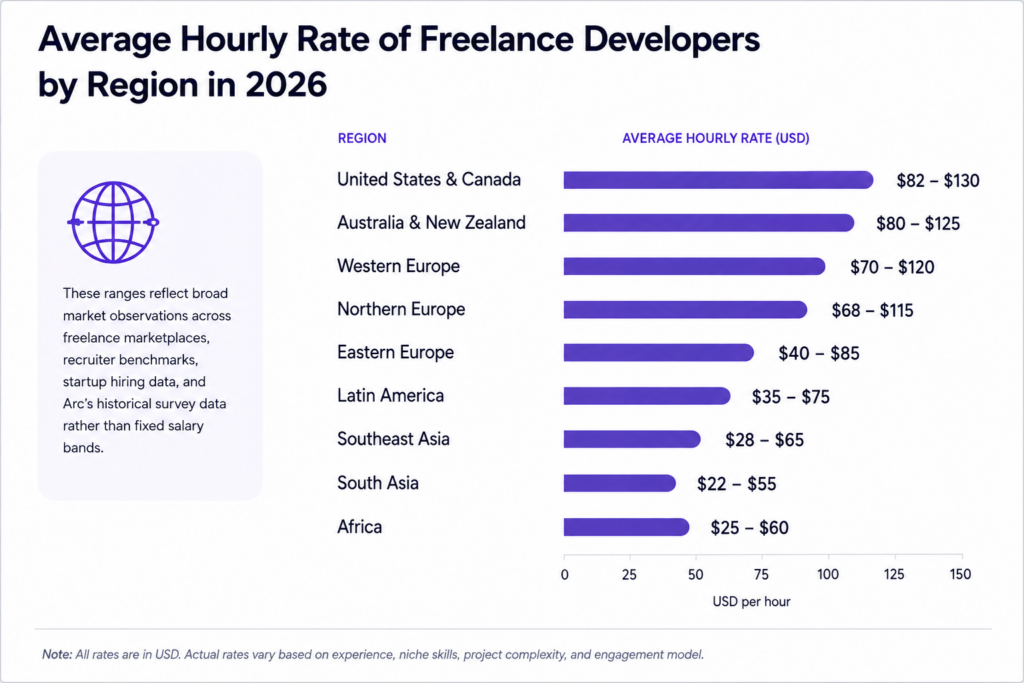
Below are the updated average freelance developer rates by region for 2026.
| Region | Average Hourly Rate (2026) |
| United States & Canada | $82–$130/hr |
These ranges reflect broad market observations across freelance marketplaces, recruiter benchmarks, startup hiring data, and Arc’s historical survey data rather than fixed salary bands.
| Region | Average Hourly Rate (2026) |
| United States & Canada | $82–$130/hr |
| Australia & New Zealand | $80–$125/hr |
| Western Europe | $70–$120/hr |
| Northern Europe | $68–$115/hr |
| Eastern Europe | $40–$85/hr |
| Latin America | $35–$75/hr |
| Southeast Asia | $28–$65/hr |
| South Asia | $22–$55/hr |
| Africa | $25–$60/hr |
These are broad regional averages across thousands of developers. Rates vary significantly depending on:
- specialization
- English fluency
- portfolio quality
- AI tooling proficiency
- seniority
- and prior startup experience
A senior backend engineer in Poland with strong async communication skills may charge more than a mid-level U.S. freelancer and still provide better overall ROI.
Why Are Some Regions Becoming More Competitive
Several hiring trends reshaped global developer pricing in 2026:
AI Increased Demand For Experienced Engineers
AI coding assistants made implementation faster, but companies still need experienced engineers who can:
- architect systems
- review AI-generated code
- maintain security standards
- and make product tradeoff decisions
That’s pushed senior engineer pricing upward globally.
Latin America Continues Growing Rapidly
Latin America remains one of the fastest-growing regions for U.S.-based remote hiring because of:
- timezone overlap
- strong engineering education pipelines
- improving English fluency
- and lower operational friction compared to offshore outsourcing models
Eastern Europe Remains Strong Despite Market Volatility
Eastern Europe continues to offer excellent senior engineering talent, especially in:
- backend systems
- DevOps
- infrastructure
- cybersecurity
- and enterprise software
However, companies are paying closer attention to geopolitical stability and long-term continuity planning.
Cost Of Freelance Developers By Country
Hiring internationally isn’t just about finding lower hourly rates.
The best hiring decisions balance:
- budget
- communication quality
- collaboration style
- legal complexity
- and operational reliability
A lower-cost contractor who disappears mid-project or requires heavy management can easily delay product timelines and increase internal engineering overhead.
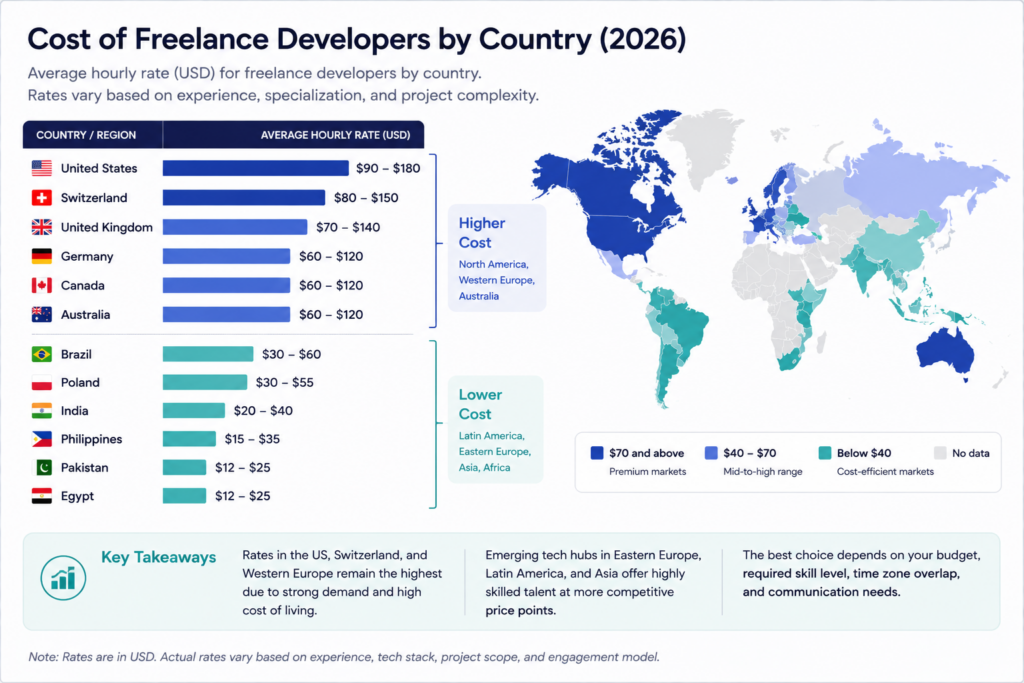
Most Expensive Countries For Freelance Developers
Countries with the highest freelance developer rates tend to share a few characteristics:
- mature startup ecosystems
- high local compensation expectations
- strong enterprise engineering markets
- and intense competition for senior technical talent
These regions also tend to produce developers with significant experience in:
- cloud infrastructure
- AI product development
- distributed systems
- cybersecurity
- and scaling venture-backed startups
For many companies, paying premium rates makes sense when the role involves:
- architecture ownership
- technical leadership
- security-sensitive systems
- or fast-moving product execution
In those cases, hiring mistakes are far more expensive than higher hourly rates. These countries continue to command premium freelance rates in 2026:
| Country | Average Senior Freelance Rate |
| Switzerland | $100–$160/hr |
| United States | $95–$150/hr |
| Australia | $90–$145/hr |
| Germany | $85–$140/hr |
| Canada | $80–$130/hr |
| Netherlands | $80–$125/hr |
| United Kingdom | $78–$125/hr |
| Denmark | $75–$120/hr |
| Sweden | $72–$118/hr |
| Singapore | $70–$120/hr |
These markets typically produce developers with:
- strong enterprise experience
- mature product development workflows
- advanced cloud infrastructure knowledge
- and extensive startup exposure
Companies often justify premium pricing when hiring for:
- architecture leadership
- AI infrastructure
- security engineering
- platform engineering
- or complex distributed systems work
Lowest-Cost Countries For Freelance Developers
Countries with lower average freelance rates still offer excellent talent pools when companies invest in proper vetting and onboarding.
| Country | Average Senior Freelance Rate |
| Pakistan | $20–$45/hr |
| Bangladesh | $18–$40/hr |
| Egypt | $22–$48/hr |
| India | $25–$60/hr |
| Nigeria | $25–$55/hr |
| Vietnam | $28–$60/hr |
| Ukraine | $35–$70/hr |
| Philippines | $22–$50/hr |
| Indonesia | $25–$55/hr |
| Serbia | $35–$75/hr |
The biggest hiring mistake companies make here is assuming lower rates automatically mean lower quality.
In practice, outcomes vary far more based on:
- screening rigor
- communication standards
- onboarding systems
- and project management maturity
The best global teams optimize for operational fit, not just hourly arbitrage.
Cost Of Freelance Developers By City
Some companies prefer remote developers in a specific time zone or metro area for collaboration. Others intentionally target emerging engineering hubs where talent quality is strong, but pricing remains relatively competitive.
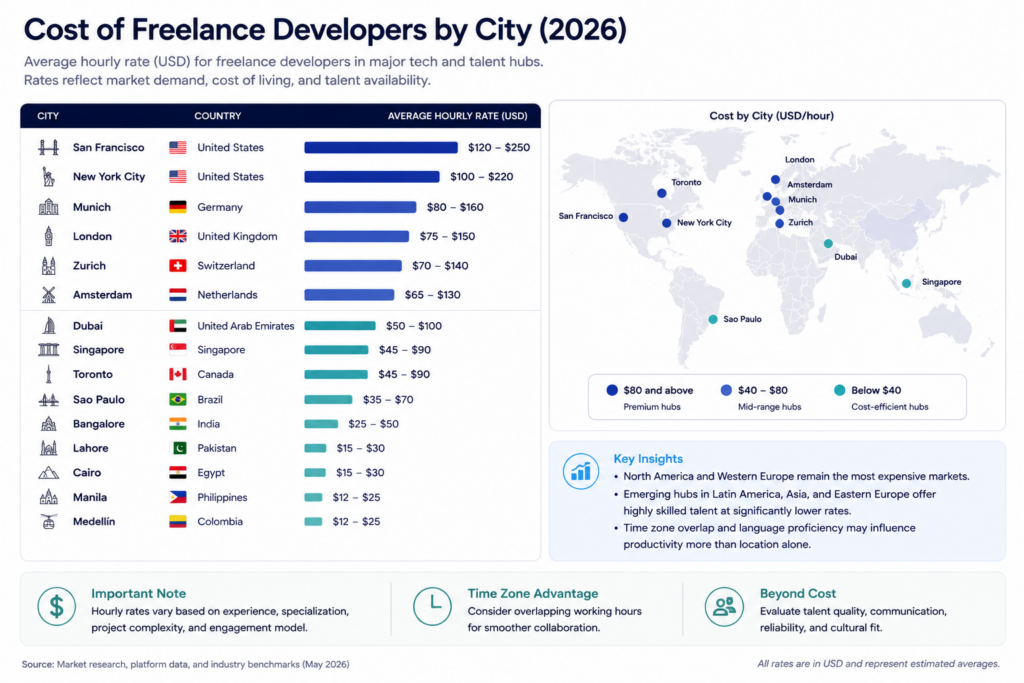
Most Expensive Cities For Freelance Developers
| City | Average Senior Freelance Rate |
| San Francisco | $120–$180/hr |
| New York City | $110–$170/hr |
| Zurich | $110–$165/hr |
| Munich | $105–$160/hr |
| London | $95–$150/hr |
| Toronto | $90–$145/hr |
| Sydney | $90–$145/hr |
| Amsterdam | $88–$140/hr |
| Copenhagen | $85–$135/hr |
| Singapore | $85–$135/hr |
These cities tend to concentrate:
- venture-backed startup ecosystems
- senior AI talent
- infrastructure engineers
- and experienced product teams
More Affordable Developer Hubs In 2026
| City | Average Senior Freelance Rate |
| Lahore | $22–$45/hr |
| Cairo | $25–$48/hr |
| Dhaka | $20–$42/hr |
| Ho Chi Minh City | $28–$55/hr |
| Medellín | $35–$65/hr |
| Belgrade | $35–$70/hr |
| Buenos Aires | $38–$75/hr |
| Kraków | $40–$80/hr |
| Manila | $22–$48/hr |
| Jakarta | $25–$50/hr |
Several of these cities have become increasingly attractive because they combine:
- growing startup ecosystems
- strong technical universities
- lower cost structures
- and expanding remote work adoption
Cost Of Freelance Developers By Tech Stack
Tech Stack Matters More In 2026 Than It Did Previously
One of the biggest changes in the freelance market over the last two years is that specialization gaps have widened significantly. A few years ago, many general full-stack developers operated within relatively similar pricing bands.
In 2026, that’s much less true. The rapid growth of AI-native products, cloud infrastructure complexity, and cybersecurity concerns created major demand spikes for highly specialized engineers.
At the same time, AI coding assistants made many implementation-heavy development tasks faster and more commoditized.
That means companies are increasingly paying premiums for developers who can:
- make architectural decisions
- review AI-generated code safely
- manage production infrastructure
- optimize system performance
- and reduce long-term technical debt
rather than simply writing code quickly.
This shift is especially visible among startups integrating LLM features, AI agents, retrieval systems, or large-scale data pipelines.
A few years ago, location was usually the biggest determinant of developer cost. That’s still true to an extent, but specialization gaps widened significantly in 2026 due to AI demand and infrastructure complexity.
Companies are increasingly willing to pay premiums for engineers who can:
- deploy AI-powered products
- manage cloud-scale systems
- improve security posture
- and integrate AI tooling into production workflows safely
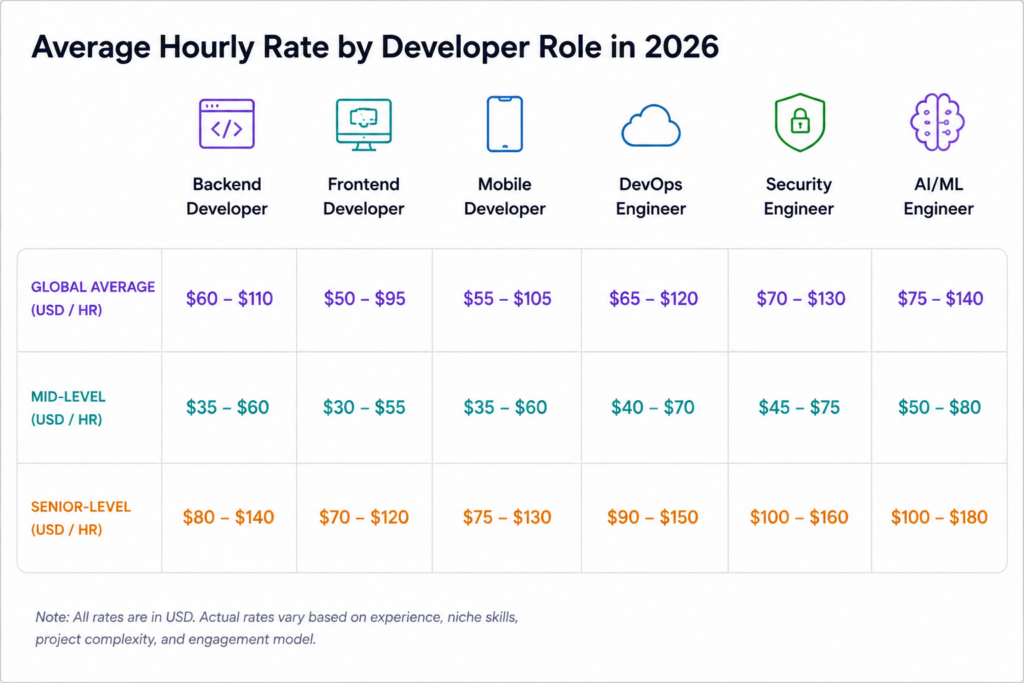
Highest-Paying Developer Specializations In 2026
The strongest upward pricing pressure in 2026 is concentrated around developers who work close to:
- AI infrastructure
- security
- cloud systems
- data-intensive products
- and large-scale platform reliability
These developers are difficult to replace because they combine technical depth with operational judgment.
Companies increasingly view these hires as force multipliers rather than interchangeable contractors.
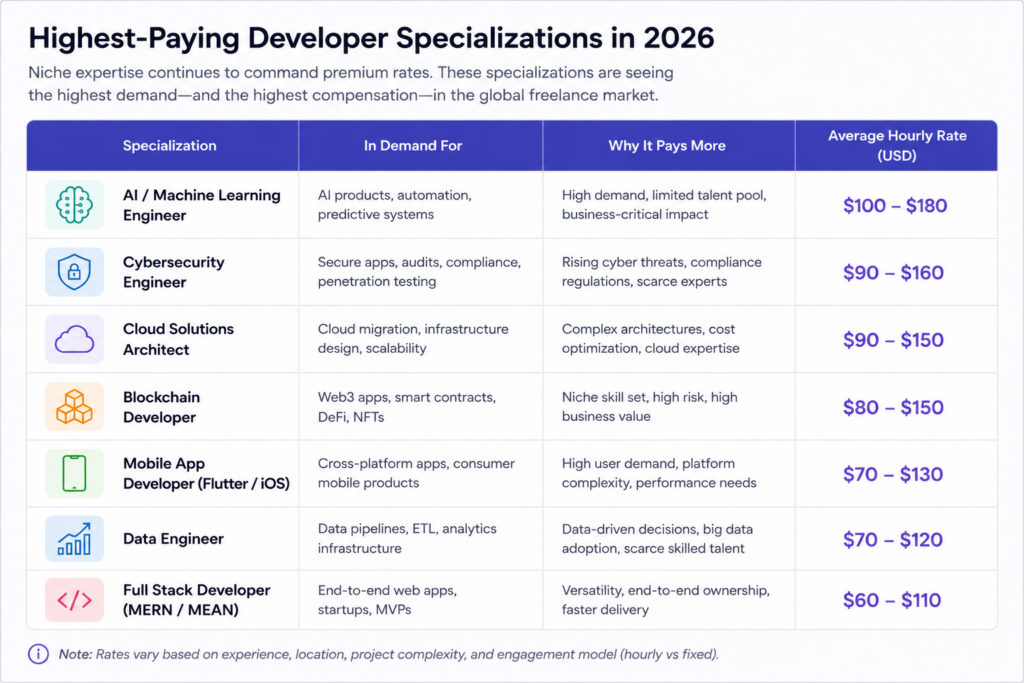
These roles command premium pricing partly because experienced engineers in these areas are still relatively scarce globally. Many startups are competing for the same small pool of senior specialists who can design scalable systems, improve reliability, and safely deploy AI-enabled products.
That’s especially true for companies building:
- AI-native products
- cloud infrastructure
- fintech platforms
- cybersecurity tools
- and data-intensive SaaS applications
| Specialization | Average Senior Freelance Rate |
| AI/ML Engineering | $110–$190/hr |
| AI Infrastructure / MLOps | $120–$200/hr |
| Cybersecurity Engineering | $100–$180/hr |
| DevOps / Platform Engineering | $90–$170/hr |
| Distributed Systems Engineering | $100–$180/hr |
| Data Engineering | $85–$160/hr |
| Cloud Architecture | $95–$175/hr |
These roles are expensive because companies are competing for relatively limited pools of highly experienced engineers.
More Standardized Development Categories
| Specialization | Average Senior Freelance Rate |
| Frontend Development | $55–$120/hr |
| WordPress / CMS Development | $35–$90/hr |
| Mobile App Development | $60–$130/hr |
| QA Automation | $45–$100/hr |
| General Full-Stack Development | $60–$130/hr |
AI tooling also changed pricing dynamics here. Routine implementation work is becoming increasingly automated, which means companies now prioritize developers who contribute:
- architecture decisions
- product thinking
- business context
- and collaboration quality
not just raw coding output.
JavaScript Is Still Dominant
JavaScript remains the most common freelance development skill globally.
However, demand has expanded rapidly for:
- Python
- TypeScript
- Go
- Rust
- Terraform
- Kubernetes
- and AI framework expertise
especially among AI-native startups.
Experience Still Matters More Than Ever
One of the clearest patterns in 2026 hiring data is that companies increasingly favor experienced developers who can operate independently. That’s partly because AI tools changed expectations around output.
Teams now expect senior engineers to:
- move faster with AI copilots
- review generated code critically
- write clearer documentation
- and manage larger technical scopes with smaller teams
As a result, the gap between mid-level and senior engineer pricing widened.
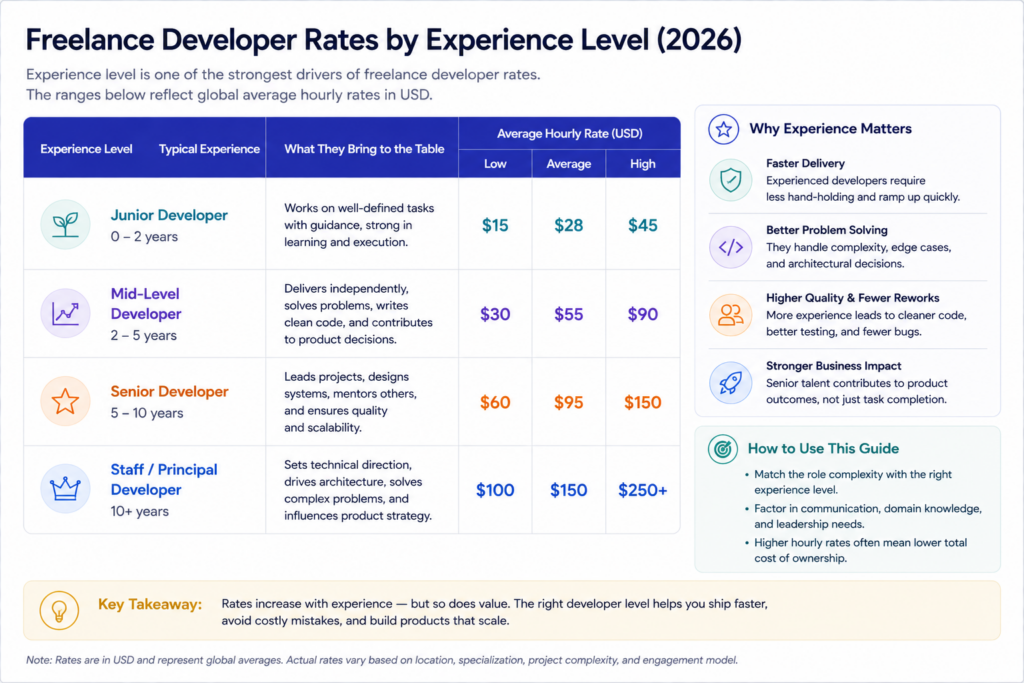
One of the clearest trends in 2026 hiring is that companies increasingly favor developers who can operate independently with minimal oversight.
That doesn’t just improve engineering velocity. It also reduces onboarding friction, communication overhead, and project risk.
This is especially important in distributed teams where senior engineers often manage larger scopes across fewer meetings and leaner organizations
| Experience Level | Average Global Freelance Rate |
| Junior (1–3 years) | $20–$50/hr |
| Mid-Level (3–6 years) | $40–$90/hr |
| Senior (7–10 years) | $75–$150/hr |
| Staff/Principal (10+ years) | $120–$220/hr |
Many startups are finding that a smaller number of highly autonomous senior engineers outperform larger low-cost contractor teams.
That’s especially true for:
- AI product development
- infrastructure modernization
- security-sensitive systems
- and fast-moving startup environments
The Real Cost Of Hiring Remote Developers In 2026
One of the biggest mistakes companies make when hiring freelancers is treating the hourly rate as the primary decision variable. In practice, the real cost of hiring developers usually comes from operational friction.
A developer who:
- misses deadlines
- communicates poorly
- creates technical debt
- or requires constant management
can quickly become far more expensive than a higher-priced senior engineer.
This is why experienced hiring teams increasingly evaluate freelance developers based on:
- autonomy
- communication quality
- reliability
- documentation habits
- and operational maturity
not just technical ability.
The rise of AI-assisted development made this even more important. AI tools can accelerate coding output dramatically, but they also increase the importance of:
- engineering judgment
- code review quality
- systems thinking
- and security awareness
Strong developers now act more like technical operators than isolated coders.
Hourly rates only tell part of the story. The operational costs of managing distributed engineering teams often matter just as much as compensation, as two developers charging the exact same hourly rate can produce dramatically different business outcomes.
Hidden Costs Companies Underestimate
- Onboarding Overhead
Even strong freelance developers need:
- architecture context
- documentation access
- tooling setup
- and communication alignment
Poor onboarding can delay productivity for weeks.
- Communication Friction
Misaligned expectations create expensive delays.
Common issues include:
- unclear requirements
- weak async communication
- inconsistent availability
- and lack of documentation discipline
- Engineering Management Bandwidth
Lower-cost freelancers sometimes require significantly more oversight. That management overhead can reduce the productivity of your internal senior engineers.
- Security And Compliance Costs
Distributed teams require:
- endpoint protection
- access controls
- device management
- compliance tooling
- and secure credential workflows
These are now standard operating costs for remote engineering teams.
- Contractor Churn
Freelancers managing multiple clients may:
- become unavailable unexpectedly
- delay delivery timelines
- or deprioritize lower-paying projects
This is why many startups now prioritize long-term contractor relationships over transactional gig hiring.
How To Budget For Remote Developers
A realistic hiring budget should include more than hourly compensation.
Companies should account for:
- onboarding time
- software licenses
- security tooling
- contractor management platforms
- communication overhead
- and contingency planning
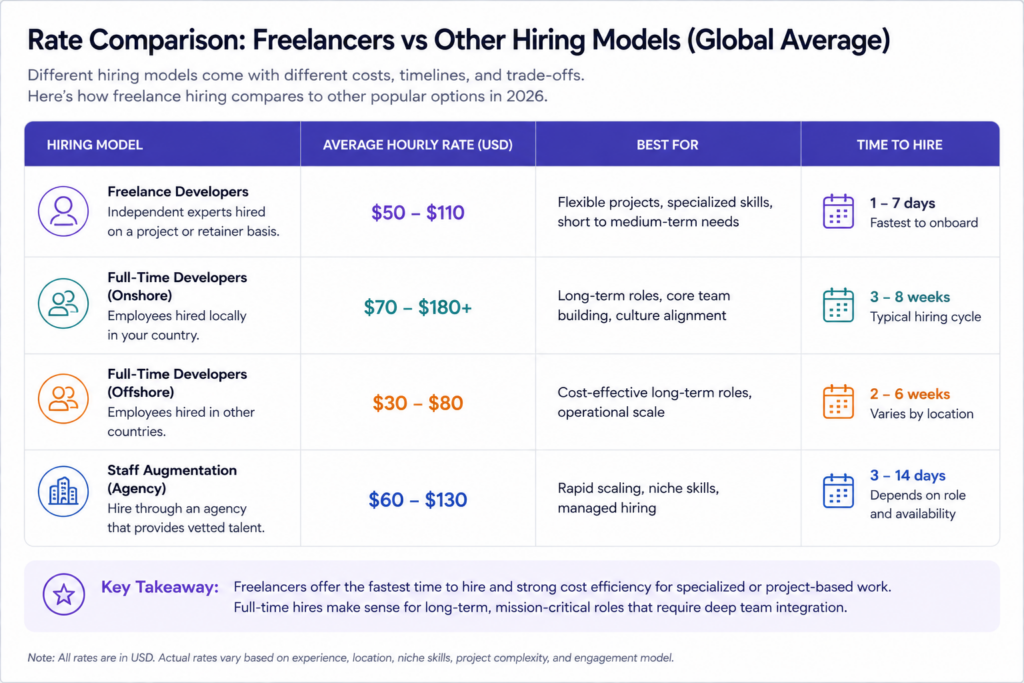
Example Budgeting Framework
| Hiring Goal | Recommended Talent Type | Typical Budget Range |
| MVP build | Senior full-stack freelancer | $8k–$35k |
| AI feature integration | Specialized AI engineer | $15k–$80k |
| Design system migration | Frontend specialist | $10k–$40k |
| Infrastructure modernization | DevOps/platform engineer | $20k–$100k |
| Long-term product roadmap | Full-time remote hire | Ongoing salary + benefits |
When Premium Talent Is Actually Cheaper
A highly experienced engineer charging $140/hr may still reduce overall project cost if they:
- architect systems correctly the first time
- require less management
- improve delivery speed
- and reduce technical debt
This is one reason companies increasingly use vetted talent marketplaces for specialized roles. Platforms like Toptal focus heavily on highly screened senior talent, which can make sense for infrastructure, AI, or architecture-heavy work where hiring mistakes are expensive.
For companies optimizing around broader global hiring flexibility and faster sourcing, marketplaces with larger vetted remote talent pools may offer better operational leverage. The key is matching hiring strategy to project risk.
Legal & Compliance For International Developer Hiring
Global hiring gives startups access to incredible talent pools, but it also introduces legal and operational complexity that many early-stage companies underestimate.
The reality is that international hiring is no longer just a recruiting decision. It’s increasingly a finance, legal, security, and operations decision too.
This becomes especially important once companies move beyond short-term freelance projects and begin building long-term distributed engineering teams.
Several common issues start appearing quickly:
- contractor classification risk
- international tax exposure
- payroll and invoicing complexity
- data protection obligations
- and country-specific labor laws
The companies that successfully scale remote teams usually build operational processes around these risks early on, rather than treating them as afterthoughts.
Global hiring creates enormous advantages, but it also introduces legal and operational complexity. This is one of the biggest areas companies underestimate when scaling distributed engineering teams.
Contractor Misclassification Risk
One of the biggest misconceptions in global hiring is that labeling someone a “freelancer” automatically eliminates employment obligations.
In reality, many countries evaluate the actual working relationship, not just the contract language. That means companies can still face compliance exposure if contractors effectively function like employees over time.
Many countries apply strict tests to determine whether a worker is actually:
- an independent contractor
- or effectively functioning as an employee
Risk factors can include:
- fixed working hours
- mandatory meetings
- exclusive working relationships
- company-provided equipment
- and direct managerial control
Misclassification penalties can include:
- back taxes
- fines
- social contribution liabilities
- and employment disputes
This becomes more important as contractor relationships become long-term.
Permanent Establishment (PE) Risk
Hiring developers internationally can sometimes create a taxable business presence in another country. This is commonly referred to as the permanent establishment risk.
The exact rules vary significantly across jurisdictions, but risk can increase when contractors:
- negotiate contracts
- manage local operations
- or function as long-term representatives of the company
Fast-growing startups should involve legal and accounting advisors before scaling international contractor teams aggressively.
Tax Nexus And Payroll Complexity
International hiring also creates operational challenges around:
- invoicing
- VAT requirements
- local tax withholding
- contractor payment infrastructure
- and cross-border compliance
Many startups now use:
- Employer of Record (EOR) providers
- global payroll platforms
- or contractor management services
to reduce administrative overhead.
Digital Nomad Visas And Remote Work Laws
Countries like:
- Spain
- Portugal
- the UAE
- Costa Rica
- and Greece
continue expanding digital nomad visa programs.
These programs made cross-border remote work easier for developers, but they didn’t automatically eliminate employer compliance obligations.
A contractor working remotely from another country can still create:
- tax exposure
- employment law obligations
- or local compliance responsibilities
depending on the working relationship.
The safest approach is to treat international hiring as an operational function, not just a recruiting exercise.
Remote Operations & Security Best Practices
The operational side of remote hiring matters far more in 2026 than it did even a few years ago. Most startups are no longer experimenting with remote work but are running fully distributed engineering organizations across multiple countries, time zones, and contractor relationships.
That shift changed how companies evaluate freelance developers. Technical skills still matter, of course, but hiring managers are increasingly screening for:
- async communication habits
- documentation quality
- reliability
- project ownership
- and security awareness
because those traits directly affect team velocity in distributed environments.
The strongest remote developers tend to operate with very little management overhead. They communicate clearly, unblock themselves quickly, document decisions, and collaborate effectively without requiring constant meetings.
That operational maturity has become one of the biggest differentiators in global hiring: The best remote engineering teams aren’t just cost-efficient. They’re operationally disciplined.
In 2026, companies increasingly evaluate freelance developers based on:
- async communication quality
- documentation habits
- security awareness
- and ability to collaborate effectively across distributed teams
Modern Collaboration Stack Expectations
Remote collaboration standards have evolved significantly over the last few years.
In many distributed engineering teams, developers are now expected to:
- document decisions clearly
- communicate asynchronously
- record walkthroughs when needed
- and maintain visibility without constant meetings
The best remote developers reduce coordination overhead instead of increasing it. That operational maturity often matters more than raw coding speed.
Remote engineering workflows now commonly include tools like:
- Notion
- Linear
- Jira
- Slack
- Loom
- Miro
- GitHub
- Cursor
- Claude
- and ChatGPT
Strong freelancers know how to:
- communicate clearly asynchronously
- document decisions
- record walkthroughs
- and manage projects with minimal supervision
These operational skills increasingly matter as much as technical ability.
BYOD Security Is Now Standard
Many freelance developers use their own devices. That means companies should implement baseline endpoint security requirements before granting access to production systems.
Recommended safeguards include:
- MFA enforcement
- encrypted devices
- endpoint detection and response (EDR)
- mobile device management (MDM)
- VPN requirements
- Git access controls
- and credential rotation policies
If contractors access customer data or sensitive infrastructure, security becomes part of the true cost of hiring.
Secure Onboarding And Offboarding
Strong remote teams also standardize:
- least-privilege access policies
- temporary credentials
- contractor access expiration dates
- repository permissions
- and structured offboarding checklists
These operational systems reduce long-term security and compliance risk substantially.
How Much Would Developers Cost For Your Project?
This report shows broad pricing trends across:
- regions
- countries
- cities
- tech stacks
- and experience levels
But successful hiring decisions rarely come down to compensation alone. The companies building the strongest distributed engineering teams in 2026 are usually optimizing for a combination of:
- delivery speed
- communication quality
- operational reliability
- security standards
- timezone overlap
- and long-term scalability
That’s why the best remote hiring strategies increasingly focus on overall engineering leverage rather than simply finding the cheapest hourly rates.
A strong senior developer who ships quickly, collaborates effectively, and improves team velocity can dramatically outperform larger low-cost contractor teams.
That’s particularly true for:
- AI product development
- infrastructure modernization
- platform engineering
- cybersecurity
- and fast-moving startup environments
Global hiring gives companies access to extraordinary talent, But building successful distributed teams requires:
- thoughtful onboarding
- strong communication systems
- clear security practices
- and realistic operational planning
The companies that get this right gain enormous advantages in:
- hiring speed
- engineering flexibility
- global talent access
- and long-term scalability
especially as AI reshapes how software teams operate.
The future of hiring is increasingly global, distributed, and AI-assisted. But the companies that win won’t simply hire the cheapest developers. They’ll build systems that help excellent developers do their best work securely, efficiently, and at scale.
That’s ultimately what separates high-performing remote teams from expensive hiring experiments. And increasingly, that’s becoming one of the biggest competitive advantages in software hiring overall.
This data shows broad developer pricing trends across:
- regions
- countries
- cities
- experience levels
- and tech stacks
But successful hiring decisions depend on much more than averages.
The best remote developers help companies:
- ship products faster
- reduce engineering bottlenecks
- improve code quality
- and scale teams efficiently
without creating operational chaos.
That usually comes down to finding the right balance between:
- expertise
- communication
- timezone overlap
- reliability
- compliance
- and budget.
In 2026, the companies building the strongest distributed engineering teams aren’t necessarily hiring the cheapest developers. They’re building systems that let great global talent operate effectively.
You can also try Arc, your shortcut to the world’s best remote talent:
⚡️ Access vetted developers, designers, and marketers
⚡️ View matches instantly with HireAI
⚡️ Freelance or full-time remote hiring
⚡️ Save time with interview-ready global talent