
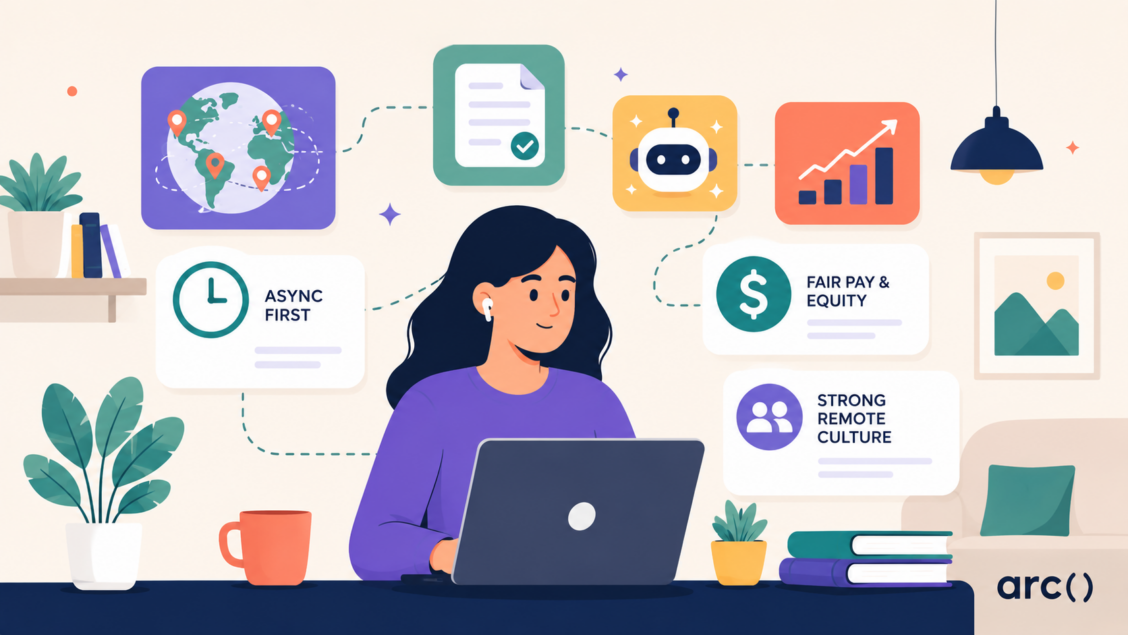

Finding the best remote companies to work for in 2026 is no longer about perks or brand names. What “great” looks like has become far more practical and harder to fake, and you can now evaluate how companies actually operate—async workflows, AI adoption, and compensation models—because the difference between a well-run remote team and a chaotic one shows up in daily work.
Arc supports that shift by helping candidates connect with companies that already meet these standards. Instead of navigating inconsistent job listings, you can get access to vetted global opportunities where async communication, clear documentation, and AI-assisted workflows are part of how teams actually operate, not just promises during hiring.
This guide breaks down what top candidates actually look for in remote companies. You’ll learn how compensation models, AI maturity, and team structure shape your day-to-day experience, and how to spot the difference before accepting an offer.
What “Best Remote Companies to Work For” Actually Means in 2026
The phrase “best remote companies to work for” gets thrown around in endless annual lists. But in 2026, what actually matters to your daily life has shifted. What separates strong remote companies from the rest comes down to operating model design and AI adoption, not perks or a fancy brand.
Rankings Are Less Useful Than Operating Models
Most “best of” lists go by employee surveys, benefits, or Glassdoor scores. Sure, those tell you how people feel, but not how the company actually runs.
A more practical lens? The operating model. Ask yourself:
- How are decisions documented? Companies that write down decisions (not just discuss them in meetings) work better for remote folks.
- Where does work happen? If it’s mostly in Slack threads and Google Docs, that’s a good async sign. If it’s mostly Zoom calls, well, brace yourself.
- Who holds leadership roles? If all the VPs are at HQ and the remote staff are just ICs, promotion paths probably aren’t great.
Rankings might nudge you in the right direction, but the operating model is what shapes your Tuesdays.
The Shift Toward AI-Enabled, Async-First Organizations
The strongest remote employers in 2026 aren’t just async-first, they’re AI-enabled. They use AI tools across the board, not just in engineering, to cut repetitive tasks, summarize meetings, draft docs, and speed up decisions.
This combo matters because AI tools amplify async workflows. When a company auto-generates meeting summaries, builds searchable knowledge bases, and routes tasks without human bottlenecks, you spend less time chasing context and more time actually working.
If a company claims “remote-first” but has zero visible AI integration, it’s probably stuck in 2020.
Remote-First vs Remote-Friendly: How to Tell the Difference
The difference between remote-first and remote-friendly isn’t just marketing fluff. It determines whether your voice matters as much as someone sitting near the CEO.
True async communication, strong documentation, and real remote culture show up in concrete ways during hiring.
Signals of True Async Culture (Documentation, Decision Logs, Timezone Independence)
You can spot a genuinely async company by looking for three things:
- Public decision logs. Major decisions get recorded in shared tools (like Notion or Confluence), with context and rationale, so remote employees can participate without being in the room.
- Written project briefs before meetings. If the company writes up context ahead of any call, they value documentation over verbal updates.
- Timezone-distributed leadership. Check LinkedIn. If the leadership team spans at least a couple of time zones, they’ve likely built processes that don’t depend on everyone being online at once.
Some companies even describe their teams as globally distributed with async-first defaults and timezone respect built in.
Meeting Load, Slack Expectations, and Hidden Sync Dependencies
Ask the hiring manager: “How many hours per week does someone in this role spend in meetings?” Anything over 10 hours per week for an IC means heavy sync dependency.
Also, ask about Slack norms. For example:
- What’s the expected response time on Slack? If it’s “within 15 minutes,” that’s synchronous messaging in disguise.
- Are Slack threads used for decisions, or just chatter? Making decisions in Slack without documenting them elsewhere creates invisible silos.
- Is “online” status tracked? If companies monitor green dots as a productivity proxy, that’s surveillance, not remote culture.
Red Flags That Indicate Office-First Thinking in Remote Roles
Watch out for these in job descriptions and interviews:
- “Remote but must be within commuting distance of [city].” Not actually remote.
- All-hands meetings always scheduled for one timezone with no rotation or recording.
- No mention of home office stipend or equipment policy. If they’re serious about remote, they’ll invest in your workspace.
- Promotion criteria tied to “visibility” or “presence.” If face time is rewarded, remote workers will always lose.
If you spot more than one of these, you’re probably looking at an office-first company pretending to be remote.
Compensation Models: How Top Remote Companies Pay in 2026
Remote job listings reveal a lot about a company’s values in how they structure compensation. The big three variables: salary structure, equity transparency, and the pricing of AI-specific roles.
Location-Based vs Global vs Role-Based Salary Structures
Remote companies usually pick one of these models:
| Model | How It Works | Who Benefits Most |
| Location-based | Pay changes based on your city or region’s cost of living | Employers in high-cost markets hiring in lower-cost areas |
| Global/location-agnostic | Same pay for the same role, no matter where you live | Employees in lower-cost areas |
| Role-based | Pay bands set by role complexity and market rate | Balances fairness and budget |
Ask the recruiter which model they use. If they can’t answer, the compensation philosophy is probably ad hoc, which means your pay could be all over the place. Some companies have talked about remote-first pay structures that don’t penalize you for where you live. That’s a good sign.
Equity Transparency, Refresh Cycles, and Long-Term Upside
For startups and growth-stage companies, equity can be a big part of your total comp. Ask:
- What’s the current 409A valuation, and when was it last updated?
- Is there a refresh grant policy? Companies that only grant equity at hire and never again are diluting your ownership over time.
- What’s the exercise window if you leave? A 90-day window is standard but rough. Some remote-first companies now offer 5- to 10-year windows.
Some companies offer equity at hire, but the value depends entirely on the terms you negotiate upfront.
How AI-Driven Roles (e.g., AI Engineers) Are Priced Differently
AI engineering and machine learning roles command a premium in 2026—often 20% to 40% above comparable software engineering roles. If you’re interviewing for an AI role, benchmark your offer against current remote salary data for that function, not just general engineering ranges.
Check if the home office or remote work stipend covers AI-specific tooling costs. GPU access, API credits, and specialized software can get expensive fast. The best employers either provide these directly or include them in a flexible stipend.
AI Maturity: A New Standard for Top Remote Employers
AI adoption isn’t optional anymore for companies that want strong remote talent. The question isn’t “do you use AI?” but how deeply AI is woven into daily workflows across every team.
How to Assess Real AI Adoption Across Teams (Engineering, Ops, Support)
During interviews, ask team-specific questions:
- Engineering: “What percentage of code commits involve AI-assisted generation or review?”
- Operations: “Do you use AI for internal knowledge retrieval, scheduling, or process automation?”
- Support: “Are support tickets triaged or drafted by AI before a human reviews them?”
If the answers are vague (“We’re exploring that”), they’re early-stage in adoption. If they can point to specific tools and metrics, AI is actually part of their workflow.
The Difference Between AI-Assisted Workflows and Surface-Level Tooling
There’s a big gap between “we use ChatGPT sometimes” and “our documentation pipeline auto-generates summaries, tags action items, and routes them to the right team.”
Surface-level tooling means individuals use AI on their own. AI-assisted workflows mean the company has built systems where AI is baked into how work moves. The latter cuts admin work and speeds up output.
Why AI-Native Companies Create Better Leverage and Faster Growth
Companies that build AI into their core operations give you more leverage per hour. You spend less time on status updates, context-gathering, and repetitive reporting.
That means faster shipping cycles, quicker feedback loops, and more time for high-value thinking. For your career, this matters a lot.
Working at an AI-native company means you build fluency with tools and workflows that are becoming standard everywhere. That experience compounds over time.
Career Growth in Distributed Teams: What Actually Scales
Career advancement in distributed teams depends on systems, not hallway chats. The companies that do this well have written frameworks, structured mentorship, and documentation practices that make growth visible and accessible, no matter your time zone.
Promotion Criteria Clarity in Async Environments
Before you accept an offer, ask: “Can you share the promotion criteria or leveling framework for this role?” If they have a written rubric (like, “Staff Engineer requires X, Y, Z over two review cycles”), that’s a strong sign.
If they say “we evaluate holistically” or “it depends on your manager,” you’re entering a system where proximity bias can quietly shape outcomes. In async environments, vague criteria tend to hurt remote folks who aren’t in the same timezone as decision-makers.
Access to Mentorship Without Proximity Bias
Strong distributed cultures pair employees with mentors across the org, not just on their immediate team. Look for:
- Formal mentorship programs with real structure and cadence.
- Skip-level 1:1s scheduled regularly, not just when things go wrong.
- Cross-functional project opportunities that connect you with leaders outside your direct chain.
If mentorship is informal and relies on “just reach out,” people in less-visible time zones usually have less access.
Documentation Quality as a Proxy for Learning Speed
In distributed teams, documentation is how knowledge transfers. If a company’s internal docs are outdated or scattered, your onboarding will be slow and your learning curve steep.
Ask in interviews: “How quickly can a new hire find answers to common questions without asking someone?” That answer tells you a lot about their documentation maturity. Companies that invest in searchable, up-to-date knowledge bases make ramp-up way less painful.
Work-Life Sustainability in Remote Companies
Remote work can improve your life—or erode it—depending on how the company handles boundaries. Sustainability isn’t about ping-pong tables or unlimited PTO. It’s about real workload expectations and how AI tools are used.
Measuring Meeting Hours, Response Expectations, and PTO Usage
Three numbers tell you more about work-life sustainability than any benefits page:
- Average weekly meeting hours. Ask the recruiter or hiring manager. Under 8 hours per week for ICs is a good benchmark.
- Expected Slack/email response time. If the norm is “within the hour” across all time zones, that’s not async. Look for companies that set 24-hour response windows for non-urgent messages.
- Actual PTO usage, not just policy. Unlimited PTO sounds great, but people usually take less. Ask: “What’s the average number of PTO days employees actually used last year?”
Burnout Risks Unique to Remote and Async Teams
Remote burnout creeps in from a few sources:
- Always-on expectations where the workday never ends.
- Context-switching between too many async threads and channels.
- Isolation due to a lack of structured social time.
Look for companies that actively address these. Structured “no-meeting days,” required minimum PTO, and regular virtual hangouts are real signals, not just nice extras.
How AI Automation Can Reduce Workload, or Increase Pressure
AI automation is a double-edged sword. At good companies, AI handles summarization, scheduling, data entry, and first-draft writing, so you can focus on creative or strategic work.
But at poorly managed companies, AI-driven productivity gains just mean higher output expectations with no extra pay or support. Ask: “When AI tools save time, does the team use that for deeper work or just take on more volume?” The answer reveals whether AI is a relief valve or a pressure cooker.
How to Evaluate a Remote Company Before Accepting an Offer
Before you sign anything, you really need to dig for details that most companies won’t just hand over. Sure, there are plenty of places to find remote job listings. But that’s just the easy bit. The real challenge is figuring out if the company’s actually a good fit.
Questions to Ask About Async Workflows, AI Usage, and Compensation
When you get to the interview stage, don’t be shy about asking specifics:
- “What tools do you use for async decision-making, and can you walk me through a recent example?”
- “How is AI used day-to-day in this team’s workflow? Is there a specific tool stack?”
- “What compensation model do you use: location-based, role-based, or location-agnostic?”
- “What is the equity refresh policy, and what is the current exercise window?”
- “How many hours per week does someone in this role typically spend in meetings?”
If the interviewer dodges or can’t get specific, well, that says a lot.
What to Look for in Interviews, Job Descriptions, and Team Structure
Before you even apply, scan those job descriptions for a few key things:
- Timezone requirements. “Must overlap with EST 9-1pm” is a whole different vibe from “must be available during EST business hours.” The first hints at async flexibility, while the second screams synchronous.
- Documentation mentions. If the JD talks about “strong written communication” or “documentation skills,” odds are they actually care about async work.
- Team distribution. Take a second to check where current employees live—LinkedIn makes this pretty easy. If everyone’s clustered in one spot except for a couple of outliers, that’s a red flag.
During interviews, pay attention to whether people reference written docs or stick to verbal context. It’s a small thing, but it reveals a lot about how the company works day-to-day.
When you’re applying on remote job boards, tweak your resume to show off async communication chops, documentation experience, and any AI tool skills. Those signals get noticed way faster than you’d think.
A Quick Checklist to Validate if the Company Is Truly “Remote-First”
Use this checklist before accepting any offer.
- Leadership team includes people in multiple time zones.
- Written decision logs or project briefs are standard practice.
- Meeting load for your role is under 10 hours per week.
- Slack or chat response expectations allow for 4+ hour windows.
- Home office or equipment stipend is provided.
- Promotion criteria are documented and shared with candidates.
- AI tools get integrated into workflows beyond just engineering.
- Actual PTO usage data is available (not just “unlimited” policy).
- Compensation model is clearly defined and consistent across locations.
- At least some remote employees hold senior or leadership positions.
If a company checks off 8 out of 10, chances are it’s a genuinely solid remote employer. Anything less than 5? That’s a red flag, no matter how great the job sounds.
Choosing Remote Companies That Actually Work for You
The best remote companies in 2026 are defined by how they operate day-to-day. Teams that prioritize async communication, clear documentation, and thoughtful AI integration create environments where you can do focused work without constant friction. Those systems shape your growth, workload, and overall job satisfaction far more than any headline benefit.
Arc helps candidates access these kinds of environments by connecting them with vetted global companies that already meet higher remote standards. Instead of guessing which roles are truly remote-first, you can focus on opportunities where workflows, expectations, and tools are aligned with how modern distributed teams actually function.
The next step is to apply what you’ve learned: ask better questions, look for concrete signals, and prioritize how a company operates over how it markets itself. Explore vetted remote opportunities that match how you want to work.
Frequently Asked Questions
What makes a company one of the best remote companies to work for in 2026?
The best remote companies in 2026 are defined by how they operate, not their perks. Look for async-first workflows, documented decision-making, and AI-assisted processes that reduce repetitive work. These factors directly impact your daily experience more than benefits or brand reputation.
How can I tell if a company is truly remote-first or just remote-friendly?
A remote-first company builds processes around distributed work, while remote-friendly companies still prioritize office-based workflows. Signs of remote-first include written documentation, low meeting hours (under 10 per week for ICs), and leadership spread across time zones. If most decisions happen in meetings or require real-time presence, it’s likely not truly remote.
What salary models do remote companies use in 2026?
Most remote companies use one of three models: location-based, global (same pay regardless of location), or role-based compensation. Global and role-based models tend to be more predictable for candidates, while location-based pay can vary significantly depending on where you live. Always ask which model is used before accepting an offer.
How important is AI adoption when choosing a remote company?
AI adoption is increasingly a baseline expectation, not a bonus. Strong remote companies use AI for tasks like documentation, meeting summaries, and workflow automation across teams—not just in engineering. This reduces manual work and improves productivity, which directly affects your workload and growth.
What are red flags to watch for in remote job offers?
Common red flags include high meeting loads (over 10 hours per week), expectations for instant Slack responses, and vague promotion criteria. Other warning signs are lack of documentation, timezone restrictions disguised as “flexibility,” and no clear compensation structure. These usually indicate office-first thinking in a remote role.
How do I evaluate career growth in a remote company?
Career growth depends on clear, written promotion criteria and access to mentorship regardless of location. Strong companies provide documented leveling frameworks and structured feedback cycles. If advancement depends on visibility or proximity to leadership, growth may be limited for remote employees.
How can I find vetted remote opportunities that match these standards?
You can find vetted opportunities by focusing on platforms that pre-screen companies and roles for remote maturity, including async workflows and compensation clarity. Look for roles that clearly define expectations, tools, and team structure before you apply. Start by exploring curated remote roles that match your preferred way of working.