


Hiring remote developers in 2026 is no longer just about sourcing talent. It now requires navigating legal frameworks, evaluating AI-assisted workflows, and choosing the right hiring model for your company’s stage and goals. Many teams struggle to verify real technical ability, especially as AI tools make it easier to polish resumes and even assist during interviews.
Companies also face confusion around international hiring laws and how different models compare. A remote staffing agency can simplify sourcing and vetting, while platforms like Arc help companies access vetted remote talent faster with structured evaluation and clear timelines.
This guide explains how remote staffing works, how it compares to EOR and PEO models, how AI is changing hiring, and how to evaluate partners with precision.
What Is A Remote Staffing Agency?
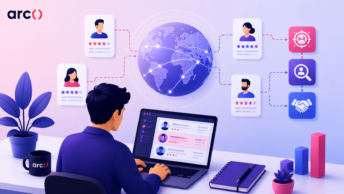
A remote staffing agency acts as a dedicated sourcing and vetting layer for global hiring. Instead of relying on inbound applications, they proactively identify, assess, and shortlist candidates who match your requirements across multiple regions and time zones.
Most agencies combine recruiter expertise with AI-assisted tools to evaluate candidates more efficiently. This often includes structured technical assessments, communication screening, and background verification before candidates meet your team.
It is important to understand that staffing agencies focus on talent discovery and evaluation, not always legal employment. While they reduce the time and effort required to find qualified candidates, companies may still need additional infrastructure to handle payroll, compliance, and contracts.
EOR Vs. PEO Vs. Staffing: What’s The Difference?
Understanding the legal structure behind remote hiring is essential, especially when recruiting across borders. Many companies assume a staffing agency covers everything, but in reality, each model plays a distinct role in the hiring process.
Remote Staffing Agency
A remote staffing agency focuses on identifying, vetting, and shortlisting candidates based on your requirements. It helps reduce sourcing time and improves candidate quality through structured screening processes.
However, the agency does not always act as the legal employer, which means your company may still be responsible for payroll, contracts, and compliance.
Employer Of Record (EOR)
An Employer of Record (EOR) becomes the official legal employer on paper for international hires. It manages payroll, taxes, statutory benefits, and compliance with local labor laws in the employee’s country.
This allows companies to hire full-time employees globally without setting up a local legal entity, significantly reducing administrative complexity and legal risk.
Professional Employer Organization (PEO)
A Professional Employer Organization (PEO) operates under a co-employment model, where employer responsibilities are shared between your company and the provider. The PEO typically handles HR administration, payroll, and benefits.
However, this model usually requires your company to already have a registered legal entity in the country, making it more suitable for domestic or established international operations.
In practice, many companies combine a staffing agency for talent sourcing with an EOR for legal employment and compliance, creating a structured hiring stack that balances speed with regulatory clarity.
Marketplace Vs. Managed Staffing Vs. EOR Platforms
Each remote hiring solution serves different purposes, and choosing the wrong model can slow down hiring or introduce unnecessary complexity. Marketplaces, managed staffing providers, and EOR platforms each address a specific part of the hiring process.
Marketplaces
Marketplaces prioritize access by allowing companies to browse and select candidates directly. While this gives hiring teams more control, it also requires a significant time investment to screen, validate, and compare candidates effectively. As a result, internal teams often take on the burden of vetting, which can slow down the hiring process and introduce inconsistency in evaluation.
Managed Staffing
Managed staffing providers deliver curated shortlists of pre-vetted candidates, reducing the need for manual sourcing and screening. They combine recruiter expertise with AI-driven matching to improve both speed and quality, allowing companies to focus only on highly relevant candidates. This model is designed for teams that want faster hiring without sacrificing candidate quality.
EOR Platforms
EOR platforms focus on legal employment and compliance rather than talent sourcing. They handle payroll, taxes, benefits, and regulatory requirements in the employee’s country, enabling companies to hire globally without setting up local entities. However, they do not provide candidates, which means companies must source talent separately or work with a staffing partner.
Marketplace vs. Managed Staffing vs. EOR Platforms: Key Differences
| Feature | Marketplaces | Managed Staffing | EOR Platforms |
| Examples | Toptal | Arc, Revelo | Deel, Remote |
| Primary Function | Talent access | Vetted talent + hiring support | Legal employment |
| What You Get | Access to freelance profiles | Curated shortlist of vetted candidates | Payroll, compliance, legal employment |
| Talent Vetting | Varies by platform | High (multi-step, human + AI) | None |
| Candidate Matching | Self-service search | Managed matching and shortlisting | None |
| Time To Hire | 2–6 weeks | 2–10 days | Depends on sourcing |
| AI Usage | Basic filtering | Matching, screening, validation | Compliance automation |
| Hiring Support | Limited | Hands-on support | Focused on employment setup |
| Legal Compliance | Your responsibility | Shared or externalized | Fully handled |
| Payroll & Benefits | Not included | Sometimes supported (via partners) | Core feature |
| Best For | One-off freelancers | Scaling teams efficiently | Global employment |
Understanding these differences helps companies align their hiring strategy with their operational needs, rather than relying on a single solution for everything.
Nearshore Vs. Offshore Hiring: Costs, Time Zones, And Tradeoffs
Geographic strategy plays a major role in how remote teams collaborate and perform. Companies often choose between nearshore and offshore hiring depending on their priorities around cost, communication, and speed.
Nearshore Hiring
Nearshore hiring involves working with professionals in similar or adjacent time zones, which allows for consistent real-time collaboration. Teams benefit from overlapping work hours, making meetings, sprint planning, and feedback loops more efficient, especially in fast-moving product environments.
This model is particularly effective for roles that require frequent communication or tight coordination. While costs may be higher than offshore options, many companies find the tradeoff worthwhile for improved speed and alignment.
Offshore Hiring
Offshore hiring provides access to broader global talent pools and often lower labor costs, making it an attractive option for scaling teams efficiently. It is especially useful when sourcing specialized skills or building teams across multiple regions.
However, offshore collaboration requires more structured communication, clear documentation, and well-defined workflows due to time zone differences. Advances in AI-powered tools and asynchronous development practices are reducing these challenges, making offshore hiring increasingly viable even for complex technical roles.
How Remote Staffing Agencies Actually Work: Step-By-Step Guide
Understanding the process step by step helps set clear expectations for timelines, responsibilities, and outcomes when working with a remote staffing agency.
- Role Intake And Requirement Definition
The process begins with a detailed role intake, where companies define technical requirements, seniority levels, and budget expectations. This includes specifying programming languages, frameworks, years of experience, and any communication or time zone requirements.
Clear input at this stage allows the agency to align its search precisely with your needs, avoiding generic or mismatched candidates and improving overall hiring efficiency.
- Talent Sourcing (AI + Recruiters)
Once the role is defined, the agency begins sourcing candidates using a combination of internal talent databases, recruiter outreach, and AI-powered matching systems.
AI helps identify relevant candidates quickly, while recruiters validate fit based on experience, communication skills, and role alignment. This hybrid approach increases both speed and accuracy in the early stages of the search.
- Multi-Layer Screening And Validation
Candidates then go through multiple layers of screening to ensure quality. This typically includes technical assessments, live or asynchronous coding exercises, and structured interviews.
Many agencies now use AI-assisted validation to detect inconsistencies, such as copied code or over-reliance on AI tools, ensuring candidates can perform independently in real-world scenarios.
- Shortlist Delivery
After screening is complete, the agency presents a shortlist of highly relevant candidates. Most companies receive between two and five candidates who closely match their requirements.
This shortlist is usually delivered within a few days, significantly reducing the time compared to traditional hiring processes and allowing teams to move quickly into interviews.
- Interview, Selection, And Onboarding
Companies interview the shortlisted candidates and select the best fit for their team. The agency may assist with scheduling, feedback collection, and offer coordination to streamline the process.
Once a candidate is selected, the agency can support onboarding and, in some cases, coordinate with Employer of Record providers to handle legal employment, payroll, and compliance for international hires.
Types Of Roles Filled By Staffing Agencies
Remote staffing agencies support a wide range of roles across engineering, design, marketing, and operations. This flexibility allows companies to build fully distributed teams without being limited by geography.
Engineering roles remain the most common, including frontend, backend, and full-stack developers, as well as DevOps engineers and data specialists. Demand for AI-related roles, such as machine learning engineers and data engineers, continues to grow as companies integrate AI into their products and workflows.
Beyond engineering, agencies also place designers, marketers, and operational professionals. This includes UX/UI designers, SEO specialists, content creators, customer support representatives, and virtual assistants, enabling companies to scale multiple functions simultaneously.
Benefits Of Using A Remote Staffing Agency
One of the most significant benefits of using a remote staffing agency is access to a global pool of vetted talent. Leading agencies maintain rigorous screening standards, often accepting only a small percentage of applicants, which increases the likelihood of high-quality matches.
Speed is another key advantage. While traditional hiring processes can take several weeks, remote staffing agencies can present qualified candidates within days. This is largely due to their existing talent pools and streamlined evaluation processes.
Cost efficiency also plays a major role. Companies can reduce recruitment overhead and access talent in regions with different salary benchmarks. Combined with flexible hiring models such as contract or project-based work, this allows teams to scale efficiently without long-term commitments.
Key Factors for Choosing a Remote Staffing Agency
Selecting the right partner requires a detailed evaluation of how the agency operates behind the scenes. The factors below directly impact hiring speed, candidate quality, and long-term success.
Screening Depth
Screening depth is one of the most important factors because it directly determines candidate quality. Strong agencies go beyond basic resume reviews and use structured evaluations such as live coding sessions, real-world problem-solving, and technical interviews conducted by experienced engineers.
Companies should verify whether candidates are tested in practical scenarios or filtered solely by automated quizzes. Shallow screening often leads to mismatches, while rigorous evaluation significantly improves hiring outcomes.
Talent Pool Transparency
Transparency around the talent pool is essential for predicting hiring success. Agencies should be able to provide clear data on candidate availability, including how many professionals are actively ready for placement, their seniority levels, and their geographic distribution.
Without this visibility, it becomes difficult to assess whether the agency can consistently deliver qualified candidates for your specific roles. A lack of transparency often signals limited depth or outdated talent pipelines.
AI Usage In Screening And Matching
AI usage is a critical differentiator in modern remote hiring. Strong agencies use AI to improve candidate matching, validate technical skills, and detect inconsistencies such as copied or AI-generated code.
In contrast, agencies that rely only on manual processes may struggle to scale or maintain consistent quality. Evaluating the use of AI in screening helps ensure faster, more accurate hiring decisions.
Legal And Compliance Support
Legal clarity is essential when hiring across borders. Companies should understand whether the agency provides support for compliance, payroll, and contracts, or if these responsibilities remain fully internal.
In many cases, agencies partner with Employer of Record providers to handle international employment. Clarifying this early helps avoid delays, compliance risks, and unexpected operational complexity as your team scales.
How To Work Effectively With A Remote Staffing Agency
Successful collaboration starts with clear communication. Companies should provide detailed role requirements, including technical skills, experience levels, and working expectations, to ensure alignment from the beginning.
Speed is also essential. High-quality candidates are often in demand and may receive multiple offers quickly, so delays in feedback or scheduling can result in missed opportunities. Maintaining a responsive hiring process improves outcomes significantly.
Finally, a structured onboarding process helps new hires integrate more effectively. Providing documentation, assigning a point of contact, and setting clear expectations during the first few weeks can reduce ramp-up time and improve long-term performance.
Trends Shaping Remote Staffing In 2026
AI is fundamentally changing both how companies hire and how professionals work. Developers now use AI tools in their daily workflows, shifting the hiring focus toward problem-solving ability and system design rather than memorizing syntax.
At the same time, staffing agencies are using AI to accelerate candidate screening and improve matching accuracy. This allows them to process larger talent pools while maintaining quality standards.
Remote work has also become a default expectation rather than a perk, leading to more distributed teams across multiple countries. As global hiring continues to expand, companies are increasingly combining different models, such as staffing agencies and EOR providers, to balance speed, flexibility, and compliance.
Build Strong Remote Teams With The Right Hiring Model
Remote hiring enables companies to access global talent, reduce hiring timelines, and build flexible teams that adapt to changing business needs. However, success depends on understanding how different hiring models fit together, from talent sourcing to legal employment.
By combining a remote staffing partner with the right compliance infrastructure, companies can reduce risk while maintaining speed and quality. Arc supports this approach by connecting companies with vetted remote talent and providing a more transparent hiring experience.
Think about it: the companies building the strongest teams today are not the ones hiring the most; they’re the ones hiring the smartest. As remote work continues to evolve, having a clear strategy, a strong evaluation process, and the right partners is what separates slow hiring from real momentum.
Frequently Asked Questions
What Is The Difference Between A Remote Staffing Agency And An EOR?
A remote staffing agency focuses on sourcing, vetting, and shortlisting candidates, helping you find qualified professionals quickly. However, it does not always act as the legal employer.
An Employer of Record (EOR), on the other hand, legally employs the worker on your behalf. It handles payroll, taxes, benefits, and compliance in the employee’s country. In most cases, companies use a staffing agency to find talent and an EOR to employ them.
Do I Need Both A Staffing Agency And An EOR?
In many international hiring scenarios, yes. A staffing agency helps you identify and evaluate candidates, while an EOR ensures those candidates can be legally employed and paid in their country.
If you are hiring contractors, you may not need an EOR. However, for full-time global employees, combining both solutions is often the most efficient and compliant approach.
How Fast Can I Hire Remote Developers Through A Staffing Agency?
Hiring timelines vary, but many remote staffing agencies can present qualified candidates within a few days. In some cases, companies can complete the hiring process in one to two weeks. Speed depends on role complexity, seniority level, and how quickly your team can review candidates and conduct interviews.
Are Remote Developers Pre-Vetted?
Most reputable staffing agencies provide pre-vetted candidates who have already passed technical assessments and interviews. This reduces the time your team spends reviewing unqualified applicants.
However, vetting standards vary, so it is important to understand how candidates are evaluated, including whether assessments involve real-world problem solving or only automated tests.
How Does AI Impact Remote Hiring?
AI plays a growing role in both hiring and day-to-day work. Staffing agencies use AI to improve candidate matching, validate technical skills, and detect inconsistencies in applications.
At the same time, candidates use AI tools in their workflows, which means hiring processes increasingly focus on problem-solving ability, system design, and practical execution rather than memorization.
Is Nearshore Or Offshore Hiring Better?
The right choice depends on your priorities. Nearshore hiring offers better time zone alignment and easier real-time collaboration, while offshore hiring provides access to larger talent pools and often lower costs.
Advances in AI tools and asynchronous workflows are making offshore hiring more effective, even for complex roles, but it still requires structured communication and clear processes.
What Should I Look For In A Remote Staffing Agency?
Key factors include screening depth, talent pool transparency, use of AI in matching and validation, and clarity around legal and compliance support. A strong agency should provide a small, high-quality shortlist quickly and be able to explain exactly how candidates are evaluated and how hiring logistics are handled.
Can I Hire Roles Beyond Developers?
Yes. While developers are the most common role, remote staffing agencies also place designers, marketers, customer support professionals, and operations specialists. This allows companies to build fully distributed teams across multiple functions, not just engineering.